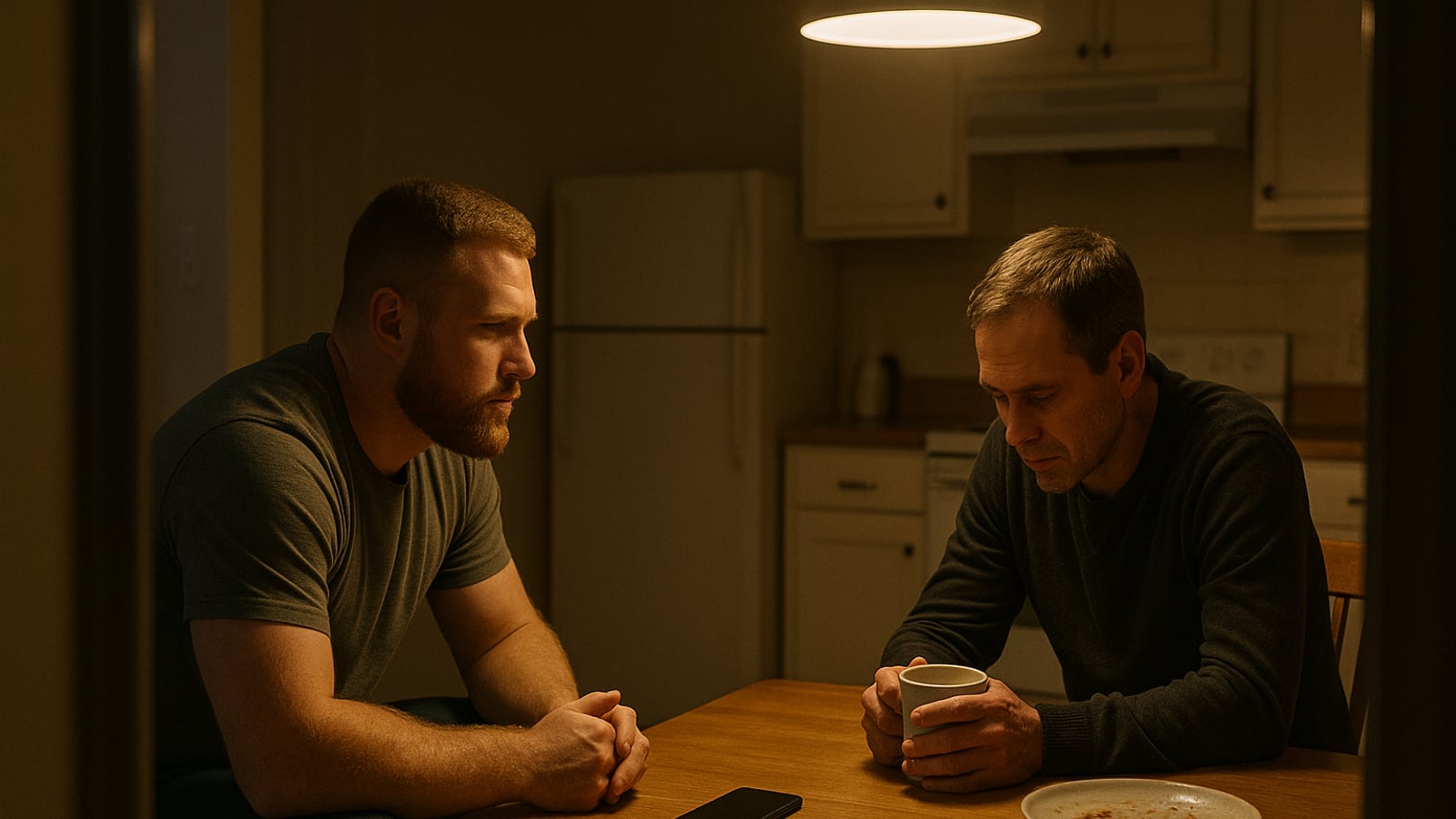
Ask the question out loud. The exact words: "Are you thinking about killing yourself?"
Not "you're not thinking of doing anything stupid, right?" Not "you okay, buddy?" The plain version, with the real word in it. Asking doesn't plant the idea. What it does is tell the person in front of you that you can hear the answer without falling apart, which is the single thing they've been guessing about all day. And if you need a number before you finish this paragraph, it's 988. Call or text, works in the US and in Canada, free, 24 hours.
Now the rest of it, in the order you'll actually need it.
The five seconds after they say yes
Your stomach drops. Your brain starts generating solutions. Don't.
Say something short and true. "I'm glad you told me." "Thank you for saying it out loud." "I'm not going anywhere." Then stop talking and let the silence sit there. Silence feels like failure to you. To them it feels like room.
The mistake almost everybody makes is arguing. You start listing reasons to live, and every reason you list is a reason they've already rejected, which quietly confirms that you don't get it and they should stop talking. You're not the defense attorney for their life. You're the guy who stayed in the room.
Things not to say, and I've heard all of them said by people who meant well:
- "Think about your kids." That's guilt, and guilt is fuel on this particular fire.
- "You've got so much to live for."
- "That's selfish."
- "I know exactly how you feel."
- "It's going to be fine."
What works better is boring and specific. "How long has it been this bad?" "What's tonight like?" "When did you first think about it?" Ask, then listen to the whole answer without building your reply while they talk.
Three questions you need answered
Once they've said yes, you need more information than "yes." Ask directly, calmly, like you're asking about a car problem.
Do you have a plan? Vague misery is different from a specific method. Both are serious. Only one of them means you're moving things tonight.
Do you have the means? Where is it, and how far away is it right now?
Have you thought about when? A date on the calendar changes everything about how the next hour goes.
None of this is you playing psychiatrist. You're finding out whether tonight is a conversation or a crisis, and you can't tell from the outside. People who are decided often look calmer than people who are still fighting.
Put distance between the person and the method
This is the most useful thing a friend can do, and almost nobody does it because it feels rude.
A suicidal crisis is weather, not climate. It builds, it peaks, and it passes. The whole job tonight is to make sure that during the peak, the fastest option isn't sitting twelve feet away in a nightstand. Time is the intervention. Distance is the intervention.
If there are firearms in the house, say so plainly and handle it like the responsible owner you're. This isn't confiscation and it isn't a political conversation. It's temporary, voluntary storage by a man who's having a bad month, which is the same instinct that makes you hand your keys to somebody at a wedding. Options: a trusted friend or family member holds them. A gun shop or range in your area holds them, and plenty will, so call and ask. Or the firearms stay put and somebody else holds the only key or combination, with a cable lock on top of it.
One caution worth ten seconds of your time. Transfer rules vary by state and province, and in some places handing a firearm to a friend for safekeeping isn't as simple as handing it over. Check your state's law, or ask the shop, before you move anything. Do it right and it stays a non-issue later.
Then do the same for everything else. Prescription bottles into a lockbox, or into your truck. Old medications out of the cabinet entirely. Keep the alcohol out of the picture tonight, because alcohol takes the brakes off a person who's already at the edge of the hill. Car keys, if driving is part of the picture.
You will feel like you're overreacting. You'll feel patronizing. Do it anyway. Nobody has ever regretted the night they made the plan slower.
Don't leave them alone, and don't promise to keep it secret
Two hard rules.
If tonight is bad, somebody stays. You, a sibling, their spouse, a friend who can be there in twenty minutes. Not a text check-in. A body in the house.
And when they say "don't tell anyone," you say, "I'm not telling everyone. I'm telling the people who can help, and I'll tell you who they are." You can be discreet. You can't be the only person who knows. Secrecy is how one exhausted friend ends up carrying something that needs four people and a professional.
What actually happens when you call 988
People hesitate because they think dialing a crisis line means police in the driveway. In the overwhelming majority of calls, it doesn't. You get a trained person on the phone who talks it through, helps make a plan for tonight, and points you at local services. You can call on someone else's behalf. You can put it on speaker and have the conversation together. Veterans and service members press 1 after dialing.
Call 911 instead when there's immediate physical danger: an overdose already taken, a weapon in hand, an injury. When you call, say the word suicide, say what's in the house, and ask whether a crisis intervention trained officer is available. That last question changes how the encounter goes more often than people expect.
Tomorrow morning, and the six weeks after
Tonight is adrenaline. Anybody can do one night. The part that actually saves people is the unglamorous stretch after, and this is where the man with a job and three kids has to be realistic.
You can't run a 24-hour watch. You'll burn out by day nine and disappear, and disappearing after all that closeness lands worse than never showing up. So build something you can actually sustain. A text every morning at the same time, three words long, no reply required. One standing thing a week that isn't a therapy session: Saturday breakfast, Tuesday range trip, mowing their yard with them. Put it in your phone as a repeating event so you don't rely on remembering.
Help them get a real appointment, and help concretely. Sit next to them while they call. Drive them. Watch the kids for two hours. "You should see somebody" isn't help. A ride and a calendar entry is help.
And get yourself a person. Tell one adult you trust that you're carrying this. You're a friend, not a clinician, and the difference matters when the follow-up stretches into months.
Here's what almost nobody tells you, so remember it in about four days when this fades and the guilt starts: you're not the reason they live or die. You're the reason tonight is slower, quieter, and has another person in it. That's an enormous amount. Go ask the question.
If you're in crisis, call or text 988 in the US or Canada. This is general information, not medical advice. A doctor or licensed mental health professional is the right person for treatment decisions.
Cal Brennan
Fitness
Strength coach. Trains fathers, tradesmen and desk workers, which means programmes that survive a bad week.

Watch
Worth an hour of your evening
More from Fitness.
From channels we rate. Plays on YouTube.
Read next