The resistance band routine that actually builds strength
Bands get dismissed as physical therapy toys because most people use them wrong. Fix the strength curve and they build real muscle in a hallway.
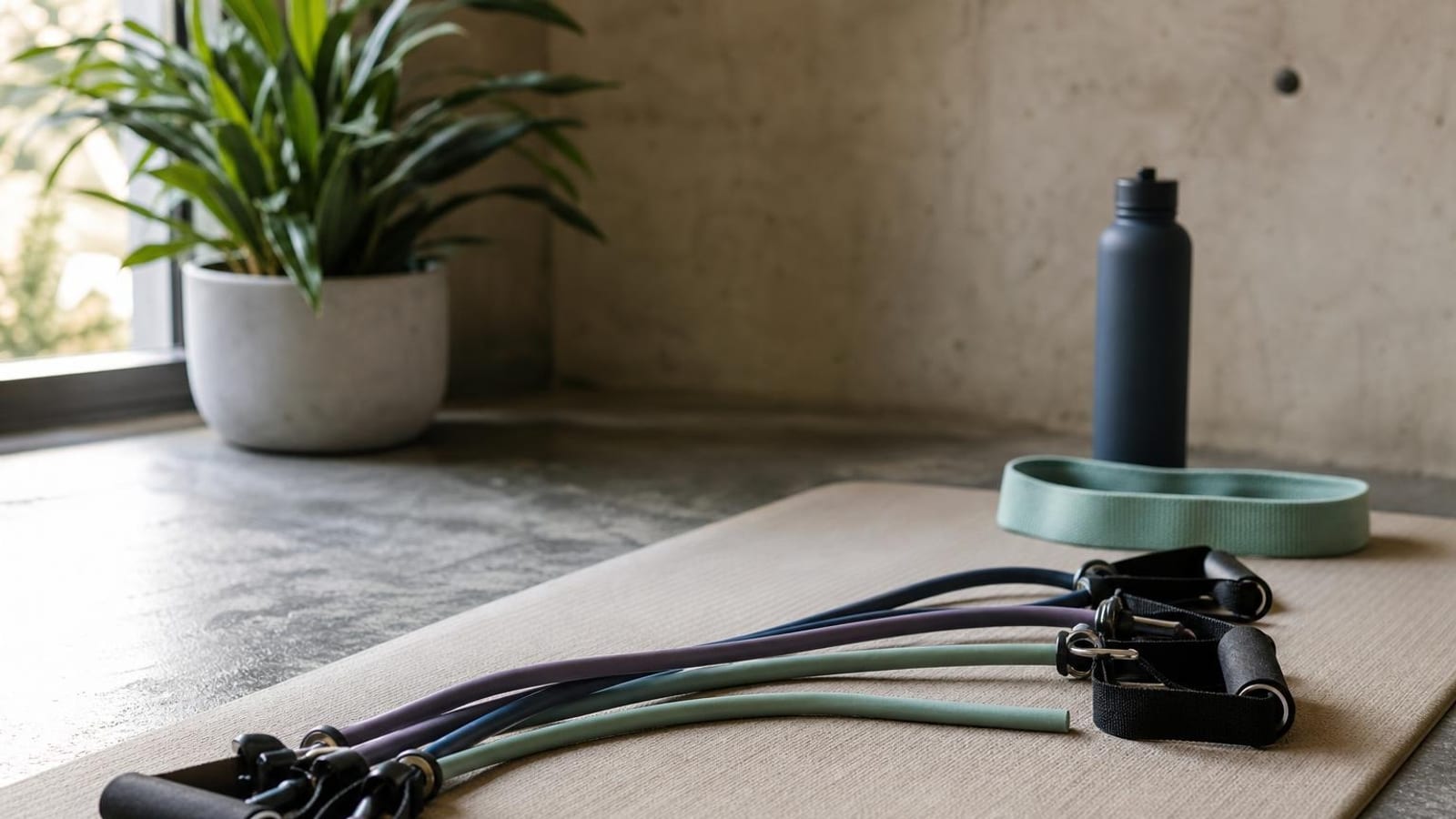
Buy flat continuous loops, not the tube set with the foam handles. The 41-inch powerlifting-style loops are the ones that hold up, and a set of four in graduated thicknesses usually runs somewhere between forty and ninety dollars depending on the brand. The half-inch one is your accessory band. The two-and-a-half-inch one will make a grown man's legs shake. Add a door anchor and you own a gym that lives in a drawer.
The reason bands have a reputation as rehab toys is that almost nobody loads them correctly. A band is easiest at the start of the rep and hardest at the end. A barbell is the opposite on most lifts, hardest coming out of the hole, easy at the top. So if you press a band the way you'd press a bar, you're getting an easy bottom, a hard top, and a set that ends because your triceps quit rather than because your chest did any work.
Everything that follows is built around that one fact.
Fix the strength curve before you fix anything else
Three adjustments turn a band from a warm-up tool into something that builds tissue.
Pre-stretch it. Step further from the anchor, or shorten the loop by wrapping it once around your hand. You want the band already under tension in the bottom position. If it's slack at the start of the rep, you've deleted the hardest and most useful part of the range.
Pause where it's hardest. One full second in the lockout of a band press. One second at the top of a row with your shoulder blade pinned back. The band wants you to rush through the end range because that's where it fights hardest. Don't.
Fight the way down. A dumbbell falls at 32 feet per second squared whether you're paying attention or not. A band actively pulls you back to the start, and if you let it, you've skipped the lowering half of the lift entirely. Take three seconds down on every rep. This single change is the difference between people who say bands don't work and people whose shirts stop fitting.
What bands can't do, said plainly
They won't give you a 400-pound deadlift. Maximum strength is stubbornly specific to heavy loads, and there's no honest way around that. Your legs are also the problem child, because a band strong enough to challenge a squat becomes miserable to hold in position long before it becomes miserable to move.
So the plan leans on single-leg work for the lower body, where your own bodyweight does most of the loading and the band just adds the rest. And you accept the trade: you'll build muscle, tendon strength and real usable capacity, and you'll give up the last ten percent of peak numbers. If you've got a barbell and time, use the barbell. If you've got twenty-five minutes and a kid who naps unpredictably, this beats the workout you didn't do.
Worth knowing: training a light load close to failure builds muscle about as well as heavy load does. That's one of the most consistently repeated findings in strength research, and it's the whole reason a rubber band can compete with iron. The catch is that "close to failure" means genuinely close. Two reps left in the tank, not six.
Two days a week, twenty-five minutes
Alternate A and B. Two sessions a week keeps it alive for years. Three is better if life allows. Four is how you end up quitting in March.
Day A
- Band split squat, 3 sets of 10 to 15 per leg. Stand on the band with your front foot, loop over the same-side shoulder. Three seconds down.
- Band chest press, 3 sets of 10 to 15. Anchor at chest height behind you, or run the band across your upper back and do push-ups. One-second pause at full extension.
- Anchored row, 3 sets of 12 to 15. Anchor low, sit or stand, pull to the ribs, one-second squeeze.
- Pull-apart, 2 sets of 25 with the light band. Fast to do, and your posture at a desk depends on it.
Day B
- Single-leg RDL, 3 sets of 10 to 12 per leg. Stand on one end, hold the other, hinge at the hip with a flat back. Your hamstrings will find out.
- Overhead press, 3 sets of 8 to 12. Stand on the band, press. Rib cage down, don't lean back.
- Pulldown or banded pull-up, 3 sets of 8 to 12. High anchor over a door, or loop the band through a pull-up bar and put your knee in it.
- Pallof press, 2 sets of 10 per side. Anchor at chest height off to your side, press straight out, refuse to rotate. This is the anti-rotation work that keeps your low back out of the conversation when you pick up a car seat one-handed.
Rest sixty to ninety seconds. The last two reps of every set should be ugly and slow. If they're not, you picked the wrong band.
How you progress when you can't add five pounds
This is where band training falls apart for most people. There's no number on the side, so they do the same thing for a year and conclude bands don't build anything. Use a ladder instead, and only move down a rung when you've topped out the one above.
- Add reps until you hit the top of the range on every set.
- Step farther from the anchor, or wrap the band once. More pre-tension, same band.
- Slow the lowering phase to four or five seconds.
- Add a second band, or move up a thickness.
- Go single-limb. One arm, one leg. Instant doubling of load with nothing new bought.
Write the band color and your reps in the notes app on your phone. Eleven words a session. Without it you'll drift, and drifting is how bands earned the reputation.
The anchor is the part that hurts you
Bands snap. Almost always at a nick, almost always at a nail head, a rough concrete edge, or a doorframe screw you didn't look at. Run your thumb along the band before you load it. A small cut in the rubber is a crack waiting for a hard rep.
Anchor on the hinge side of a door that opens away from you, and put something heavy in front of it if there are kids in the house. Never set up so your face is in the line of the band. A deck post, a fence post or a rack upright beats a door every time. And don't stretch a loop much past two and a half times its resting length, which is easier to judge than it sounds: if the band has gone thin and pale, you're done.
Keep them out of direct sun and out of the garage in August. Heat and UV are what turn a good band into a brittle one.
Why this survives when a gym plan doesn't
You can do the whole session in a hallway while a toddler uses the light band as a jump rope two feet away. It doesn't wake anyone. It doesn't leave you so wrecked that you're useless for the rest of Saturday, which matters a lot more than it sounds when you're working on six broken hours of sleep.
And the bands travel. Hotel room, in-laws' basement, a soccer field while your daughter finishes practice. A program you can execute at 90 percent in a strange room beats a perfect one you abandon every time you leave the house.
None of this is medical advice. If something in a shoulder or a low back is already talking to you, get a physical therapist to look at it before you load it with anything, rubber included.
Two sessions. Twenty-five minutes. Do it for a year and the guy who spent that year researching the optimal split will ask what you've been doing.
Cal Brennan
Fitness
Strength coach. Trains fathers, tradesmen and desk workers, which means programs that survive a bad week.

Watch
Worth an hour of your evening
More from Fitness.
From channels we rate. Plays on YouTube.
Read next