

Trades that died, and the men who wrote them down
Five books by working men whose crafts faded, and why their standards are worth more than the tools they used.
Quick answer: Start with The Wheelwright's Shop if you love tools, Life on the Mississippi if you want a story, and One Man's Wilderness if you want to be left alone with the work. All five are clean. One needs a warning about hard sailor's life, and it's noted below.
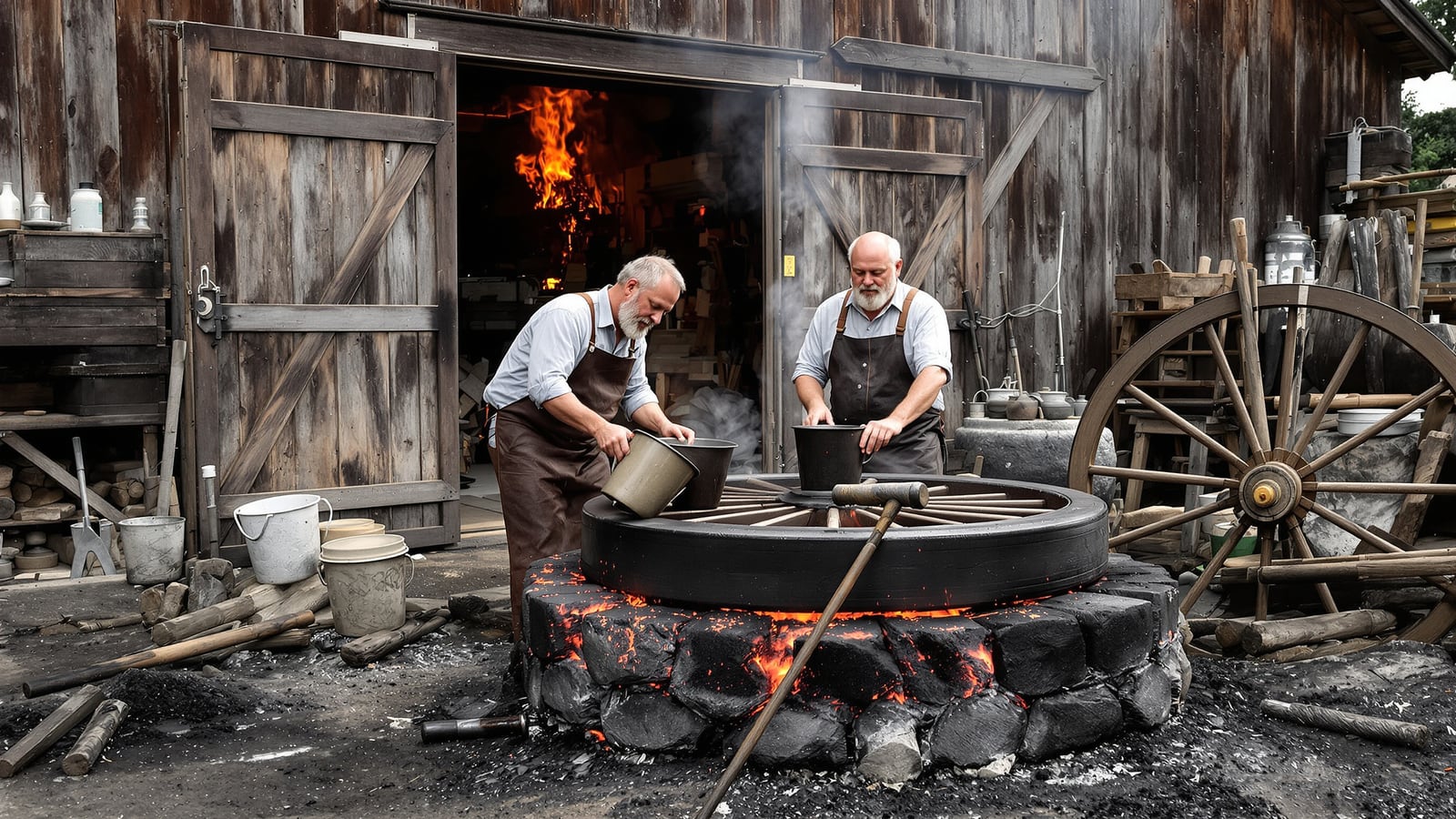
George Sturt ran his family's wheelwright shop in Farnham, England, and he knew the trade was ending while he was still in it. So he wrote it down. How a wheel is built. Why the spokes lean the way they do. What happens when the iron tire is heated and hammered onto the wooden rim, then doused with water before the whole thing catches fire.
Nobody asked him to. The knowledge had always passed from hand to hand, and he could see the hands running out.
That's the reason to read these books. Not nostalgia. A man who can do something well and explains it plainly is the best teacher you'll find, and the trade doesn't have to be one you'll ever practice.
Don't read them to learn the trade
You won't learn to build a wagon wheel from a book, and you shouldn't try. What you get is the standard. How long a man waited for lumber to season. What he refused to ship. How he could look at an ash plank and tell you what it wanted to be.
That's worth more than the technique, because the standard travels. It works in a garage, an office or a kitchen.
A concession up front: not all of these are strict autobiographies. Some are a craftsman's account of his shop, or his journals, put in order. They're still first-person and still written by the man or from his own hand, which is the point.
The Wheelwright's Shop, by George Sturt (1923)
This is the one to hand a man who likes to fix things. Sturt writes about timber, tools and the quiet pride of a shop where every customer was known by name. He's also honest about what was lost when factory-made goods got cheap enough to beat the village shop.
It's slow in places. You'll read a full page on how an elm hub gets seasoned, and you'll like it more than you expect. Take it a chapter at a time.
Suits: Anyone who owns a workbench, a toolbox or a stubborn streak.
Life on the Mississippi, by Mark Twain (1883)
Twain trained as a cub pilot on a steamboat. A pilot had to carry the entire river in his head, every bend and bar and snag, and learn it all over again because the river kept changing shape. Railroads and the Civil War ended the golden age of it.
Read the early chapters, where he learns the river and gets humbled by a man who knows far more. Past the middle the book turns into a travelogue with tall tales, and you can drift away without guilt. The lesson of the early chapters is the best account I know of what it costs to become good at something nobody can fake.
Mature content: Clean, but it's an 1880s book with 1880s language in places. Fine for teenagers with a word from you.
Suits: Fathers and sons reading together. Anybody who thinks competence arrives quickly.
Two Years Before the Mast, by Richard Henry Dana Jr. (1840)
Dana left Harvard and shipped out as a common sailor aboard the brig Pilgrim, sailing from Boston around Cape Horn to California to trade for cowhides. It's the working sailor's side of the sailing-ship age, told by a man who then went home and became a lawyer.
It's not about romance. It's about cold, bad food, hard captains and the way a crew becomes a unit. The middle drags when he gets into the hide business, so skim it.
Mature content: Flag this one. A flogging is described, and it's hard to read. Dana wrote it to show what the men endured, and he later spent a career defending sailors' rights. Keep it for older readers.
Suits: Men who like the sea, or who want to know what hard work looked like before anyone thought to complain about it.
One Man's Wilderness, by Sam Keith (1973)
This is built from the journals of Dick Proenneke, who in his fifties went to Twin Lakes, Alaska, and built a log cabin largely with hand tools. He notes each notch, each peg, each day's weather. He made his own hinges, a table and a chair.
It reads like a man whispering to himself. There's no drama and no sermon. Just a fellow who decided he could do it, then did it one log at a time.
Mature content: None.
Suits: Anyone planning a cabin, a shed or a year with less noise. A good first pick for a reader who thinks books are boring, because the pages move.
A Cabinetmaker's Notebook, by James Krenov (1976)
Krenov writes about the bench the way other men write about a long marriage. He talks about patience, about stopping when a joint isn't right, and about making one thing properly rather than ten things fast. It's closer to a notebook of thoughts than a full memoir, so it's the least story-driven of the five.
But it's the one that changes how you sand a board, or write a report. Read it a few pages at a time.
Mature content: None.
Suits: Woodworkers, obviously. Also anyone who rushes.
One to skip
The Autobiography of Benvenuto Cellini is the famous one, a Renaissance goldsmith telling his life. It's a great read in the sense that a car wreck is dramatic. He's boastful, violent and frank about sins I won't describe here. It doesn't belong on a family shelf. If you pick it up anyway, you've been warned.
How to make it a habit
Pick one book. Not all five.
Keep it where your phone usually sits at night. Read a chapter, or twenty pages. Sturt and Krenov suit that pace, because they reward slow reading.
You'll find that three of these are old enough to turn up free in the library or online. Our piece on what your library card is actually worth shows how to get the others without spending a dime.
If these leave you hungry for men who did hard things and wrote about them plainly, the war memoirs from the men who were actually there are the next shelf over. And if you're still building your list, twenty books every man should read before forty is a good place to put these.
Then go find the man who's still doing it
Every one of these trades has someone left. The farrier. The stonemason. The old guy at the hardware store who can tell you what's wrong with your hinge before you finish the sentence. Take the book, take a coffee, ask a question and listen.
Sturt wrote his shop down because nobody else was going to. Most of what a skilled man knows is gone with him unless somebody asks.
Be the one who asks.
Marcus Vale
Editor-in-Chief
Twenty years in magazines, most of it deciding what to cut. Writes about work, discipline and the decisions that compound.

Watch
Worth an hour of your evening
More from Books.
From channels we rate. Plays on YouTube.
Read next