The squeal is a warning you paid for. Don't ignore it.
That high-pitched chirp is a built-in alarm. Here's what each brake noise means, how to check your pads in five minutes, and when to stop driving.
Quick answer: A steady squeal when you brake lightly usually means the wear indicator is touching the rotor and the pads are nearly done. Book the job this week. A deep grinding or growling means the pad material is gone and metal is cutting metal. Stop driving it.
What that squeal actually is
Most pads have a small steel tab riveted or clipped to the backing plate. It's cut to sit just shy of the rotor when the pad is healthy. As the friction material wears down, the tab gets close enough to scrape the rotor surface. The result is a thin, annoying squeal that you can't unhear.
The engineers did that on purpose. It's the cheapest warning system on the car, and it only works if you act on it.
Many pads wear to roughly 3 millimeters, about an eighth of an inch, before the tab starts to sing. Some designs squeal while you're braking. Others squeal while you're rolling and go quiet when you press the pedal, because braking pins the tab flat. Don't let the second kind fool you into thinking the problem fixed itself.
Plenty of newer cars skip the tab and use an electronic sensor instead: a small wire loop buried in the pad. When the pad wears through, the loop breaks and a brake warning light comes on. The sensor is single-use. If your light is on, replace the sensor with the pads. Your owner's manual will say which system you have.
How long you've got once it starts
Nobody can give you an honest number, and anyone who does is guessing. It depends on your car's weight, your driving, your pads and how far past the tab you already are. It might be a few weeks. It might be a couple thousand miles of gentle highway driving. It might be one long mountain descent with a trailer on the hitch.
Treat the squeal as the start of a countdown with a hidden timer. Book the work within days, not months.
And don't tow, haul a heavy load or take a big downhill drive on squealing pads. That's exactly when a thin pad finishes the job.
Noises that aren't the wear indicator
Not every brake noise means you're out of pad. Sort them like this:
- Squeal for the first few stops on a damp morning, then gone. Moisture leaves a thin film of surface rust on the rotors overnight. The pads scrub it off. Normal.
- Squeal on every stop, even with fresh pads. Often cheap or glazed pads, missing anti-rattle shims, or dry caliper hardware. Annoying, rarely dangerous. A good shop fixes it with the right grease and clips.
- Rhythmic chirp that speeds up with the wheels. Could be the tab on a warped or grooved rotor, or a stuck pad. Get it looked at.
- Deep grinding or growling. Pad material is gone. The steel backing plate is against the rotor. Parking the car is cheaper than driving it.
- Clunk when you shift between drive and reverse or when you start braking. Loose hardware or a worn caliper bracket. Not urgent today, but don't let it sit.
Check them yourself in five minutes
You don't have to wait for a noise. Do this once every few months, or any time you rotate the tires.
- Park on level ground with the engine off and the car in park. Set the parking brake if the rear wheels aren't the ones you're checking.
- Grab a flashlight. Turn the front wheels to full lock so you can see inside the wheel.
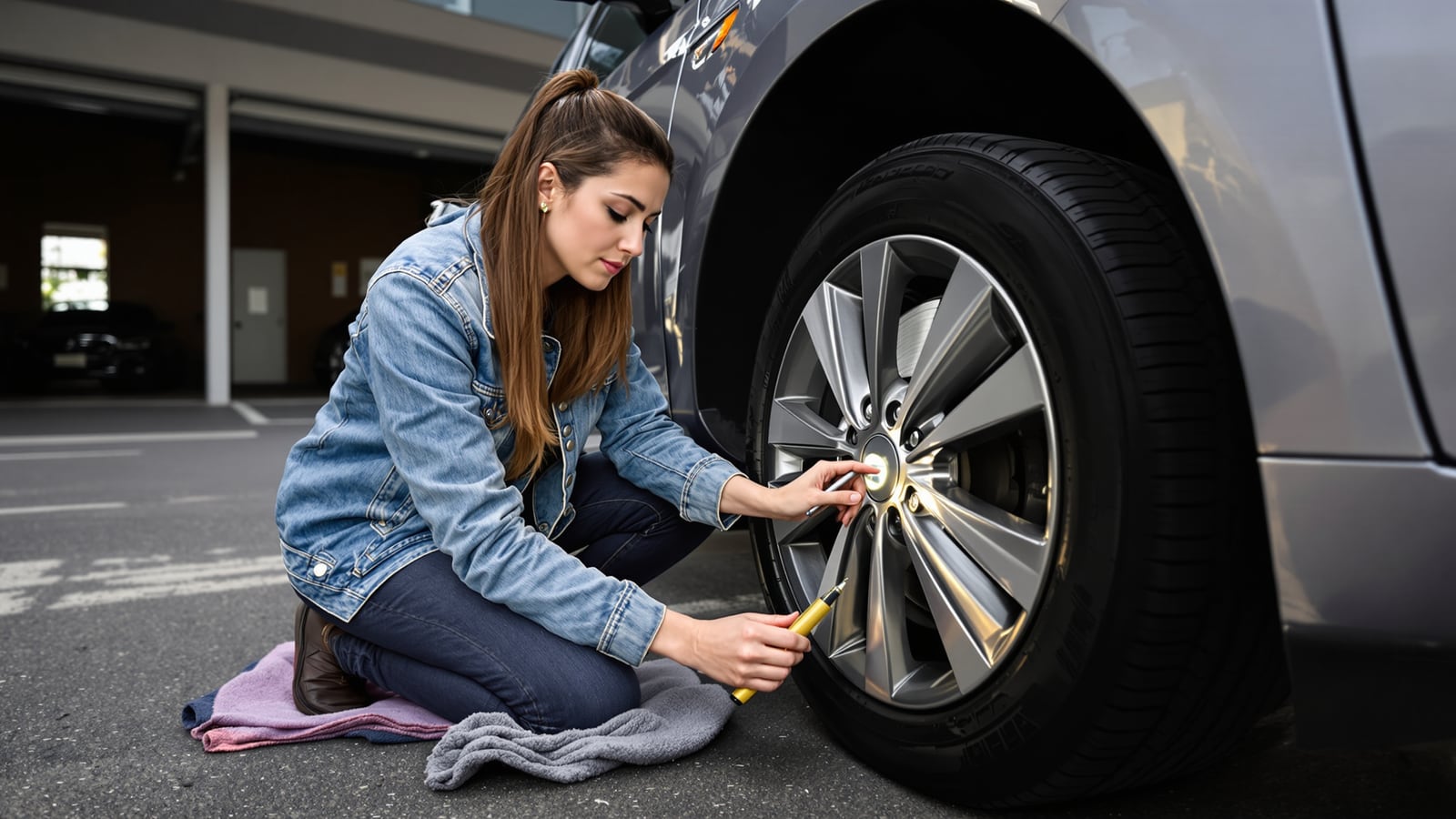
- Look through the spokes at the caliper. The pad is the slab pressed against the shiny rotor. You're looking at its thickness from the edge.
- Compare. A new pad is usually about a half inch of friction material. At a quarter inch, start planning. At an eighth, replace them now.
- Check both sides and, if you can see them, the rear. Pads rarely wear evenly across the axle, and the inner pad, the one you can't see from outside, often goes first.
If your wheel design hides the pad, pull the wheel. It takes ten minutes with a lug wrench and a jack with stands. Never work under a car on a jack alone.
What you want to see is even wear and a rotor face that's smooth, without a deep lip at the edge or a blue tint from heat.
Why waiting costs real money
A set of pads is a modest bill. Rotors cost more. Calipers cost more again. Run past the squeal into grinding, and you've turned a pads-only job into pads, rotors and possibly a caliper that seized from heat. The labor doesn't get cheaper, either, because the shop's already in there.
There's another cost, and it matters more. Stopping distance gets longer as pads thin out. The car that takes your family to school and church parking lots has to stop on the day somebody pulls out in front of it. Brakes are the last place to be cheap on time.
Other signs the squeal isn't the whole story
Some symptoms point beyond worn pads:
- Pedal pulses under braking. The rotors have uneven thickness. They may need resurfacing or replacing, depending on how much metal is left.
- Car pulls to one side when you brake. A caliper may be sticking or a hose is collapsing internally. Get it checked soon.
- Soft or sinking pedal. Could be air in the lines, low fluid or a leak. Don't drive it. Have it towed.
- Brake fluid level dropping. Pads wearing normally raise the fluid level in the reservoir slightly lower over time, so check the level against the min and max marks. A fast drop means a leak.
Doing it yourself, or handing the keys over
Pads are one of the friendlier DIY jobs for a patient guy with basic tools: a jack, stands, a socket set, a C-clamp or piston tool, brake cleaner, high-temperature brake grease and a torque wrench. The torque wrench is not optional. Caliper bolts and lug nuts have specs for a reason.
Take a photo before you take anything off. Clean and lightly grease the slide pins. Replace the pads on both wheels of the axle, never just one. Pump the pedal a few times before you drive anywhere, because the first press will go nearly to the floor until the pistons seat.
If you hand it to a shop, ask for the old pads back. A decent shop won't blink. Look at them: you should see where the wear was and how much friction material was left. And ask whether the rotors measure above minimum thickness, not just whether they "look fine."
Whichever route you take, leave the car better than you found it. Bolts torqued, hardware cleaned, wheels back on in a star pattern, lug nuts rechecked after fifty miles. The next person who drives it might be your wife or your son.
Make it a family habit
Teach everyone who drives your car to report a new noise the day they hear it. A kid who tells you about a squeal on Tuesday has saved you a grinding bill on Saturday. Put the pad check on the same schedule as your oil changes and tire rotations. The servicing that can't wait, and the kind that can draws that line clearly, and brakes sit firmly on the "can't wait" side. A flashlight look now and then is part of what it takes to get a car past 250,000 miles. And if you're shopping for a used one, twenty minutes with the engine off should include a look at the pads and rotors.
The squeal is polite. The grinding isn't. Catch the first one and you'll never hear the second.
Dean Shaw
Gear & Garage
Reads the warranty, the parts list and the long-term owner reviews before anything else. Trucks, tools, watches, and the cheap version that costs more.

Watch
Worth an hour of your evening
More from Cars.
From channels we rate. Plays on YouTube.
Read next