
What to Do and Photograph in the First Ten Minutes After a Crash
Adrenaline makes you stupid for about five minutes. Have a plan so your hands know what to do while your brain catches up.
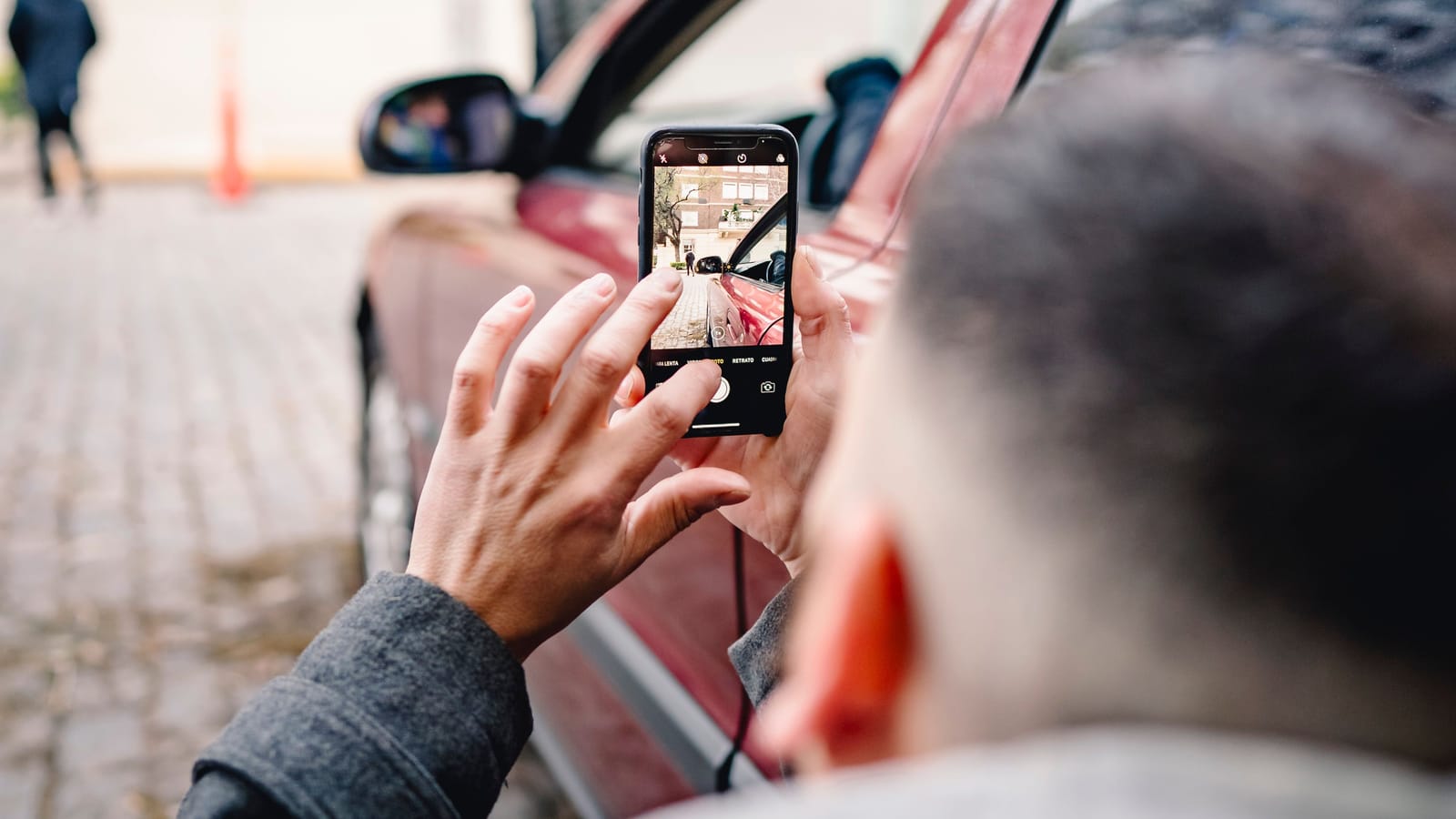
Hazards on. Do that before anything else, before you check the damage, before you unbuckle. Your car just became an obstacle, and the people coming around the bend behind you have no idea yet.
Then breathe once and take stock. Adrenaline is a liar. It will tell you you're fine, it will make your hands shake so badly you can't work a phone, and it will burn off in about five minutes and leave you fuzzy. The point of having a plan is that you don't have to think clearly to follow it.
The first sixty seconds are about not getting hit again
Secondary collisions are what turn a fender-bender into a funeral. Stay buckled until you've looked. If you're in a travel lane on a highway and the car still moves, get it to the shoulder or an exit ramp. If it doesn't move, and you're on the shoulder of a 70 mph interstate, the safest place is usually out of the car and well behind the guardrail, uphill of traffic, not standing between two bumpers taking pictures of a scuff.
Never stand in the space between your car and the other one. That's the spot that gets people killed when a third driver arrives distracted.
If you've got reflective triangles in the trunk, now's when they earn their keep. A three-pack runs around twenty bucks at any parts store and it's the cheapest insurance in the vehicle. Set them back along the shoulder, not next to the car. Flares are fine too, though triangles don't burn out and don't care about wind.
Should you move the cars
Depends where you're and how bad it is. On a residential street with nobody hurt and both cars drivable, take your photos first, then move them out of the roadway. On a freeway, move first and photograph second. The scene is evidence, but you're not a crime lab and you're not worth more dead than the skid marks are worth in court.
Some states require you to move drivable vehicles out of the travel lanes. Your insurance company won't punish you for clearing the road.
Airbags deployed? The car is probably done for the day. Deployed bags mean a tow, not a drive home, even if it looks fine. Same if you smell gas, see fluid running, or the hood won't latch.
Call it in, and get the number
Call 911 if anyone's hurt, if a car needs a tow, if the other driver is behaving strangely, or if there's any argument about what happened. In a lot of places, police won't come out to a minor no-injury crash. Fine. Then you file a report yourself, and most states let you do it online within a set window.
If an officer does respond, get three things before they leave: the officer's name, the agency, and the report or incident number. Photograph the card they hand you. Cards get lost between the scene and your kitchen table.
The photo list, in order
Work from far away to close up. Most people do the opposite and end up with forty pictures of a dented quarter panel and nothing showing where the cars actually were.
- The other car's license plate. First photo, every time. People drive off. A plate is a claim; a description of a gray sedan is nothing.
- Wide shots from all four corners of the scene. Stand back thirty or forty feet. Get both vehicles, the lane lines, and the road in one frame. Four of these, one from each direction.
- A shot that includes a landmark. A street sign, a mile marker, a storefront, an exit number. This is how you prove where later.
- The traffic controls. The stop sign, the signal head, the yield, the speed limit sign, the lane arrows painted on the pavement. If a tree branch is blocking the sign, that photo is worth more than all the others combined.
- Skid marks, gouges, broken glass, debris fields. Debris scatters in the direction of impact and it gets swept away within the hour.
- Damage on both vehicles, wide then close. Wide enough to see which car it is. Close enough to see the crease.
- The undamaged parts of both cars. Sounds strange. It stops anyone adding a pre-existing dent to your bill.
- Interior shots. Deployed airbags, anything that flew forward, the position of the shifter.
- Weather and light. Wet pavement, glare, fog, the sun sitting low right in the eastbound lane at 5:40 p.m.
- Their documents. Insurance card, front and back. Driver's license if they'll let you. Registration.
Then shoot one slow video walkaround, thirty to sixty seconds, phone held steady, turning a full circle. Narrate only facts. Date, time, cross street, direction each car was traveling. Don't narrate opinions about who did what. That file may be watched by people who aren't on your side.
If you run a dashcam, hit the lock or emergency button now. Loop recording will write over the clip, sometimes within the hour. Better yet, pull the card and put it in the glovebox.
Trade information, not theories
You need their name, phone number, insurance company and policy number, plate, and the make and model. You give the same. That's the whole transaction.
What you don't do is settle it right there. The guy offering you four hundred cash to keep it off insurance isn't being generous. He's being cheap, and when the bumper comes off the car and the bill is $2,200, you have no paperwork and no case.
And don't apologize as though you're accepting fault. Be decent. Ask if everyone's okay. Help somebody's grandmother out of a car. But "I'm so sorry, I didn't see you" is a sentence that follows you into a claims adjuster's file. Your insurer will tell you the same thing in plainer language.
Witnesses evaporate
The three people standing on the sidewalk right now will be gone in four minutes and you will never find them again. Walk over. Get a first name and a cell number on your phone. That's it, you don't need a statement. A neutral third party who saw the light is the difference between "he said, she said" and a closed file.
Then check on your people, honestly
Kids don't always report pain. They report being scared, or they report nothing at all because they're watching you to see how scared they should be. So be the calm one. Ask specific questions instead of "are you okay." Does your neck move? Does your belly hurt where the belt was?
Neck and back pain often show up the next morning. Anyone who took a real jolt should see a doctor, and that's a conversation for your physician, not for an internet article.
On car seats: NHTSA's guidance is that a seat should be replaced after a moderate or severe crash, and that a minor crash meeting certain specific conditions may not require replacement. Read the actual criteria and check your seat's manual, because manufacturers differ and several say replace after any crash at all. If the kid was in it during an impact, err toward a new one and let the claim cover it.
Last thing before you drive off, if you're driving off. Sit for two minutes. Don't post anything about it online. Then call your insurer from the shoulder while it's all still sharp, because tomorrow you'll remember the sound and not much else.
Ten quiet minutes of work is what stands between you and being called a liar six months from now by someone you've never met.
Dean Shaw
Gear & Garage
Reads the warranty, the parts list and the long-term owner reviews before anything else. Trucks, tools, watches, and the cheap version that costs more.

Watch
Worth an hour of your evening
More from Cars.
From channels we rate. Plays on YouTube.
Read next