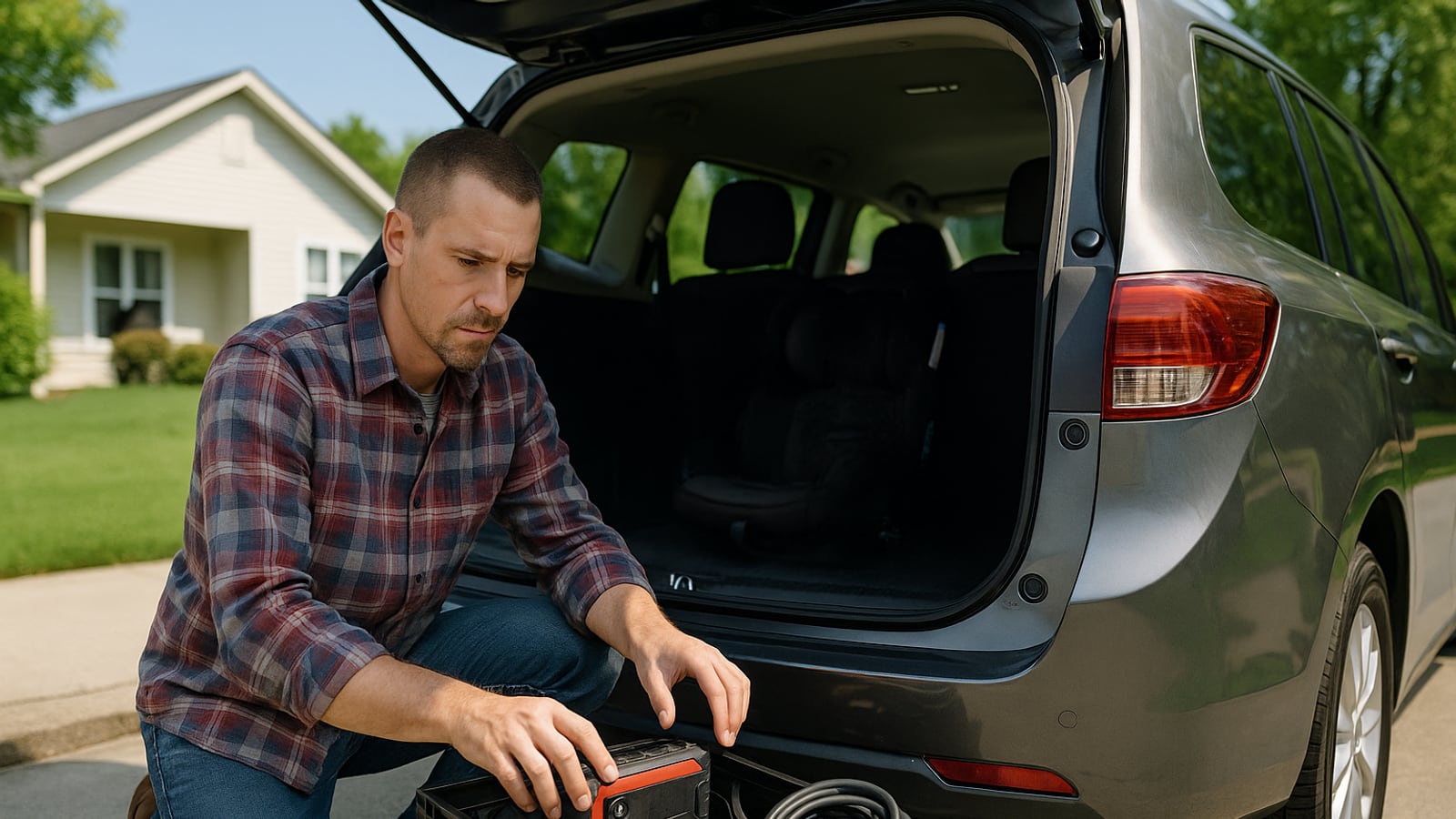
Buy for two failures before you buy for anything else: a battery that won't turn the engine over, and a tire that's gone soft on the shoulder. Everything else in the trunk is a distant third. A lithium jump pack and a plug kit with a 12V compressor will run you somewhere around $150 to $200 together, and between them they cover the overwhelming majority of the times a family car stops moving when you didn't want it to.
The rest of what follows costs maybe another $80 and fits in one milk crate.
The jump pack, and what the cheap one really costs
Jumper cables need a second car. On a dark shoulder with two kids in the back, flagging down a stranger and asking him to nose his bumper up to yours is a worse plan than it sounds. A lithium jump pack removes that whole negotiation.
Good ones start around $90 to $120. NOCO's smaller Boost models and Anker's jump starters sit in that band. The cheap ones, the $35 things with a picture of a truck on the box, fail in three predictable ways. The clamps are thin stamped metal that won't bite through corrosion on an older terminal. The lithium cell self-discharges faster than the box implies, so the pack you charged in March is dead in August. And the amp rating on the front is a peak figure that lasts a fraction of a second, which means it'll start a Civic and stare blankly at a V8.
If you drive a small four-cylinder, park in a garage, and you're honestly going to top the pack off every few months, the cheap one is fine. That's a real use case, not a consolation prize. But if the pack is going to live in a trunk that hits 130 degrees in July and 10 degrees in January, spend the extra sixty dollars. Heat is what kills these things, and the better ones have more cell to lose.
One habit that costs nothing: plug it in the first weekend of every quarter. Set the reminder now, not later.
Tires
A plug kit is about $15. A 12V compressor is $35 to $70. Together they'll get a nail hole holding air well enough to reach a tire shop, which is the actual goal. You're not repairing the tire. You're buying twenty miles.
The cheap compressors work. They're just slow and they get hot. A $35 unit might take eight minutes to bring a passenger tire from 15 psi to 32 and it'll want to rest afterward. A $70 one with a metal cylinder does it in three and keeps going. If you have one car and flat tires are a once-every-few-years event, take the slow one and the savings. If you tow anything, or you're running a truck with larger tires, the slow one will frustrate you into buying the other one anyway.
Check the spare. Right now, before you read further. Most spares sit at whatever pressure they held the day the car left the factory, and a donut at 25 psi isn't a spare. Also confirm the jack and the lug wrench are actually in the car and that the wrench fits your wheels. Plenty of vehicles have left the dealer missing one or the other, and plenty of aftermarket wheels use a different lug than the tool in the trunk.
The part that changes because there are kids
An adult stuck for two hours is bored. A four-year-old stuck for two hours in a cold car is a different situation entirely, and the gear that fixes it's embarrassingly cheap.
- Water. Four one-liter bottles, rotated every six months. Bottles crack if they freeze, so in a cold climate keep them at three-quarters full.
- Real blankets, not just the foil ones. The mylar emergency blankets cost a dollar each and work, but they're loud, they tear, and a small child won't keep one wrapped around herself. Keep two mylar sheets for the adults and one actual fleece blanket per kid.
- Food that survives a trunk. Not granola bars with chocolate. Crackers, fruit pouches, a sleeve of something plain. Replace at the same time you rotate the water.
- Wipes and a roll of paper towels. You'll use these more than anything else in the kit, and not for emergencies.
- A change of clothes for the smallest kid, sized one up, in a zip bag.
- Twenty dollars in small bills. Card readers fail. Tow truck drivers appreciate cash.
- One boring, non-electronic thing. A deck of cards, a pad and pencil. The phone will be conserving battery.
Light, and being seen
Buy a headlamp, not a flashlight. Changing a tire takes both hands. A $25 rechargeable headlamp with a red mode beats the $8 plastic flashlight with the leaking alkalines that's currently rolling around your glovebox, which you should throw out today.
Then buy visibility. A three-pack of reflective triangles runs about $25 and does more for your family's safety than anything else on this list. Put them out at 50, 100, and 200 feet behind the car if you're on a highway. Skip road flares. They're a burn hazard in a car with kids and the triangles do the job without an open flame.
A $10 high-visibility vest is worth having if you're the one who'll be crouched at the wheel well while traffic goes past at 65.
Skip the pre-packed roadside kit
The $40 zippered bag with 96 pieces printed on the front is mostly adhesive bandages, a pair of cotton gloves, and jumper cables too thin to jump anything. The tow strap in those kits is generally rated for far less than a stuck vehicle's weight. You're paying for the bag.
Build your own. Use a plastic crate or a cheap duffel and put the whole thing where you can reach it without unloading groceries. A kit at the bottom of the spare tire well under a stroller isn't a kit.
The one exception: a combination seatbelt cutter and window punch, clipped where the driver can reach it while belted. That's $10 to $15 and it's the only piece here that's for a genuinely bad day. Mount it. Don't leave it in the bag.
For medical gear, keep it modest. Gauze, tape, a pressure bandage, nitrile gloves, a tourniquet if you've been trained on one. An actual class from the Red Cross or a similar provider is worth more than another hundred dollars of supplies, and if anyone in the family has a specific condition, ask your doctor what belongs in the car for them.
When you should buy less than this
If you live in a dense suburb, both cars are under five years old, and you've got roadside assistance with a twenty-minute response time, the honest answer is a jump pack, a headlamp, water, and the window punch. Maybe $150. The compressor and the blankets matter far more on a two-lane highway forty miles from the nearest town, or anywhere winter means something.
Buy for the drive you actually take. Not the one in the catalog photo.
Twice a year, when the clocks change, open the crate. Charge the pack, swap the water, check the spare, and see whether the spare clothes still fit the kid they were bought for. That last one sneaks up on everybody.
Wes Dunbar
Country & Skills
Grew up on an acreage and never quite left. Covers trucks, trades, land, and how to do the thing yourself.

Watch
Worth an hour of your evening
More from Gear.
From channels we rate. Plays on YouTube.
Read next