

Dig the drainage ditch from the bottom up
Most ditches fail because the water has nowhere to go. Start at the outlet, set a grade you can measure, and the pooling by your house and barn stops.
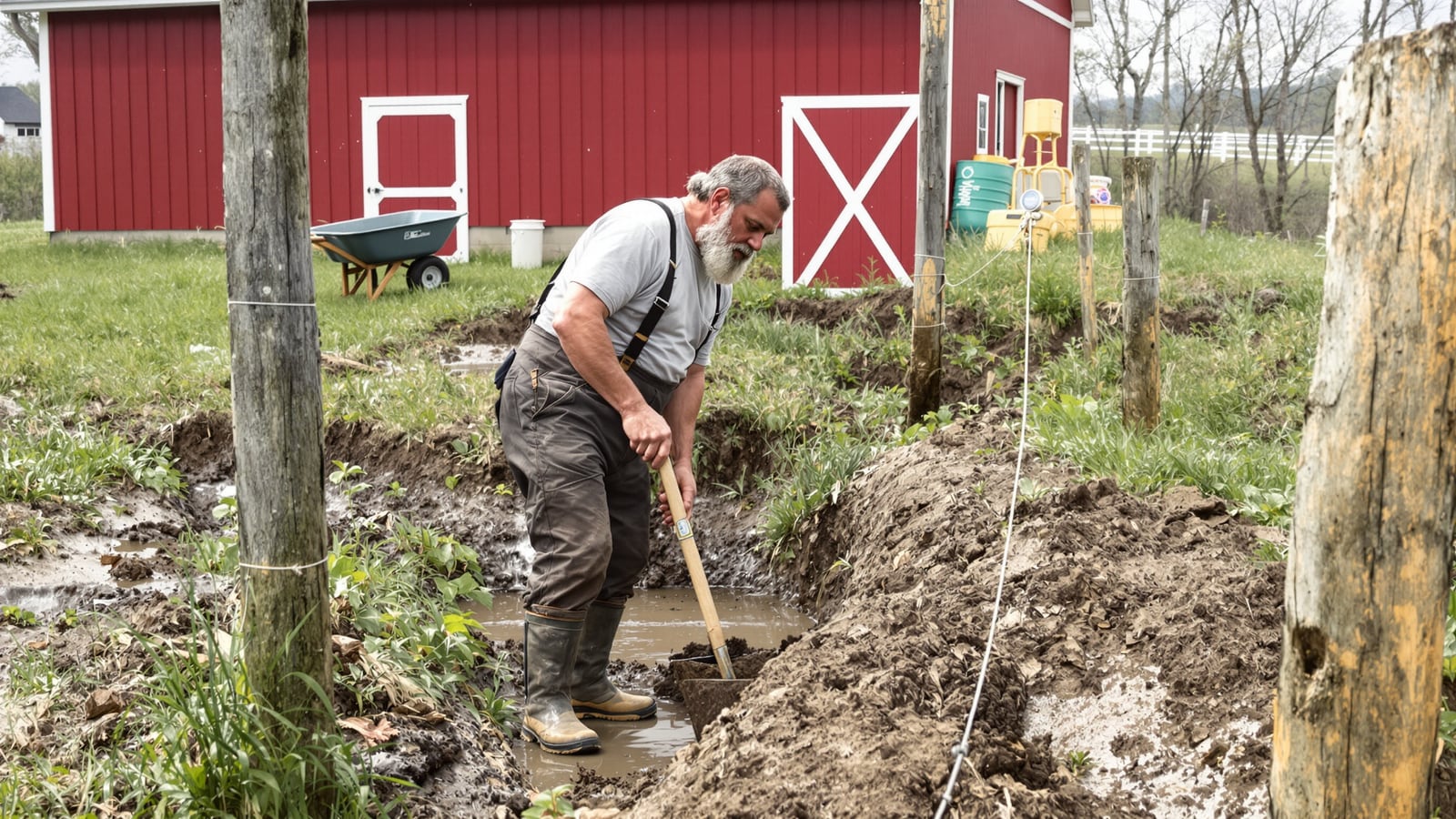
Quick answer: Pick where the water will leave your property first, then dig back toward the house. Give the ditch a fall of at least 1 foot per 100 feet, make it wide and shallow so you can mow it, and seed it the day you finish. Dig it backward and you'll have a very straight trench full of standing water.
The mistake everybody makes
You see the puddle by the barn door, so you dig a trench from the puddle. It looks like progress. The next rain, the trench fills, sits, and gives you a longer puddle.
A ditch moves water from one place to a lower place. If you haven't picked the lower place, you've dug a pond with a handle.
Walk the property during a hard rain, in boots, with a coffee. Better yet, do it the morning after. Watch where the water runs, where it stops, and where it leaves. The line of flattened grass and little sticks of debris will tell you what the ground already wants to do. Your job is to help it, not argue with it.
If you're still shopping for land, do this walk before you sign anything. It's one of the questions to ask before you buy your first few acres.
Find the outlet before you touch a shovel
The outlet is where the ditch empties. It has to be lower than the problem spot, and it has to be somewhere you're allowed to send water. That means a low corner of your own land, an existing creek bed or draw, or a roadside ditch that was built to take it.
It does not mean your neighbor's back forty. Moving water from your barn to his field is how a drainage fix becomes a feud, and in many places it's also a legal problem. Rules on diverting runoff vary by state and county. Call your county conservation district or extension office. They answer this kind of question all the time, usually for free, and they know the soil in your area. The unwritten rules of having neighbors in the country apply here too: water should leave your place the way it was already leaving it, not in a new spot.
Keep the ditch well away from your well and your septic field. Water running over a drain field is a problem you'll pay for, which the well and septic cost breakdown will show you.
Then call 811 before you dig. It's the free utility locate service. Buried gas, power and water lines don't care about your weekend.
Measure the fall
You can't judge slope by eye. Everybody who tries ends up with a ditch that runs uphill for a stretch.
You need two stakes, a ball of mason's string, and a line level (about the price of a sandwich). Or a laser level if you've got one. Drive one stake at the high end and one at the outlet. Tie the string at ground level on the high stake, stretch it to the low one, and hang the line level on it.
Raise or lower the string on the low stake until it reads level. Then measure from the string down to the ground at the low stake. That number is your total fall. Divide by the distance and you have your grade.
The numbers that matter:
- Minimum: 1 percent, which is 1 foot of drop per 100 feet. Less than that and it holds water.
- Comfortable: 2 percent for a grass-lined swale.
- Too steep for grass alone: somewhere past 4 or 5 percent the water gets fast enough to cut the bottom out. You'll need rock lining or check dams.
If the total fall is too small, don't dig deeper at the outlet to cheat it. Go find a different outlet.
Shape it so you can live with it
A narrow, deep, V-shaped ditch looks like drainage. It's also a trap for your mower, your kid's bike and your own ankle. It erodes at the sides and clogs with whatever falls in.
Dig a shallow, wide dish instead. Aim for side slopes of about three feet across for every one foot down, or flatter. A swale 12 inches deep and 6 feet wide carries a surprising amount of water, and you can drive a mower or a tractor right through it.
If you're moving a lot of ground, rent a mini excavator or hire someone who owns one. A box blade on a tractor will also shape a long swale quickly. For 30 feet by hand, a square shovel and a rake will do it. Dig from the outlet back uphill, so any water that shows up during the job has somewhere to go.
Deal with the dirt
Where you put the spoil matters as much as the ditch itself.
Don't leave it piled on the downhill edge. That makes a berm, and the berm catches water trying to enter the swale. Spread it thin, or better, use it to build up the ground next to the foundation or barn wall.
Code in most places wants the soil to fall away from a house about 6 inches in the first 10 feet. Barns deserve the same. Pack the fill in layers by tamping it with the back of a rake or running a tractor tire over it. Loose fill settles, and in two years you'll have a trough against the wall again.
Roof water is its own animal
If your puddle sits under an eave, a ditch is a patch. The real source is the roof. A 30-by-40 barn roof sheds a lot of water in one storm, and it all lands in one strip.
Gutters and downspouts help only if the downspout ends at least 10 feet from the wall. Run the extension into the head of your swale and let the ditch take it from there. Solid pipe underground is better than a splash block, but it needs the same fall and a clear outlet.
Crossings, armor and seed
Anywhere a driveway or lane crosses the ditch, you need a culvert. Go bigger than seems necessary. A pipe that's too small is the part that washes out in the one storm that matters. Your county road department can tell you what size local conditions call for.
Put a few inches of rock at both ends of the pipe, and at the outlet. Water leaving a ditch is faster than water entering it, and bare soil at the exit erodes first.
Seed the whole swale the day you finish, with a grass mix suited to your area, and lay straw over it. A ditch that sits bare through one rain is a ditch that's already halfway filled in. Grass roots are what hold the shape.
Test it, then keep it
Don't wait for weather. Run a hose into the head of the swale for 20 or 30 minutes and walk the length. Any spot where the water stalls is a spot you dug too flat. Fix it now, while the shovel is still out.
After the first big storm, go look again. You'll find a low spot or two. That's normal, so patch it and move on.
Then keep it. Mow it. Pull out the branches and silt every fall, before the leaves clog it. And keep an eye on it in January too, because a ditch that freezes full does nothing, as the piece on what freezes first on a property explains.
A ditch isn't a project you finish. It's a small piece of the place you look after, like a fence line. Leave it better than you found it, and the water will leave on its own.
Wes Dunbar
Country & Skills
Grew up on an acreage and never quite left. Covers trucks, trades, land, and how to do the thing yourself.

Watch
Worth an hour of your evening
More from Country Bro.
From channels we rate. Plays on YouTube.
Read next