

The outbuilding foundation that won't heave or sink
Frost needs three things to wreck a shed or shop. Take one away and the door will still latch in April.
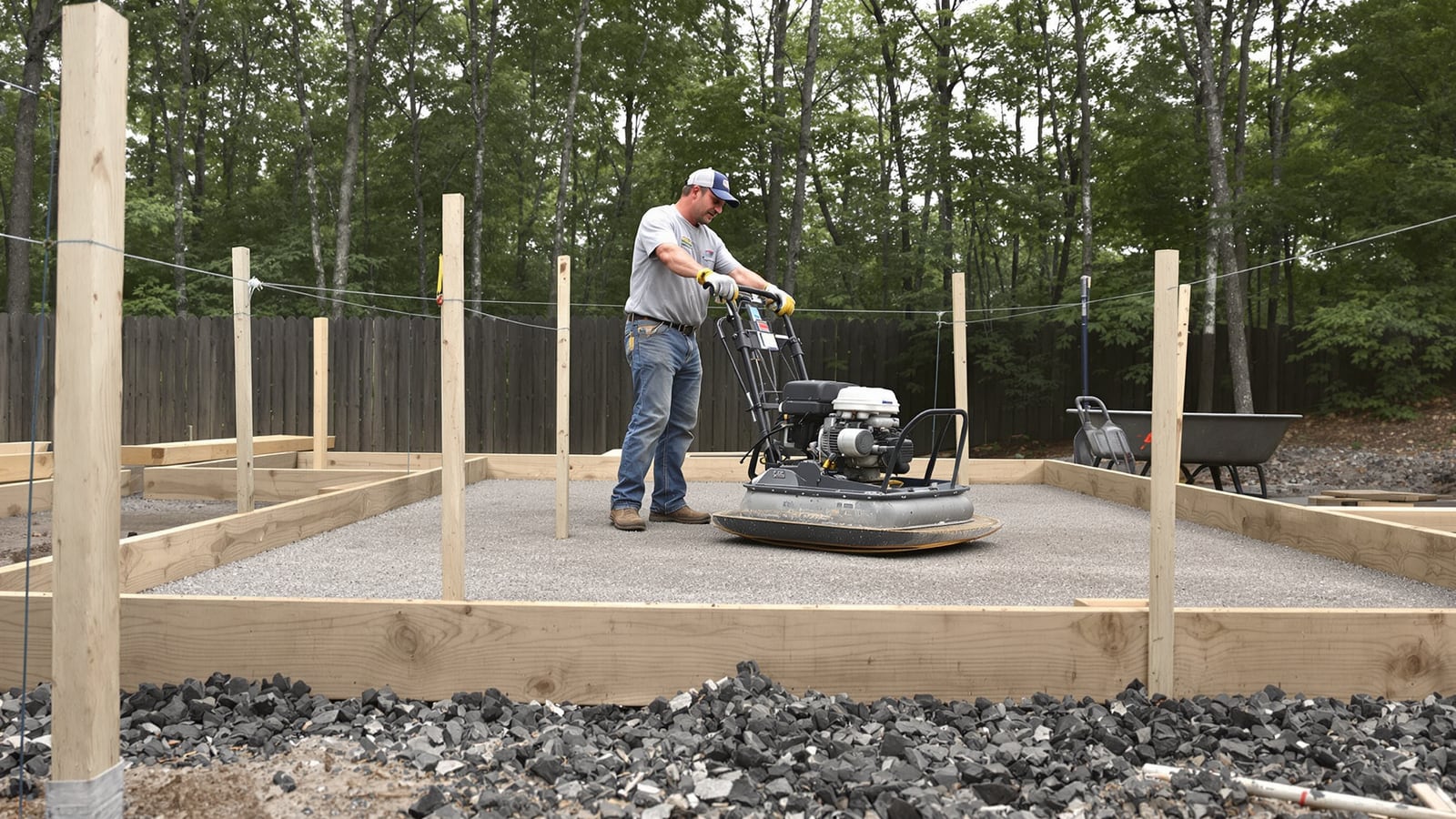
Quick answer: Find your local frost depth from the building department. Then pick one: piers below that depth, a thick compacted gravel pad for a light building, or insulated shallow footings if you're pouring a heated slab. Whichever you pick, move the water away from it.
The shed door sticks in January. By April it won't close at all, and by June it closes fine again. The corner by the downspout is two inches lower than the others, and nobody remembers pouring anything wrong.
Nothing went wrong in the pour. The ground did what ground does.
Frost needs three things
Frost heave takes soil that holds water, temperatures that freeze it, and water to feed it. Silt and clay are the worst for this. They wick moisture upward toward the freezing zone, and it collects as ice lenses that push the soil, and your building, up. Clean sand and gravel drain and don't heave much.
You can't change the weather. You can change the other two.
- Put the footing below where the ground freezes, and the freezing can't get under it.
- Swap the soil under the building for something that drains.
- Send the water somewhere else.
Do any one well and you're mostly fine. Do two and you'll never think about it again.
Find the number first
Frost depth runs from a couple of feet in the mid-South to four or five feet and more in the northern states. Don't guess, and don't use your uncle's number from a different county. Call the local building department and ask what frost depth they require for footings. It takes five minutes, and it's the number an inspector will measure against.
Ask a second question while you've got them. Many places let you skip a permit on a small, light, unattached shed, but the size limit varies. Anything with a slab, a heater, power or a loft is another conversation. For a big building, a structural plan from a local engineer is money well spent.
Before you dig, have your state's utility locate service mark the lines. It's free, and it beats finding the water line with a post-hole digger.
Option one: piers below frost
This is the standard answer for a pole barn, a deck-style shop floor or a shed on beams.
Dig below frost depth to undisturbed soil. Fill-dirt bottoms settle, so don't stand on one. Widen the bottom of the hole into a flare or a footing pad, since a wider base resists being pushed up and spreads the load in spring.
A 12-inch round pier four feet deep takes about seven or eight 60-pound bags of mix, more with the flare. Plan on a wheelbarrow and a bad afternoon, or order a truckload if you're setting a dozen.
Here's the part the video tutorials skip. Frozen soil grips the sides of the pier and lifts it, even if the bottom sits below frost. It's called adfreeze, and it's how a perfectly deep pier still creeps up over ten winters. Fix it three ways:
- Use a smooth form. A cardboard tube is fine. Ragged, rough-sided holes are worse.
- Backfill around the pier with gravel instead of the clay you dug out.
- Keep the pier straight or slightly wider at the bottom. Never wider at the top.
Set the same way, a fence's corner posts get the same treatment. The logic is identical, and it's covered in the corner posts decide whether your fence lasts twenty years.
Option two: the gravel pad
For a light shed under a couple hundred square feet, a deep stone pad is cheaper and easier. It's also honest about what it does.
Strip the topsoil. Lay landscape fabric, which keeps the stone from mixing into the clay. Add crushed stone with fines, the kind that locks up when you pack it, in lifts no thicker than four inches. Run a plate compactor over each lift. Six to twelve inches of stone, extending a foot or more past the building on every side, is a reasonable build. Slope it slightly so water leaves.
Be straight about the trade-off. A pad doesn't stop the ground from moving. It lets the whole thing move together, slowly, and drains the water that causes most of it. A shed on skids rides it out, and you can re-level it with a bar and some shims. A masonry building can't ride anything out.
Rent the compactor. A hand tamper on a 10-by-12 pad is a punishment, and you'll skip lifts.
Option three: a slab that's allowed to stay shallow
If you want a concrete floor in a heated shop, a shallow slab can work if frost never reaches the soil under its edges. That means rigid foam insulation laid horizontally around the perimeter, with the slab edge insulated too. This is called a frost-protected shallow foundation, and building codes recognize it. It has to be designed for your climate zone, so it's an engineer's or an experienced builder's job. Copying a picture off the internet is how you end up with a cracked slab and a lawsuit-sized lesson.
An unheated slab poured shallow with no insulation is the one to skip. The edges lift, the middle doesn't, and you've built a bowl that hurts your door seals.
Water is the whole game
Spring sinking is the other half of heave. The ice melts from the top down, the thawed layer can't drain through frozen soil below it, and you've got a wet sponge holding up the corner of your building. Weight goes in, and it goes down.
Fix the water and most of the problem leaves with it.
- Grade the ground to fall away from the building, about six inches over the first ten feet.
- Put gutters on it, and run the downspouts out at least six to ten feet, not onto the pad.
- Don't let a roof valley, a driveway or a pasture slope dump onto the footing line.
- Skip the planting bed that holds water against the wall.
Frost does the same to your pipes, your gate posts and your yard hydrant. What freezes first on a property and how to stop it walks through the rest of the list. And if you're still shopping for dirt, the questions to ask before you buy your first few acres should include what the soil does in March.
What to buy, what to skip
Buy:
- Crushed stone with fines, not round river rock. Round stone rolls instead of locking.
- Landscape fabric under the stone.
- Smooth cardboard tube forms for piers.
- A rented plate compactor.
- A long level and a string line. Check them twice before the concrete sets, because concrete doesn't negotiate.
Skip:
- Building on a pile of backfill that hasn't settled for a year.
- Concrete blocks stacked dry on bare dirt. They'll walk.
- A thin pad poured on topsoil.
- Digging to "about" frost depth.
The best foundation is dull. Nobody looks at it, it never needs a jack, and the door shuts the same way every month of the year. That's the whole job.
Wes Dunbar
Country & Skills
Grew up on an acreage and never quite left. Covers trucks, trades, land, and how to do the thing yourself.

Watch
Worth an hour of your evening
More from Country Bro.
From channels we rate. Plays on YouTube.
Read next