

Find your county's frost depth before the shovel goes in
One number from the county office decides whether your posts, footings and water lines stay put or get shoved out of the ground by February.
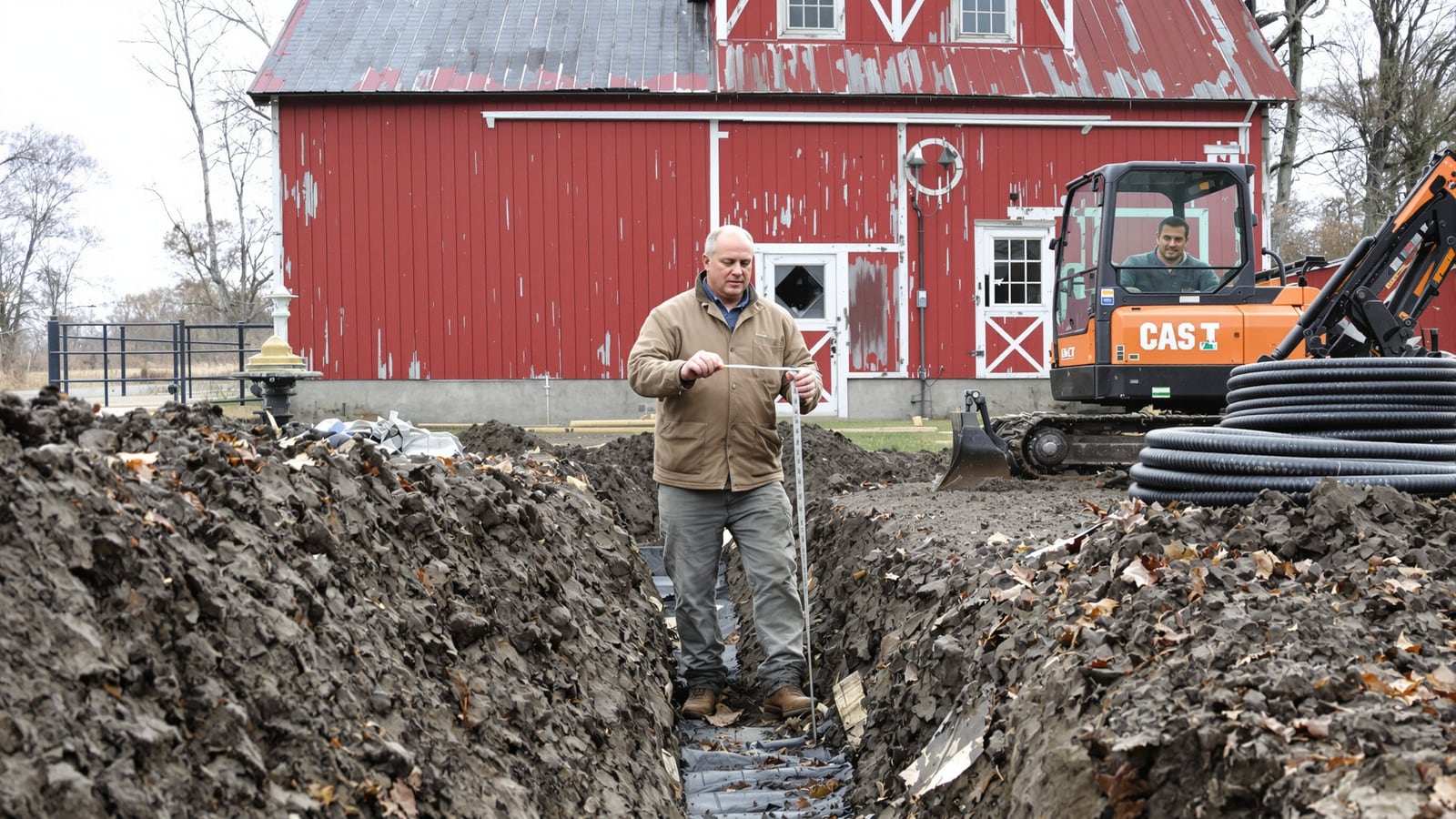
Quick answer: Call your county building or code office and ask for the frost depth used for footings. That's the minimum depth for anything that has to stay put: footings, piers, posts, buried water lines. Add a few inches, and dig to that.
What the frost line actually is
Water expands about nine percent when it freezes. Put that water in soil and the ground swells, pushing up whatever sits in the frozen layer. The frost line is how deep that freezing normally reaches in a hard winter.
Below it, the soil stays unfrozen and holds still. Above it, the ground moves. If your concrete, your post or your pipe sits in the moving part, it moves with it.
The number isn't the same everywhere. Along the Gulf Coast a code might say six or twelve inches. Across the northern tier it runs three, four, five feet or more. Two counties forty miles apart can have different numbers, and so can two ends of the same county if one sits in the hills.
The mistake that costs a spring
A man digs forty fence posts for a pasture gate line, two feet deep, because that's what the video said. His county writes forty-two inches. The first winter looks fine. The second, the gate post has climbed an inch. By the fourth spring the latch doesn't meet the catch and the whole run looks like a row of bad teeth.
Nothing was wrong with his posts, his concrete or his effort. He just dug above the line, and the frozen ground lifted every post a little each winter. Frost heave is slow and patient, and it doesn't give back what it takes. Soil settles around the lifted post on the thaw, and next winter it lifts again.
The corner and gate posts take the worst of it, since they carry the load. That's one more reason the corner posts decide whether your fence lasts twenty years.
How to get your number
You've got four places to ask, and the first is the best.
- County building or code office. Ask what frost depth or footing depth they require. It's a code number they quote all day, and they'll tell you in one sentence.
- The permit counter, if you're pulling a permit. The inspector will check your footings against it, so it's the number that counts.
- Your county extension office. They know the soils and the weather history, not just the code.
- A local excavator or well driller. Ask how deep they bury lines. They've seen what frozen ground does in your area, and they'll tell you if the code number is optimistic.
Write it on the inside of your tool shed door. You'll use it again.
One catch. The code number is a design depth for a normal hard winter, not the worst on record. Bare ground freezes deeper than ground under snow, because snow insulates. A plowed driveway, a gravel pad or a path the wind keeps clear can freeze deeper than the field next to it. In a cold, snowless winter, you want some margin. Six inches past code costs you a little more digging and buys you real peace.
What has to go below it
Anything you want to hold still goes below the line.
Footings and piers. A deck, a porch, a pole barn, a shed on piers. If it's attached to a house, or big enough to need a permit, the inspector will hold you to the code depth. If it's a free-standing shed on skids, the rules relax, and it can ride the heave and be re-leveled. Plenty of people do that on purpose.
Fence posts. Gates and corners first. Line posts can sometimes get by shallower since the wire has slack, but a post that's too short will still creep up. Dig a flared or belled bottom if you can. A post with a wider base is hard for the ground to pull straight up.
Water lines. A line that freezes doesn't just stop flowing. It can split, and you won't find out until the thaw. Bury the line below frost depth, and slope it so it drains if you're running a seasonal line to a barn or pasture. If you've got an older property, find out how deep the existing lines are before the first freeze. What freezes first on a property is the place to start.
Frost-free hydrants. The name is misleading. The valve seat sits below the line, and the pipe above it drains when you shut it off. That only works if the hydrant is bought for your depth, and if the drain hole at the bottom has gravel around it so the water can leave. A hydrant that's packed in clay holds its water in the pipe, and it freezes anyway.
Septic and well lines. Your installer should handle these to local code, but ask them the depth. What a well and septic really cost to keep running covers why a frozen line is an expensive way to learn about it.
Soil matters as much as depth
Frost heave needs two things: water and soil that holds it. Silt is the worst. It wicks water upward and freezes in lenses. Clay holds a lot of water. Clean sand and gravel drain, so they don't heave nearly as much.
So how you backfill matters. A post set in a hole of dense clay, then topped with clay, is sitting in a water-holding sleeve. A foot of gravel at the bottom, and gravel or crushed stone around the sides, gives the water somewhere to go. It's cheap to do and nobody sees it afterward.
And a post sitting in a sink of standing water is going to rot long before it heaves. Slope the soil away from it.
When deep isn't practical
In the far north, digging five feet for a deck footing is a real job. The ground is hard, the hole fills with water, and a two-man auger will earn its rental fee. You can rent a skid steer auger by the day, and for forty holes, it pays for itself in the first morning.
There's another route for some structures: frost-protected shallow foundations, which use rigid foam insulation to keep the ground under a footing from freezing. They're recognized in the residential building code, but they need to be designed and approved. If you're building something permitted, ask the office whether they'll accept one. Don't improvise it.
And if you're building something small and cheap, and you're fine with re-leveling it every few years, skip the deep hole. Know what you're trading before you decide.
Before you dig anything
Make your call-before-you-dig request a few days ahead so the utilities can mark their lines. Then check your number, add six inches, and pick the right backfill.
Whoever built your place may have guessed. Take the time to find out.
A hole is the one thing on a property that's cheaper to do right the first time than to dig twice.
Wes Dunbar
Country & Skills
Grew up on an acreage and never quite left. Covers trucks, trades, land, and how to do the thing yourself.

Watch
Worth an hour of your evening
More from Country Bro.
From channels we rate. Plays on YouTube.
Read next