Running a chainsaw without ending up in the emergency room
Kickback and falling wood cause most of the damage. Both are predictable, and both are avoidable if you change how you stand and how you cut.
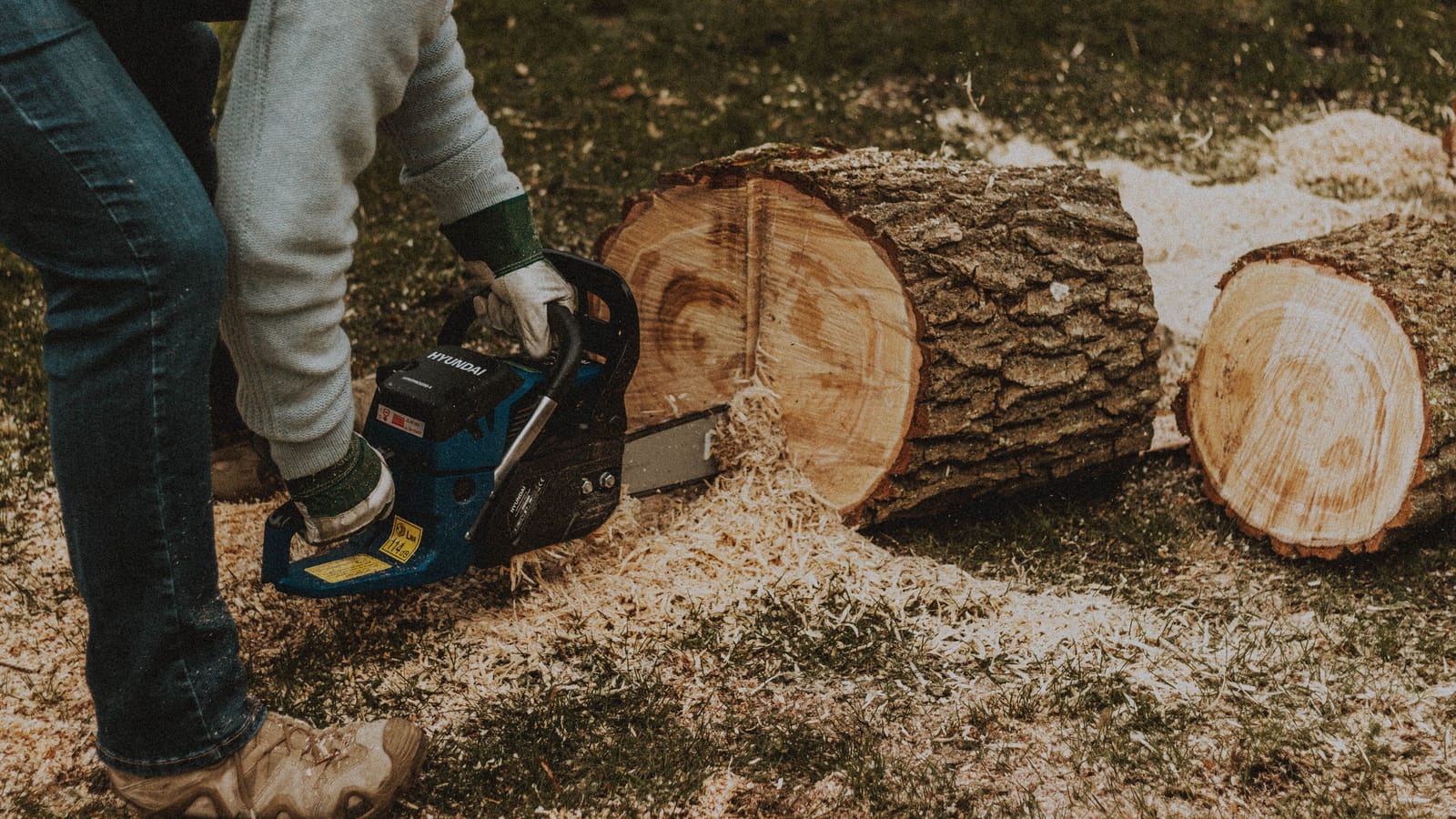
Two things put people in the hospital with a chainsaw: the saw coming back at them, and the tree going somewhere they didn't plan. Everything else is a distant third. If you fix those two, you've handled most of the risk, and neither fix requires talent. They require you to stand somewhere different and cut in a different order.
Start with the boring part, because the boring part is what keeps your leg attached.
Chaps, and why "it's one cut" is the sentence that gets people
Chainsaw chaps aren't armor. They're layers of long loose fiber. The chain catches them, drags the fiber into the drive sprocket, and jams the saw solid in a fraction of a second. That's the whole design. They work, and they only work if you're wearing them.
The one-cut jobs are where people get hurt. You're in jeans, the saw's already in the truck bed, there's a branch across the driveway. You tell yourself it's thirty seconds. The saw doesn't know that.
Minimum kit, every time you pull the cord:
- Chaps or chainsaw trousers. Wrap-around if you fell trees, apron-style is fine for bucking rounds.
- Eye protection. A mesh visor sheds chips better than safety glasses and doesn't fog.
- Hearing protection. Hearing loss is cumulative and permanent. A helmet system with muffs and visor solves three problems at once.
- Gloves and boots with toe protection. Steel or composite, doesn't matter.
- Nothing loose. No hoodie drawstrings, no unbuttoned cuffs, no jacket hanging open.
If you don't own chaps, that's the purchase to make before the next tank of fuel. Not a better saw.
Kickback comes from one place
The top quarter of the bar nose. That's it. When that part of the chain contacts wood, the teeth can't clear the chip, the chain grabs, and the bar pivots up and back toward your face at a speed you can't react to. You don't catch it. You avoid it.
So: know where your bar tip is at all times, the way you know where the muzzle of a rifle is. When you're focused on the cut you're making, the tip is off in the brush contacting something you're not looking at.
Practical habits that prevent it:
- Keep both hands on the saw. Left thumb wrapped around the front handle, not resting on top. A wrapped thumb is what stops the bar traveling when the saw does kick.
- Stand to the side of the bar line, not behind it. If the saw comes back, it goes past your shoulder instead of into your face.
- Don't cut above chest height. Your leverage is gone and your reaction time doesn't exist. Get a pole saw or a ladder and a different plan.
- Start every cut with the chain already running at speed and the bumper spikes against the wood if you can set them.
- Plunge cuts are a learned skill. You enter with the bottom of the nose, never the top. If you haven't been taught it in person, don't improvise it on a leaning tree.
The chain brake is the backup, not the plan. Set it whenever you take a step. Every step, not just long walks.
A sharp chain is a safety feature
A dull chain makes you push. Pushing is how the bar wanders, how the tip finds things, and how you get tired. Tired is when the mistakes happen.
Sharp chain throws chips. Dull chain throws dust. If you're making dust, stop and file. Two or three passes per tooth with the right round file and a guide takes a few minutes in the field and transforms the saw.
Check chain tension cold and check it again after the first few cuts, when everything's warmed and stretched. You want to be able to lift the drive links partly out of the bar groove and have them snap back. A loose chain can derail and come off the bar. Also check the bar rails for burrs and flip the bar occasionally so it wears evenly.
And keep fuel fresh. Ethanol-blended pump gas left in a two-stroke over winter causes more no-start misery than anything else. Mix small batches or run canned premix.
Read the wood before the chain touches it
Every log under load is either in compression or tension. Cut the compression side first and the kerf closes and pinches your bar. Cut the tension side first and the log splits open toward you and the far end swings.
A log supported at both ends with a gap underneath is in compression on top. Cut down about a third from the top, then come up from underneath to meet it. A log supported at one end, overhanging, is the reverse: cut up from beneath about a third, then down to meet.
If you get the saw pinched anyway, don't yank it. Shut it off, drive a plastic wedge into the kerf above the bar, and free it. Carry two wedges and a small axe or hammer. They cost almost nothing and they save whole afternoons.
Spring poles deserve their own paragraph. A sapling bent under a fallen tree stores enormous energy and releases it at head height. Find the apex of the bend, stand on the inside of the curve, and shave the outside of the bend with a series of small cuts until it releases gradually. Never cut straight through a spring pole. People get knocked unconscious this way in their own woodlot.
Felling is where amateurs get killed
Bucking on the ground is forgiving. Dropping a standing tree isn't, and the difference in consequence is enormous.
Before the saw starts: look up. Dead limbs hung in the canopy will come down when the trunk moves, and they land where you're standing. Check the lean, check the crown weight, check for wind. Then clear two escape routes at roughly forty-five degrees back from the fall line, opposite each other, and actually walk them. Move the brush. Move the fuel can.
The cut itself, simplified: an open-face notch on the side you want the tree to fall, about a fifth to a quarter of the way into the trunk, with the two faces meeting cleanly at a point. Then the back cut, slightly above the notch apex, coming in from the opposite side. You stop before you reach the notch and leave a band of uncut wood across the trunk. That band is the hinge, and the hinge is what steers the tree. Roughly a tenth of the diameter is the usual guide. Cut through it and you've got no control at all.
When it starts to move, you move. Along your escape route, eyes up, not watching the show.
None of that makes you a faller. If a tree is leaning into a building, tangled in another tree, wrapped in wire, or bigger than you're comfortable with, the correct move is a phone call. Storm-damaged wood in particular is under loads you can't see from the ground. Professionals decline that work all the time.
Assume you'll be alone at the wrong moment
Tell someone where you're and when you'll be back. Keep your phone in a chest pocket, not the truck. A chainsaw wound to the leg is a bleeding problem, and bleeding problems are measured in minutes.
Carry a tourniquet you've actually practiced applying one-handed, plus pressure dressing, in a pouch on your belt. Not in the truck a hundred yards away. Take a bleeding-control or wilderness first aid class from a qualified instructor; reading about it isn't the same as doing it.
The best saw operators I know are unhurried, almost slow-looking. They stop and file. They reposition instead of reaching. They put the saw down and think about a log for a minute before cutting it. Speed comes from not having to redo anything, and from still having ten fingers in year thirty.
Wes Dunbar
Country & Skills
Grew up on an acreage and never quite left. Covers trucks, trades, land, and how to do the thing yourself.

Watch
Worth an hour of your evening
More from Country Bro.
From channels we rate. Plays on YouTube.
Read next