

Watch a John Ford Western with the sound off
Ford's best Westerns are built on Monument Valley, not plot. Here's how to see it, which ones to start with, and what to know before the kids sit down.
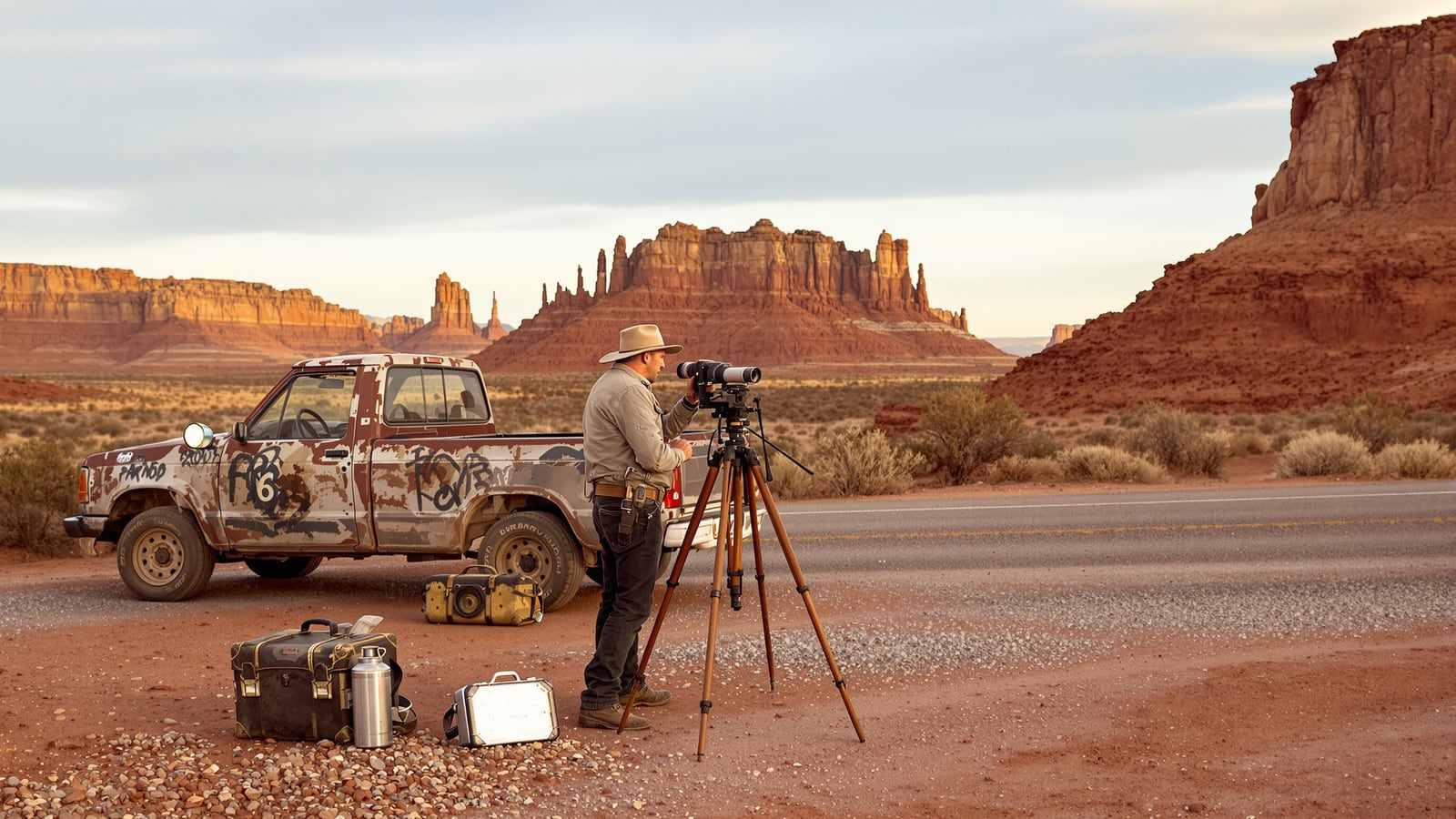
Quick answer: Start with Stagecoach (1939), then She Wore a Yellow Ribbon (1949). Save The Searchers (1956) for teenagers and up. And one correction before you go looking: Rio Bravo isn't a Ford picture. More on that below.
Here's the test. Put on Stagecoach, find the first long shot of the coach crossing open desert, and mute the TV for five minutes.
You'll still know what's going on. Small coach, huge country, and the country isn't impressed. A bad director would need dialogue to tell you that these people are exposed, that help is a long way off, that the trip is a gamble. Ford lets the horizon say it.
Plot is the cheap part
The story of Stagecoach fits on an index card. Nine passengers ride to Lordsburg while Apache raiders are on the loose. A drunken doctor, a banker with a secret, a lawman, a gambler, a whiskey salesman, a pregnant officer's wife, a woman run out of town for her reputation, and John Wayne as the Ringo Kid, an escaped convict with a score to settle. That's it. Westerns before and since have had more twists.
What Ford had was a place. He took the production to Monument Valley, on the Utah-Arizona line inside the Navajo Nation, and it did something no studio backlot could. The buttes stand like they've been waiting a few million years for somebody to point a camera at them. Every character looks small against them, and that's the moral argument of the picture. These people have rank and grudges back in town. Out here, they have each other.
The famous chase, with the Apache riders closing on the coach across a dry lake bed, is a landscape sequence as much as an action one. Stuntman Yakima Canutt's work still holds up. The flat white ground gives you room to see exactly how bad things are getting.
Thomas Mitchell won the Oscar for playing the drunken doctor, and he earned it. But you'll remember the sky.
The one you can't skip a decade later
My Darling Clementine (1946) is Ford's Tombstone, with Henry Fonda as Wyatt Earp and Victor Mature as a coughing, worn-out Doc Holliday. It's quieter than you expect. Fonda tilting back in a chair on the boardwalk, boots against a post, is practically a landscape of its own. Fair warning for the history buffs: the facts of the O.K. Corral are loose here, and Monument Valley turns up in a place Tombstone never had it. Ford cared about the feel of the thing more than the footnotes.
She Wore a Yellow Ribbon (1949) is the one to show somebody who thinks old movies look dull. It's in Technicolor, and cinematographer Winton Hoch won an Oscar for it. The orange rock, the thunderstorm rolling in across the valley, the cavalry column strung out small on the horizon. Wayne plays a captain days from retirement, and he's good at it. The plot is a patrol, a few fights and a tender goodbye. You'll remember the light.
Then The Searchers
Most critics call it Ford's best, and plenty call it the finest Western ever made. It opens and closes on the same shot: a door, a dark room, and the bright desert outside. The whole film is held inside that frame.
It's also the hardest one on this list. Wayne's Ethan Edwards spends years hunting a kidnapped niece, and he's consumed by hatred of the Comanche. The film doesn't excuse him. It watches a man hollowed out by his own bitterness, and it asks what it costs the people near him. That's a real conversation to have with a teenage son.
Don't put it on for younger kids.
The control group: Rio Bravo
Your reading list may have tacked Rio Bravo (1959) onto Ford. It's Howard Hawks, and it's worth watching for exactly that reason. Hawks and Wayne made it partly as an answer to High Noon, which they felt had a sheriff begging a town for help. Wayne's sheriff here turns down help he doesn't trust.
Put it beside Ford and the difference is plain. Rio Bravo lives in a jail, a hotel and a street. The landscape is a backdrop. What carries it is Wayne, Dean Martin as a deputy fighting to stay off the bottle, a young Ricky Nelson, and Walter Brennan as a crotchety old jailer. It's a hangout movie with gunfights in it, and a very good one.
That's the point. Hawks makes you care about the people in the room. Ford makes you care about the room the whole country is, and then drops the people into it.
What to know before the family sits down
Rate your own household; these are the things you'll run into. For a quick method of checking anything before you press play, the eight-minute vetting routine works fine on old films too.
- Stagecoach: Frequent gunfire and some deaths. The Apache are shown as a faceless threat, which is a stereotype of its era and worth a short talk with older kids. Heavy drinking by one character. A woman is shunned for her past, with nothing shown. Fine for most kids ten and up.
- My Darling Clementine: Gunfights, saloon scenes, drinking, and the killing of a young brother that drives the plot. Doc Holliday's illness is portrayed plainly. Roughly twelve and up.
- She Wore a Yellow Ribbon: Cavalry skirmishes, a saloon brawl played for laughs, some drinking. The portrayal of Native tribes is dated. A good first Ford for a family.
- The Searchers: Violence, racist language and attitudes from the lead, and the aftermath of a raid on a homestead, kept off-screen. Teens and up, ideally with a parent in the room.
- Rio Bravo: Shootouts, a lot of whiskey, a character in recovery, and some light flirting. Clean in the ways that matter. Good for twelve and up.
If you'd like a longer menu, the Westerns every man should watch at least once goes wider than Ford. And if your kids haven't done black-and-white yet, the classics they should see before thirteen is a gentler on-ramp.
How to watch
Use the biggest screen in the house, and turn off the lights. Ford composed these shots for a theater. A phone in your lap will flatten every one of them.
Pause on a wide shot, any wide shot, and ask the kids what they notice. Where are the people? How big is the sky? They'll tell you it's empty, and then they'll say it looks lonely, and then they'll say they'd have wanted to be there.
That's the lesson. A good Western is a place first and a story second. Ford knew it in 1939, and a ten-year-old with a bowl of popcorn gets it in about four minutes.
Marcus Vale
Editor-in-Chief
Twenty years in magazines, most of it deciding what to cut. Writes about work, discipline and the decisions that compound.

Watch
Worth an hour of your evening
More from Movies & TV.
From channels we rate. Plays on YouTube.
Read next