Read a Fish Finder Right and Skip the Features You Won't Use
A 20-degree cone in 20 feet of water sees a circle seven feet wide. Everything else you need to know follows from that.
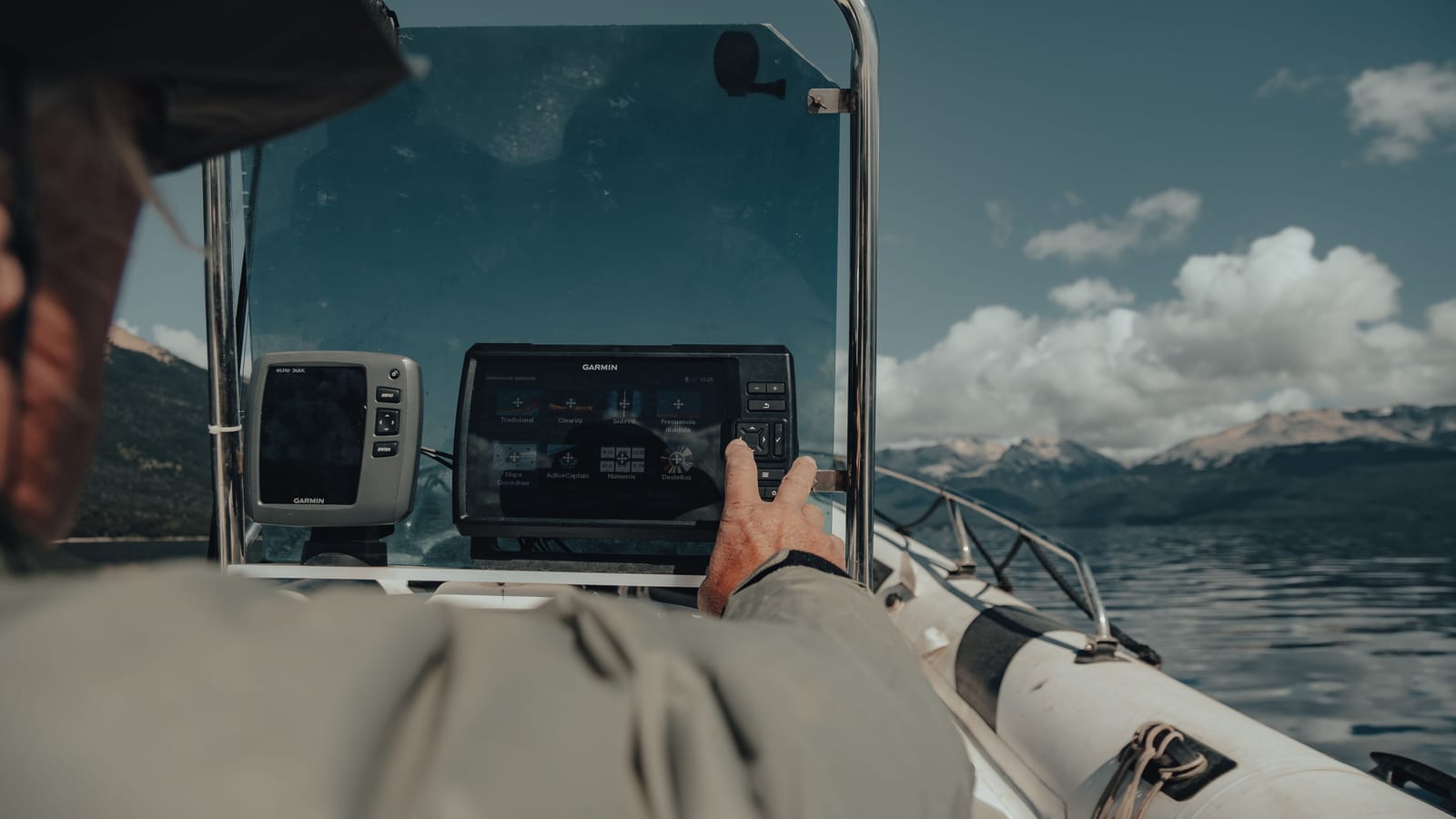
A 20-degree transducer cone in 20 feet of water is looking at a circle about seven feet across. Do the math yourself: two times the depth times the tangent of half the cone angle. At 40 feet you're seeing 14 feet. At 6 feet in a pond you're seeing about two feet of bottom, which is roughly the size of a trash can lid.
That single fact fixes most of the confusion people have with sonar. When somebody idles over a spot and says "there's fish stacked here," the "here" is very small and directly under the boat. Not off to the left. Not where you just made that cast. Under the transducer, in a narrow ice cream cone of sound.
Once that lands, the rest of the screen starts making sense, and so does the question of what you actually need to buy.
The transducer is the purchase. The screen is the receipt.
Head units get the marketing. Transducers do the work. A mid-priced unit with a properly mounted transducer will out-read an expensive unit with a transducer bolted six inches behind a hull rivet, every single time.
Two things ruin transducer performance and both are free to fix. The first is turbulence. The transducer face needs clean, solid water, which means mounting it on the transom away from strakes, rivets, and the prop wash arc, with the face level or kicked down a hair at the back. If your bottom reading turns to confetti above 12 mph, you've got aerated water, not a bad sonar.
The second is the bottom of your boat. Shoot-thru-hull installs work on solid fiberglass. They don't work on aluminum, and they don't work through a cored hull with air in the core. Put a transducer inside an aluminum jon boat and you'll get a beautiful reading of absolutely nothing.
On a kayak or a small tiller boat, a trolling motor mount or a simple transom arm beats anything clever. Keep it simple and keep it in the water.
Turn off Fish ID before your first cast
Out of the box, most units run in a friendly mode that converts sonar returns into little cartoon fish. Kill it. What that icon is really saying is "the unit received a return of a certain strength and size that the software decided to flatter you about." Suspended grass, a bubble trail, a dying shad, and a nine-pound walleye can all earn the same fish.
While you're in the menus, do these four things:
- Set sensitivity manually, then raise it until you see a light speckle of static across the water column. That speckle is the unit telling you it's hearing everything. Back it off one notch.
- Set range manually when you're working a specific depth. Auto range keeps rescaling, and every time it does, your mental picture resets. If you're fishing a 25-foot flat, lock the range at 30.
- Turn the chart speed up until the screen scrolls briskly. Slow scroll compresses detail into mush.
- Pick your frequency on purpose. High frequency, around 200 kHz, is narrow and detailed. Low, around 83 kHz, is wide and forgiving. Narrow for detail and deep water. Wide when you're idling around trying to find where the bottom changes.
That's the whole setup. Ten minutes in the parking lot, and it costs nothing.
What the screen is actually telling you
Arches are a side effect of motion. A fish makes an arch because the boat moves over it, so the fish enters the edge of the cone, passes through the center where it's closest, and exits the far edge. If you're sitting still, that same fish draws a flat horizontal line. Anglers anchored over a brush pile look at straight lines and assume they're seeing limbs. Half the time they're seeing crappie.
The second bottom line is your friend. Below the real bottom return, most units paint a fainter echo at double the depth. If that second return is thick and bright, you're over hard bottom — rock, gravel, shell. If it's thin or missing, you're over soft mud. Nobody sells this as a feature and it's free on any 2D unit made in the last twenty years. It's how you find a gravel bar on an otherwise featureless flat.
A fuzzy horizontal band that isn't the bottom is usually the thermocline. Crank sensitivity to find it in late summer. Fish above it. Below it there's often not enough oxygen to hold much of anything.
Bait looks like weather. Clouds, smudges, popcorn. Big balls that ride off the bottom at first light. Find bait with a hard bottom under it and you've found a spot.
Now the part where you keep your money
GPS with a decent base map is worth it. Not for the pretty screen. For the waypoint. The ability to drop a pin on the one stump on a 300-acre flat and come back to it in March is the most useful thing sonar ever gave a fisherman, and it comes standard on almost everything now.
CHIRP isn't an upsell anymore. It's the default on nearly every current unit. Don't pay a premium for the word.
Down imaging earns its keep. It's a thin slice, so it shows structure in a way that reads like a photo. Standing timber looks like standing timber. Brush looks like brush. Cheap, useful, and it makes a beginner's screen legible.
Side imaging is conditional. It shines in water 8 to 25 feet deep, over flats, where you're hunting scattered cover across a wide area. If you fish steep bluff banks, rivers under 6 feet deep, or a 40-acre pond where you already know every laydown, you'll admire it twice and then stop turning it on.
Forward-facing live sonar is the big one. It's genuinely remarkable technology. It's also a serious investment once you add the unit, the transducer, the dedicated mount, and the battery to run it. Before you spend it, ask yourself honestly how many days a year you fish open water for suspended fish. If the answer is "I fish a river for smallmouth and a lake for crappie in brush," you'll catch more by spending that money on gas and days off.
The trade-off runs the other way for some people, and I'll say so. If you chase suspended stripers or offshore walleye, where fish move constantly and are nowhere near the bottom, live sonar will change your season. Just buy it because your fishing calls for it, not because a video made it look easy.
Ten minutes that teaches you more than a manual
Go to water you already know. A dock you've fished a hundred times, a channel bend, the point by the ramp. Idle over it slowly and watch the screen while you picture what's actually down there. Your brain calibrates fast when it can check its own answers.
Then drop a jig straight down and watch it fall on the screen. That's the drill that makes sonar click. You'll see your own lure land, you'll see the cone width in real terms, and you'll never again wonder whether that mark is a fish or a branch — because now you know what a known object looks like.
One last practical note. Seasons, limits, and even what electronics you may use vary by state and province, and a few tournament circuits have put their own restrictions on forward-facing sonar. Check the current regs where you're launching, not the ones you memorized in 2019.
The fish were there before the screen was. The screen just stops you from driving past them.
Dean Shaw
Gear & Garage
Reads the warranty, the parts list and the long-term owner reviews before anything else. Trucks, tools, watches, and the cheap version that costs more.

Watch
Worth an hour of your evening
More from Fishing.
From channels we rate. Plays on YouTube.
Read next