A Tackle Box That Covers Ninety Percent of Freshwater Fishing
One tray, about forty pieces, and you can fish a farm pond, a trout stream, a walleye flat and a bass river without repacking.
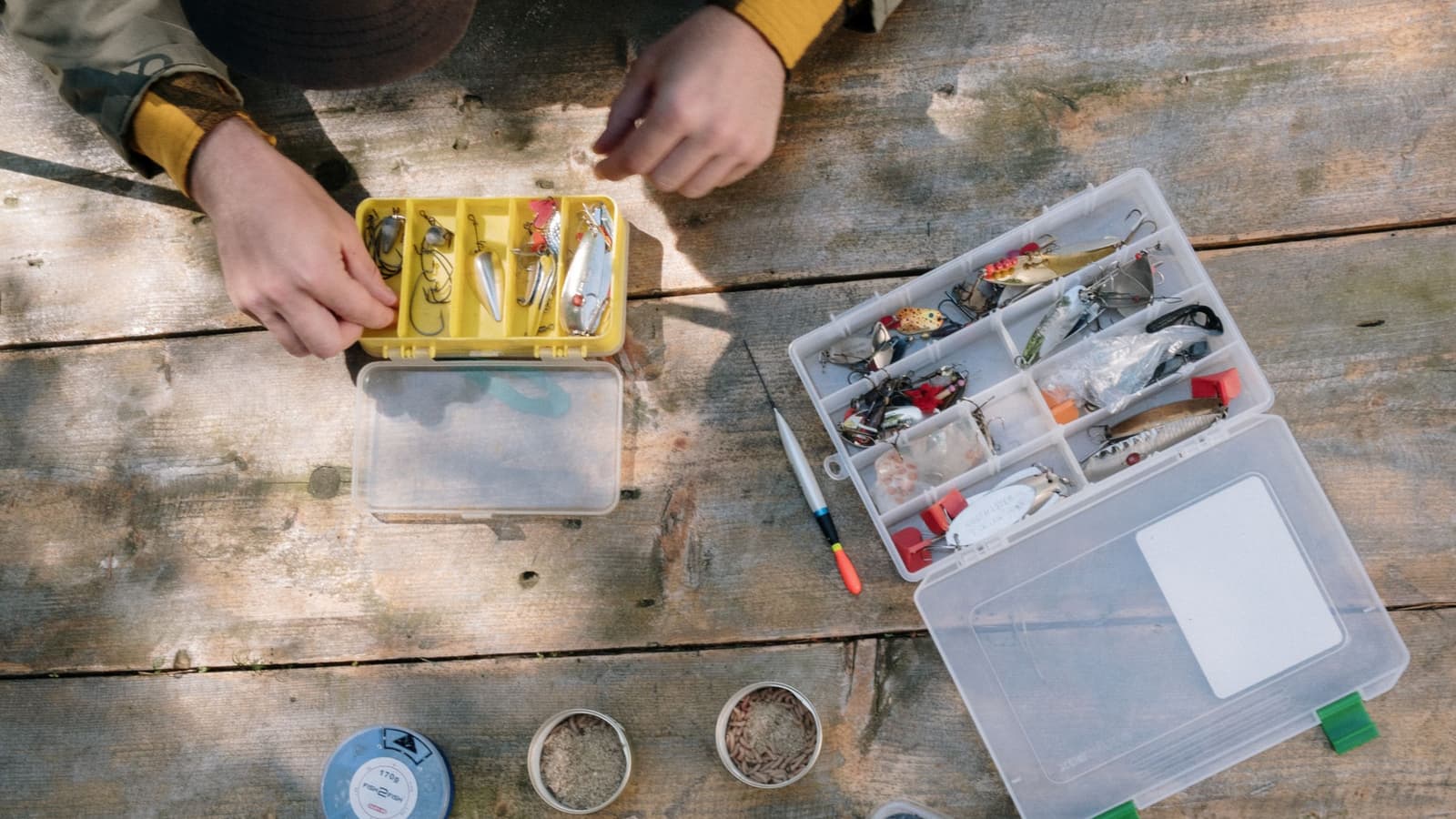
One 3600-size utility box. That's the target. It's the flat plastic tray with adjustable dividers that fits in every soft-sided tackle bag ever made, it costs less than a large pizza, and if you pack it right you can walk up to almost any water in North America and catch something.
The 3700 is the bigger version, and plenty of guys use it. I'd argue against it for this purpose. A bigger box just gets filled with the stuff you never tie on, and then you're carrying nine pounds of regret to a pond you could fish with two lures.
Start with soft plastics, because they catch everything
Half your box is plastic worms and grubs. That's not laziness, that's math. A soft plastic covers more depths, speeds and moods than any other category, and when a fish eats one it holds on long enough for you to react.
Pack these:
- 5-inch stick baits (the Senko style), green pumpkin and black-blue. A pack of five usually runs under ten bucks. Wacky-rigged on a #1 hook, these catch largemouth, smallmouth and the occasional very confused catfish.
- 3-inch curly-tail grubs, white and smoke. On a 1/8 oz jig head this is the best all-around lure ever made for a person who doesn't know what's in the water. Crappie, perch, walleye, smallmouth, trout, pickerel.
- A finesse worm, 4 to 5 inches, green pumpkin. Drop shot it, Ned rig it, split shot it.
- A small craw, 3 inches. Trailer for a jig, or Texas rigged along rock.
- 1-inch soft plastic panfish baits in something bright. When nothing is happening, a 1/32 oz head with a tiny plastic under a float will save the day with your kids in the boat.
Two colors per shape. That's the discipline. Green pumpkin for anything that looks like a crawfish or a goby, white or pearl for anything that looks like a baitfish, and one loud color for dirty water. You're not going to out-color the fish.
The metal that holds it all together
Terminal tackle is where most boxes go wrong. Guys buy fourteen lures and three hooks.
Hooks worth having: size 1 and 1/0 octopus hooks for wacky rigs and live bait, 3/0 and 4/0 extra-wide-gap worm hooks for Texas rigs, and a small envelope of #6 and #8 baitholders for worms and minnows. Add a few #8 and #10 trebles as replacements, because factory trebles on cheap crankbaits are made of pencil lead.
Jig heads: 1/32, 1/16, 1/8 and 1/4 ounce. Round heads are fine. If you fish rock, get a couple of 3/8 oz football heads too.
Weights: bullet sinkers in 1/8, 3/16 and 5/16 for Texas rigs, plus drop shot weights in 1/4 and 3/8. Split shot in two sizes. Note that several states restrict lead sinkers and jigs under a certain size or weight because of loon and waterfowl mortality, and the rules differ by state and by province. Check before you buy a pack of lead split shot for a Northeast trip.
Then: barrel swivels, snap swivels, bobber stops, two slip floats, and a spool each of 8 and 12 pound fluorocarbon leader. That's the whole department.
Four hard baits and not one more
Hard baits are the fun part and the part that eats your money. Cap it.
A square-bill crankbait, shad pattern, running 2 to 4 feet. Bang it off rock and laydowns. Nothing shallower than that matters much until you're solving specific problems.
A suspending jerkbait, 4 inches, running 4 to 6 feet. Cold water, clear water, staging fish. Pause it longer than feels reasonable.
Inline spinners, size 2 and 3, one silver blade and one gold. This is the single most underrated lure in freshwater. Trout in a mountain creek, smallmouth in a river, pike in a weed bay, all on the same $6 spinner.
A 3/8 oz spinnerbait, white with silver willow blades. Weedless, snagless, and it covers a hundred yards of shoreline in ten minutes when you don't know where the fish are.
If you want a fifth, make it a 1/4 oz casting spoon. Gold. It jigs vertically through the ice, it casts a mile in wind, and it costs almost nothing.
The tools decide whether the day is good
You can lose a great fish to a bad pair of pliers. Put these in the bag, not the box:
Needle-nose pliers with side cutters that actually cut braid. A 6-inch pair of forceps for panfish and trout that swallow a hook. Line nippers on a retractor. A small hook file. A headlamp, because you will eventually be walking out in the dark, and a phone flashlight held in your teeth is how people drop phones in lakes.
And a tape measure. Not optional. Slot limits are real, wardens are real, and "it looked about fifteen inches" isn't a legal defense anywhere.
What this box doesn't cover
The other ten percent, honestly named.
It won't cover muskie. That's a different rod, wire leaders, and baits the size of a loaf of bread. It won't cover deep-water trolling for lake trout or salmon, which means downriggers, dipsy divers and line counters. It won't cover serious flathead catfish, where you're running 8/0 circle hooks and 3-ounce sinkers on gear that would embarrass a bass rod. And it isn't a fly box.
It also gets thin in one common situation: gin-clear, heavily pressured water in August. When bass have seen every square-bill in the county, you want a full finesse arsenal, and one drop shot worm won't carry you.
That's fine. Ninety percent is the goal. The other ten percent is a specialty box you build when you decide to chase that specialty.
Licenses, and the part people skip
Every state and every Canadian province sets its own rules, and they change. Season dates, bag limits, slot limits, hook restrictions, live-bait rules, whether you can move a minnow from one lake to another, and whether a particular stretch of river is artificial-lures-only or barbless-single-hook. Some waters inside a state have their own regulations posted at the access point and nowhere else.
Buy the license online before you leave the driveway, download the regulations PDF to your phone, and read the special-regulations section for the specific water. It takes eleven minutes.
Keeping fish is good and right. A limit of crappie in a cooler on ice, cleaned that night, fried in cornmeal, is one of the best meals in America and one of the great reasons to teach a kid to fish in the first place. Releasing fish is also good and right, especially the big old females that make more fish. Do either one well. Wet your hands, support the belly, don't hold a fish by the gills, and if you're keeping it, kill it quickly and get it cold.
Keep the box honest
Once a season, dump the whole tray on the garage bench. Throw away the rusted hooks. Replace the trebles on anything that's caught more than a dozen fish. Rinse the box, dry it open overnight, and put back only what you actually tied on last year.
You'll find the same six things keep earning their spot. That's the box. Everything else is a hobby you're welcome to have.
Now go find a pond nobody fishes on a Tuesday.
Dean Shaw
Gear & Garage
Reads the warranty, the parts list and the long-term owner reviews before anything else. Trucks, tools, watches, and the cheap version that costs more.

Watch
Watch how it's done
Picked for this article.
From channels we rate. Plays on YouTube.
Texas Parks and Wildlife
Fishing Tips: Freshwater Tackle Box
AnglersEscape
Ultimate Freshwater Tackle Box Setup- Bass, Crappie, Catfish, Panfish