Real bread on a weeknight, no starter required
One dough, a kitchen scale, and a hot pan. What actually goes wrong when you try to bake bread after work, and how to stop it.
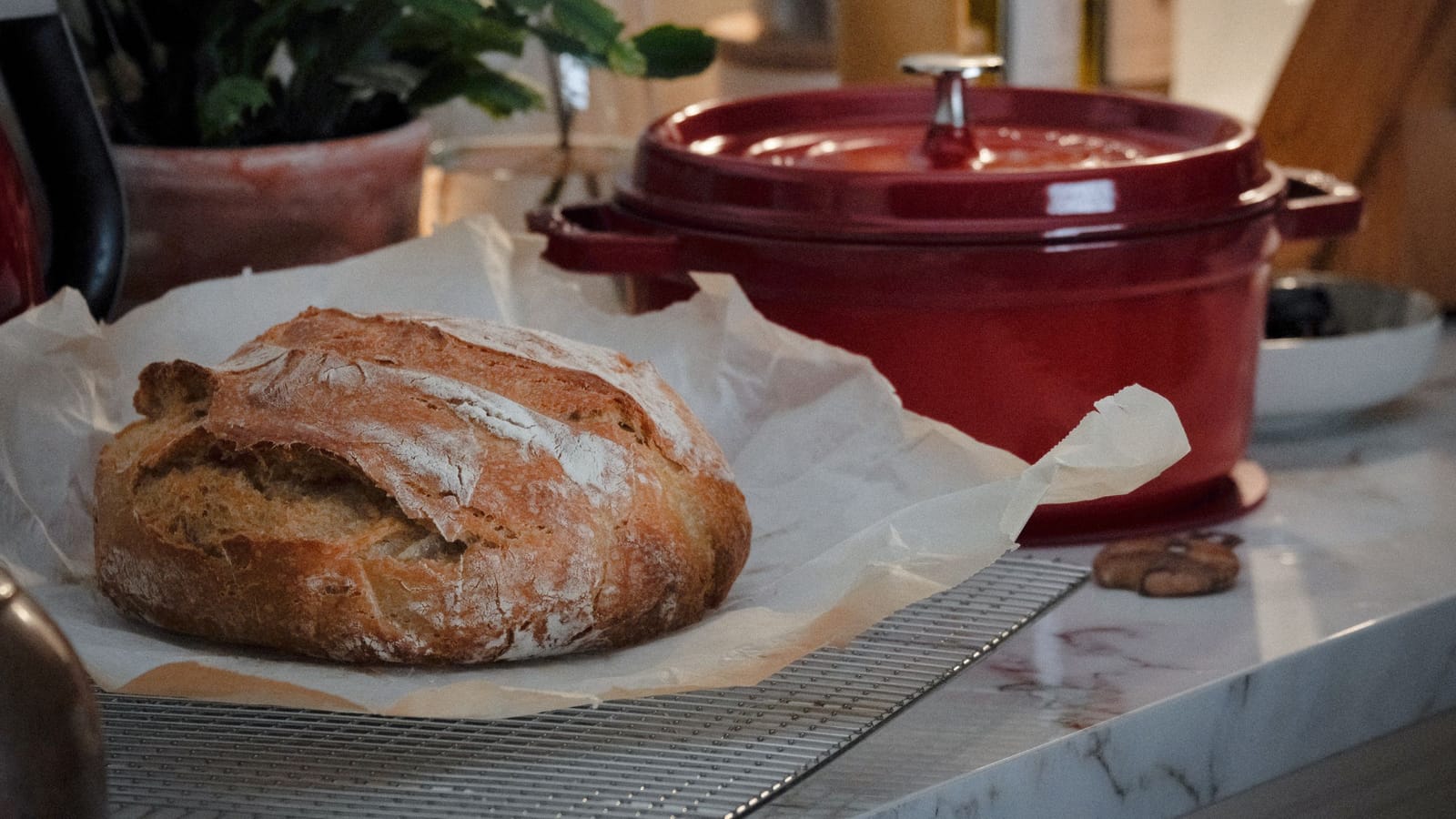
Forget sourdough for a minute. The thing standing between you and bread on a Tuesday isn't skill, it's the clock, and the clock is fixable. Commercial yeast lets you trade time for yeast. More yeast, less waiting. That's the whole trick, and once you understand it you can slot a loaf into whatever gap your evening actually has.
Start with a scale. Cups are the single biggest reason home loaves come out dry and tight. A cup of flour can vary by a third depending on how you scoop, and a third is the difference between a soft crumb and a brick. A digital scale costs less than two bags of good flour and it removes the guesswork permanently.
The base dough, and the numbers behind it
Five hundred grams of bread flour. Three hundred and fifty grams of water. Ten grams of fine salt. Yeast depends on your window.
That's 70% hydration and 2% salt, which are the two numbers worth memorizing. Go below 2% salt and the dough turns slack and the bread tastes flat and slightly metallic. Go much above and you slow the yeast down.
For yeast, work backward from dinner:
- Four to five hours (mix at 2pm on a Saturday, bake for dinner): 3g instant yeast
- Two to two and a half hours (home at 6, bread at 8:30): 6g
- Ninety minutes, no negotiating: 8g, and accept a plainer flavor
The long version tastes noticeably better. Flavor in bread comes from time, and no amount of yeast buys that. But a fast loaf still beats the bagged stuff by a mile, and a fast loaf you actually make beats a perfect loaf you don't.
Water temperature matters more than people expect. You want the finished dough around 76–78°F. In a 68°F kitchen that means water at roughly body temperature. Hot tap water is a common killer — much past 130°F and you're poaching the yeast, and you won't know until the dough sits there sulking an hour later.
Mixing, and why you don't need to knead
Put the flour, salt and yeast in a bowl and whisk them dry so the salt isn't sitting in a pile against the yeast. Add the water. Mix with your hand until there's no dry flour left. It'll look like wet, shaggy garbage. That's correct.
Cover it and walk away for twenty minutes.
Come back and do a fold: wet your hand, reach under one side of the dough, stretch it up and lay it over the middle. Turn the bowl a quarter and repeat. Four pulls, ten seconds total. Do that three times over the first hour, spaced twenty to thirty minutes apart.
You've just built the same gluten structure that ten minutes of kneading gives you, minus the flour on the counter and the arm work. Between folds the dough is doing it by itself — that's what the rest period is for.
After the last fold, let it rise until it's roughly doubled and feels airy and domed. Poke it. If the dent springs back fast, it needs more time. If it stays put and the dough sighs a little, it's ready.
The cold kitchen problem
This wrecks more weeknight loaves than any other single thing. Recipes are written for a warm kitchen. If your house sits at 64°F in February, every rise time you read is a lie by about half again.
Fix it cheaply: turn your oven on for sixty seconds, turn it off, and put the covered bowl inside with the light on. Or set the bowl on top of the fridge, which is warmer than you think. Or fill a mug with boiling water and shut it in the microwave with the dough.
Judge the dough, not the clock. Every time.
Shaping and the hot pan
Tip the dough onto a lightly floured counter. Resist the urge to flour it heavily — excess flour on the surface ends up as a dusty seam inside the loaf and dries out the crumb.
Fold the edges into the center like an envelope, flip it seam-side down, and drag it toward you a few times with cupped hands to build tension on the surface. You're making a taut skin. That skin is what makes the loaf rise up instead of spreading out.
Rest it seam-side up in a floured bowl or a towel-lined colander for thirty to forty-five minutes while the oven heats.
Now the part people skip: preheat the Dutch oven with the oven. Empty, lid on, 500°F, a full thirty minutes after the oven beeps. A cold pot gives you a pale, flat loaf and there's no recovering from it.
Turn the dough out onto parchment, score it once down the middle with a razor or your sharpest paring knife, about half an inch deep and held at a slight angle. Lower it in, lid on, 20 minutes. Then lid off, drop to 450°F, another 15 to 20 until it's properly dark. Not golden. Dark.
The enclosed pot traps the dough's own steam, which keeps the crust soft long enough to let the loaf expand. That's what a professional steam oven does, and a cast iron pot does it for free.
Know when it's done, and then leave it alone
Underbaked bread is gummy in the middle and there's no fixing it after the fact. A thermometer in the base reads 205–210°F when it's finished. No thermometer? Tap the bottom — it should sound hollow and feel light for its size.
Then don't cut it.
The starch is still setting as it cools. Slicing a hot loaf smears the interior and you get a dense, wet crumb from bread that was actually perfect. Thirty minutes minimum on a rack, an hour if you can stand it. The crust crackling as it cools is the sound of you getting it right.
The versions for nights when there's no time at all
Flatbread, twenty-five minutes. Same dough, half the water. Don't bulk ferment — rest it thirty minutes, divide into six, roll thin, and cook in a dry cast iron skillet over medium-high. Ninety seconds a side. They puff, they blister, they go with everything.
Focaccia, one hour. Take the base dough after its first rise, press it into a well-oiled sheet pan, dimple it hard with your fingertips, salt it, and bake at 450°F for 20–25 minutes. Forgiving, fast, and kids demolish it.
Soda bread, no yeast, no rise. Flour, buttermilk, baking soda, salt. Mix until it just comes together — overworking it makes it tough — shape it into a round, cut a deep cross in the top, bake at 425°F for around 40 minutes. From bowl to table in under an hour.
The overnight. Mix Monday at 9pm with 2g yeast, put the bowl in the fridge, bake Tuesday evening. The cold slows fermentation to a crawl and the flavor that develops is the closest you'll get to sourdough without keeping a starter alive.
Bake one loaf a week for a month and you'll stop reading the numbers. You'll know the dough by how it feels on your hands, and you'll be the guy whose house smells like that when people walk in.
Dean Shaw
Gear & Garage
Reads the warranty, the parts list and the long-term owner reviews before anything else. Trucks, tools, watches, and the cheap version that costs more.

Watch
Worth an hour of your evening
More from Food.
From channels we rate. Plays on YouTube.
Read next