
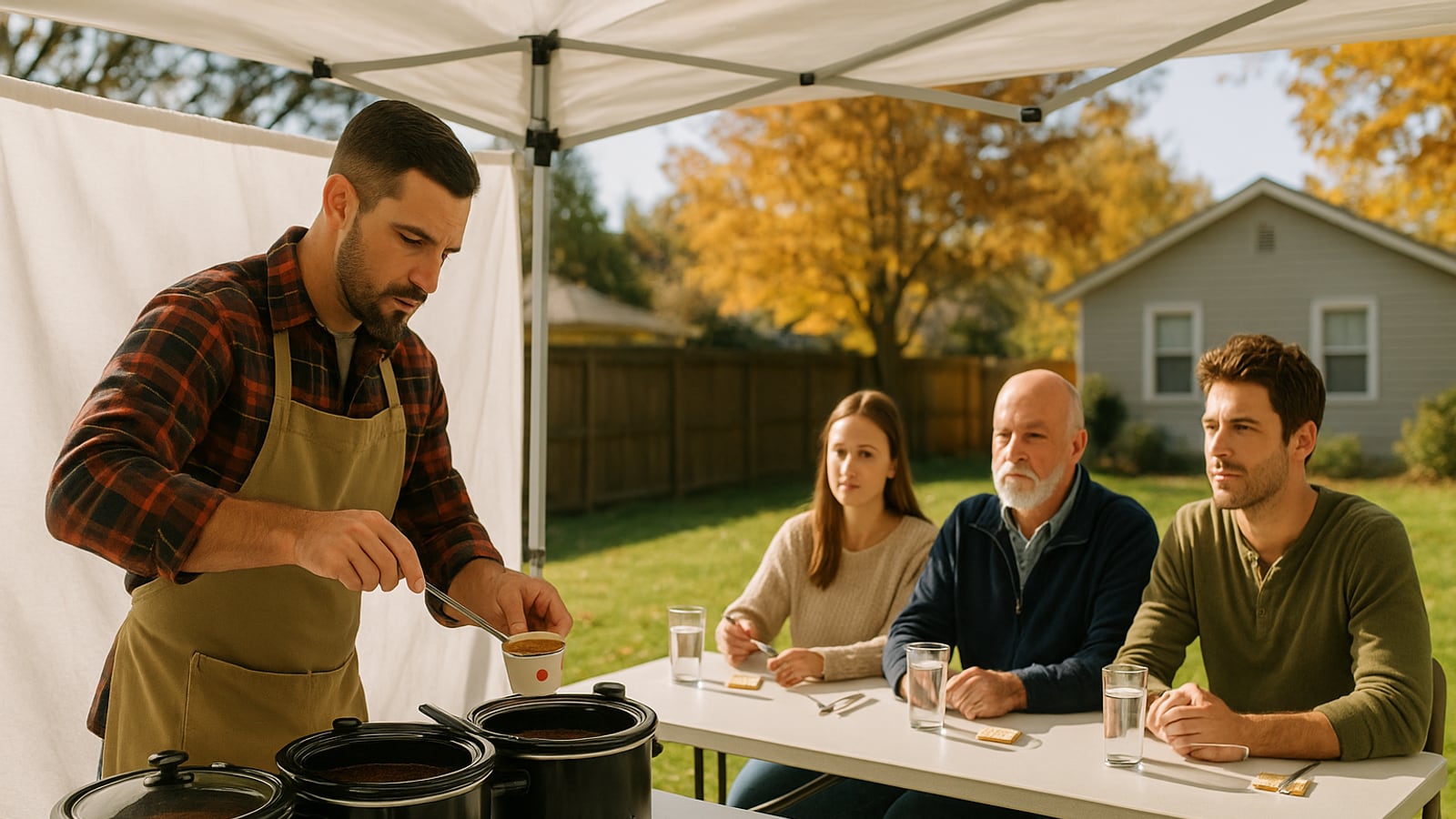
Quick answer: Judge blind, from numbered cups ladled out of sight of the pots. Score taste double. Run a separate People's Choice so the popular guy still gets his moment, and make the trophy something that travels.
Every backyard chili cook-off hits the same wall around the third year. Somebody's brother-in-law brings eleven friends, they all vote for his pot, and a perfectly decent chili made with canned kidney beans and a packet of seasoning walks off with the ladle. The guy who spent Saturday toasting dried anchos in a skillet goes home quiet. Next year he doesn't enter.
Most cook-offs don't fail on the food. They fail on the judging. Fix that and everything else is folding tables.
Send the rules a week out
Put it in writing. A text thread works. Short, specific and final, because the host who makes rules up on the day is the host who ends up refereeing an argument over whether pinto beans are a moral failing.
What goes on the sheet:
- Turn-in time. Pick one, say 4:30, and mean it. A pot that shows up at 4:45 can eat with everyone else, but it doesn't get judged. This is the rule you'll be tempted to bend for a friend. Don't.
- How much. One gallon minimum. That's 128 ounces, which gets you roughly sixty two-ounce tasting cups. Plenty for the judges, the crowd and seconds.
- Arrive cooked. It comes hot, in a slow cooker or a pot you can plug in or keep on a burner. Nobody's browning three pounds of chuck in your kitchen at 3 p.m.
- Categories. One is fine. Two is better if your crowd has opinions: Traditional Red (meat, chiles, no beans, no pasta, no fillers, the way sanctioned cook-offs like CASI's run it) and Open (beans, turkey, white chili, venison, anything with a spoon in it).
- Ingredient card. Every entry tapes an index card to the underside of the lid listing anything that could put a guest in the hospital: nuts, shellfish, dairy. And a heat rating from one to five, so nobody hands a seven-year-old a cup of ghost pepper.
- No names on pots. You'll explain why on the day.
The breaker you're going to trip
This is the part nobody warns you about. Ten slow cookers plugged into one outdoor outlet will go dark twenty minutes before turn-in, and you'll be in the garage with a flashlight while everyone's chili cools.
A standard household circuit is 15 amps, which at 120 volts gives you about 1,800 watts to work with. Slow cookers are labeled with their wattage on the bottom. Check a few. Once you add up the pots on any single circuit, the math gets tight fast, and a microwave or space heater on the same line finishes it off.
Spread entries across circuits. Kitchen, garage, and a heavy-duty extension cord run from a different room. Walk the house with a lamp the day before and figure out which outlets actually share a breaker. It takes fifteen minutes and saves the whole afternoon.
Then heat. Chili has to stay at 140°F or above while it's sitting out. That's the standard food-safety line, and below it bacteria get busy. Put a cheap instant-read thermometer on the table and check pots when they arrive and once an hour after. Anything that's been sitting lukewarm for two hours gets pulled, entry or not. You can be nice about it. You still pull it.
Blind judging, done properly
Here's why the pots stay anonymous. Everybody knows Dave's red slow cooker. Everybody knows Linda brings the enamel Dutch oven. If the judges can see the pot, they're judging the person.
So set it up like this:
- One runner. Pick somebody who isn't cooking and isn't judging. They take each pot at the door.
- Numbers from a hat. The runner draws a number, writes the cook's name on a card, seals it in an envelope with the number on the front, and puts the envelope in a drawer.
- Ladle out of sight. The runner fills two-ounce cups in the kitchen or garage, writes the number on the bottom of each cup (not the side, where it can be read across a table), and walks them out to the judges on a tray in a shuffled order.
- Judges never see the pots. Seat them inside or around a corner. They get cups, a score sheet, and nothing else.
Pick three to five judges who have no entry and aren't married to anyone who does. Odd numbers break ties cleaner. Give each judge plain saltines, a glass of water and a glass of milk. Milk actually cuts capsaicin, water just moves it around. One clean spoon per cup, no exceptions.
The score sheet
Five categories, one to ten each:
- Aroma
- Color
- Texture. Is the meat tender, is it soupy, is it paste?
- Taste (counts double)
- Aftertaste. What's left thirty seconds later: warmth and depth, or just burn and regret?
Doubling taste is the whole trick. Without it, a gorgeous chili that tastes like a salt lick can win on looks. Highest total takes it. If there's a tie, the higher raw taste score wins. Write that on the sheet before anyone starts so nobody argues it afterward.
Tell judges to score each cup before tasting the next one and not to go back. Palates fade by cup eight. Fine. That's why the order is shuffled.
People's Choice and the kids' table
The popular guy still deserves a shot, and People's Choice gives him one honestly. Once the judges' cups are out, put all the pots on the long table with their numbers showing, set out the toppings, and let everyone taste. Each guest gets one dried bean or poker chip to drop in a cup behind the pot they liked best.
He can bring his eleven friends. That's his trophy. The judges' ladle is a different thing, and everyone knows it.
Give the kids their own panel, too. Three kids, same score sheet, crayons optional. Their winner gets a ribbon and the cook gets bragging rights that mean more than they'll admit. Kids are brutally honest judges, and it gives them a real job at a grown-up event instead of a screen in the back room.
Host provides the toppings: shredded cheddar, diced onion, sour cream, Fritos, oyster crackers, and a pan of cornbread. If you've got a cast iron skillet that's been sitting in the cabinet, this is its day.
Make a trophy worth keeping
Don't buy a shiny plastic cup from a party store. Nobody remembers who won one of those.
Build something that travels. A few ideas that hold up:
- A thrift-store bowling trophy with the bowler pried off and a ladle bolted on in his place.
- An old stockpot spray-painted gold, mounted on a scrap of oak.
- A wooden spoon on a plaque with room for small engraved plates underneath, one per year.
The plates are the point. The winner keeps it on the mantel for twelve months and brings it back to hand over. By year four, that little row of names is the reason people enter. Nobody wants to be the guy who had it once and lost it.
Add a second, smaller award if you like. A "Most Honest Effort" ribbon for the first-timer who clearly tried hard keeps new cooks coming back.
After the last cup
Open the envelopes in reverse order, third place first. Read the name, then the number, then let the room react. It's more fun than it has any right to be.
Then the old code. The winner stays to stack chairs. Everyone who entered leaves with a clean slow cooker, or at least a rinsed one. Leftovers go into quart containers for anybody who wants them, and one goes next door to the neighbor who put up with the parking. Leftover chili freezes beautifully, and it's the kind of component that makes a weeknight easy.
And the guy who toasted his own anchos? With blind cups and taste counting double, this year he might finally win. If he doesn't, at least he lost to a better bowl. That's all anybody wants from a cook-off.
Wes Dunbar
Country & Skills
Grew up on an acreage and never quite left. Covers trucks, trades, land, and how to do the thing yourself.

Watch
Watch how it's done
Picked for this article.
From channels we rate. Plays on YouTube.
Annette Daly
Beginner's Guide For Chili Cook-offs: Rules for Competing
Phil Ryan
Texas Chili Judge
Read next