

Mount the shop cabinet light at the front, not the back
Most under-cabinet shop lights wash the wall and leave your hands in the dark. Where you mount them matters more than how many lumens are on the box.
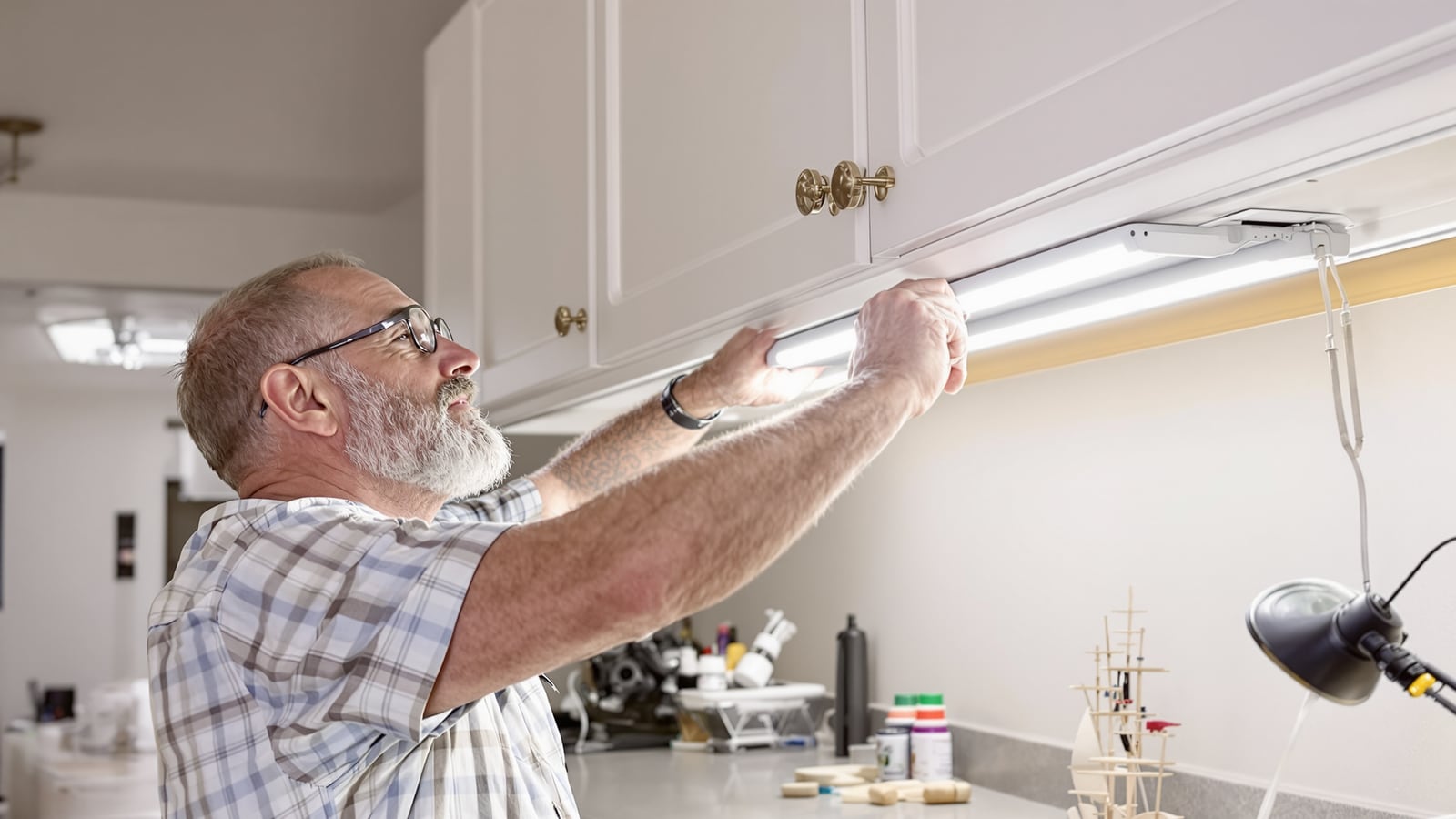
Quick answer: Mount one continuous, diffused LED bar in the front third of the cabinet underside, tucked behind a small lip. Pick 90+ CRI and a neutral-to-cool white. Skip puck lights and skip strips stuck against the wall.
You've seen the bad version. Somebody bolts a row of lights under the wall cabinets, flips the switch, and the backsplash glows like an art gallery. Meanwhile the front six inches of the bench, where your hands actually are, sits in a dim gray band. You lean in to read a drill bit marking and your own head blocks what little light there was.
That's not a brightness problem. It's a geometry problem, and you can't fix it by buying a bigger light.
Why the back-mounted light fails
A light mounted against the wall sits behind your work and shines down and toward you. Three things go wrong at once.
The wall and the back edge of the bench get hammered with light at a steep angle. They look great and do you no good. The front of the bench gets only the leftover spill, at a shallow angle, so every tool, bolt and pencil line throws a long shadow toward you.
And if your bench top is glossy, painted, or covered in a sheet of laminate, the light bounces off it and straight into your eyes. That's glare, and it makes you squint at the exact spot you need to see.
Now move the same light to the front edge of the cabinet. It sits above and slightly ahead of your hands. Light falls on the work at a more natural angle. Shadows land behind the objects instead of in front of them. Glare bounces away from your eyes, toward the wall.
The back wall still gets light. It just gets it at a gentler slant, which is all it needed.
Bar, puck or strip
Three styles dominate the shelves. Only one earns a spot over a workbench.
Linear bars with a diffuser. A rigid bar with a frosted cover spreads light in one continuous line. No bright spots, no gaps, no scallops. This is what you want. Check that the cover is frosted or opaque white, not clear. Clear covers show every individual LED as a hard dot, which reflects off metal as a row of tiny glares.
Puck lights. Each puck throws a circle. Put three or four under a cabinet and you get overlapping bright pools with darker bands between them. Move a piece of stock across the bench and your eyes keep adjusting. Pucks make sense inside a display case. They don't make sense over a place where you're measuring.
Bare LED strips. Cheap, flexible, and easy to install badly. A strip with no diffuser behind a lip can work fine. A strip stuck flat to the underside with the dots in plain view is the glare problem again. If you go this route, buy an aluminum channel with a frosted cover and mount the strip in that. It costs a few dollars more per foot and it's the difference between a work light and a nightclub.
Where, exactly
Mount the bar in the front third of the cabinet's depth, not the dead front edge. If your cabinets have a face frame or a little bottom lip, tuck the bar right behind it. The lip hides the LEDs from your eyes when you're standing at the bench and keeps you from seeing the light source directly.
No lip? Add a strip of thin wood or aluminum angle along the front edge. Ten minutes with a saw and a few screws. You'll be glad you did.
If the bench is deeper than about two feet, or you do detailed work, run a second bar in the back third too. Run it at lower output if the fixture allows. The front bar does the real work. The rear one fills in so nothing at the back sits in shadow.
One honest exception: if you spend most of your time at pegboard hanging tools on the wall and rarely work at the bench itself, a back-mounted bar or strip is fine. You're lighting the wall, so light the wall.
Color matters more than people think
Two numbers on the box decide whether you can trust what you see.
CRI is the color rendering index. It tells you how faithfully the light shows real colors. Get 90 or higher. At lower numbers, a red wire and a brown wire can look like cousins, and wood stain won't match what you see in daylight. Cheap lights often skip printing it. If the box won't tell you, assume it's low.
Color temperature is measured in Kelvin. Warm light around 2700K is lovely in a living room and muddy in a shop. Go for roughly 4000K to 5000K. It reads as clean and neutral, close to daylight, and it keeps fine print and small hardware sharp. If you can find a bar with a switch between temperatures, set it near 4000K and leave it.
Check the lumens too, but read them per foot of fixture, not the total on the front of the box. A long bar with a big total can still be dim where it counts. A longer fixture also helps because it lights the whole length of the bench evenly instead of making a bright patch in the middle.
Power, switching, and the part you'll forget
Hardwired is cleanest, but plug-in bars with a cord and a built-in switch are fine for most garages. Run the cord along the back corner and clip it so it doesn't dangle over the bench.
Put the switch where your hand already goes when you walk in, not at the back of the cabinet. If you want the lights to come on without thinking about it, a motion sensor or a smart plug on a schedule does the job. The smart-home piece on kit that earns its place covers which of those are worth the money and which end up in a drawer.
Dimmable is nice but not necessary. A bar that's too bright is a rare complaint in a shop.
Test it before you drill
Before you commit to screw holes, tape the bar in place for a day. Then run two checks.
The pencil test. Hold a pencil upright near the front edge of the bench. Look at the shadow. It should fall back toward the wall, short and soft. If it stretches toward you, the light is too far back.
The glare test. Put a shiny wrench flat on the bench and look at it from your normal standing spot. If you see a bright streak or the actual bulbs reflected in the steel, raise the lip or move the bar a half inch back.
Fix it, then screw it down.
What to skip
Skip anything that doesn't list CRI. Skip clear covers over bare LEDs. Skip pucks for anything but the display shelf. Skip the three-pack you grab at the register because it's eleven dollars and you'll be back in a month to buy the right thing.
And wipe the diffuser once a season. Sawdust and shop haze dull a bar more than age does. A damp rag and thirty seconds, and the light you paid for is the light you actually get.
You'll know you got it right when you stop noticing the light at all. You just see your work.
Dean Shaw
Gear & Garage
Reads the warranty, the parts list and the long-term owner reviews before anything else. Trucks, tools, watches, and the cheap version that costs more.

Watch
Worth an hour of your evening
More from Gadgets.
From channels we rate. Plays on YouTube.
Read next