The freezer isn't the problem. Your garage is.
Most garage freezers don't die in a bang. They drift warm, ice up, and cost you a deer. Here's how to pick one that holds and keep it that way.
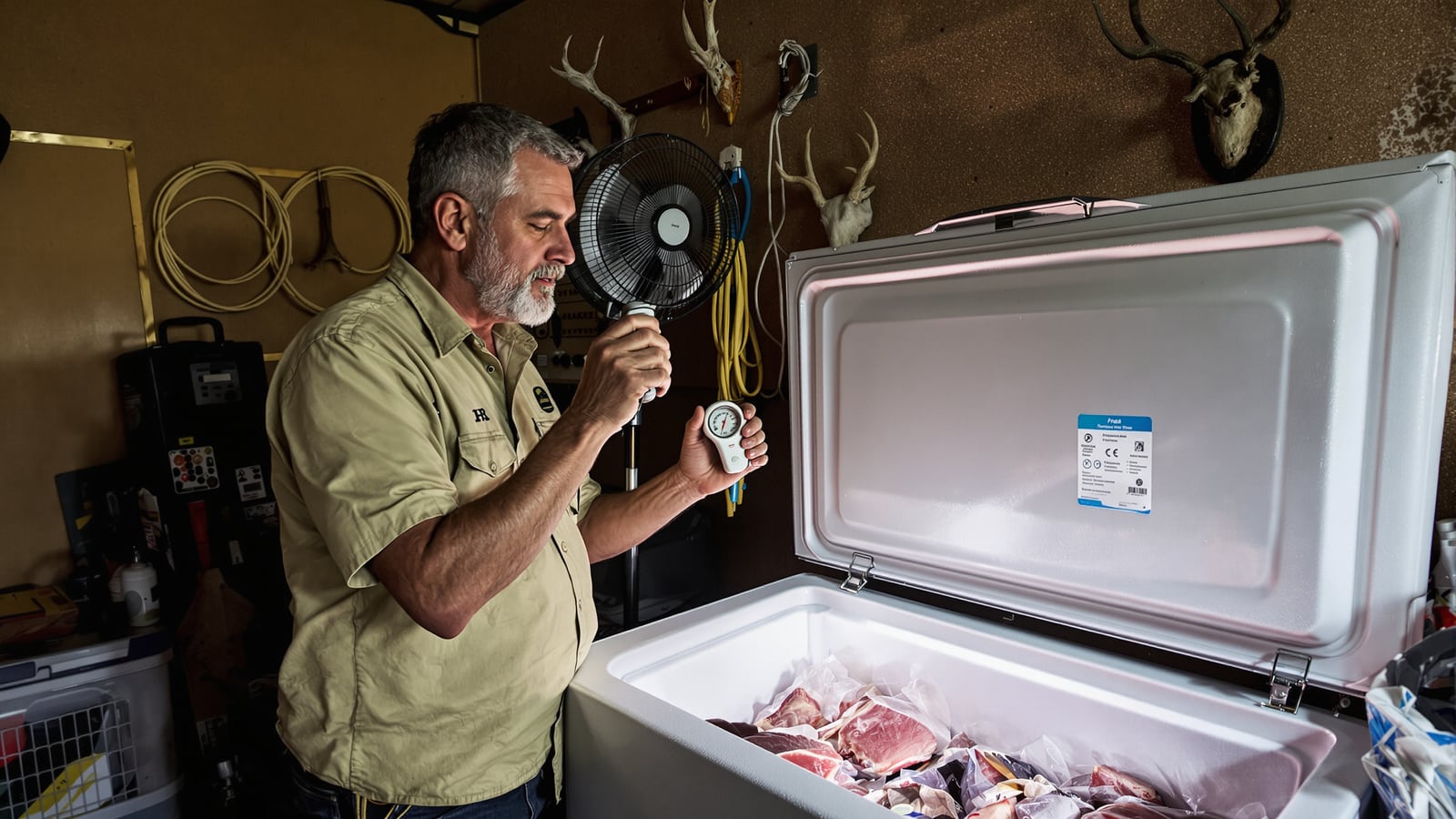
Quick answer: Buy a chest freezer rated for your garage's worst temperatures, keep it full, put a thermometer inside, and check the door seal twice a year. Food stays safe at 0°F. Anything that lets it drift above that without telling you is the real enemy.
The August discovery
Every guy who owns a garage freezer knows somebody with the story. They reach in for a package of venison in late summer and find a tub of cold, gray slush, and a smell that tells them how long it's been that way.
The freezer didn't explode. It just worked a little less well every week until it quit, and nothing in the garage said so.
That's the whole problem. A garage isn't a kitchen. It swings from freezing to well over 100 degrees depending on where you live. It's humid in summer and dusty year round. Most freezers are designed for a climate-controlled room, and the ones that fail in garages are usually the ones that were never meant to be out there.
Check the ambient range first
Plenty of standard freezers list a minimum and maximum room temperature they're built to handle. Find it on the spec sheet or in the manual. Then compare it to your worst January and your worst August, not your average Tuesday.
Look for a model that says garage-ready or lists a range wide enough to cover both. If the seller can't tell you, skip it.
Heat is the quieter killer. In a hot garage the compressor runs almost constantly, and a motor that never rests doesn't last. Cold causes a different failure, mostly in fridge-freezer combos, where the thermostat lives in the fridge side and the freezer warms up while the garage is cold. That's why the old fridge you moved to the garage keeps thawing your ice cream every winter. A dedicated freezer doesn't have that split-brain problem.
Chest or upright
For most men, chest. Here's the honest trade.
Chest freezers
- Cold air sinks, so when you open the lid it mostly stays put.
- They're manual defrost, which means no heater cycling to warm the food a little every few hours.
- They hold cold longer when the power drops.
- The annoying part: you dig. Bottom-layer food gets forgotten, and it takes floor space.
Uprights
- Shelves and drawers make it easy to find things.
- They take less floor area.
- Frost-free models run a defrost heater, which uses more power and can give meat freezer burn over a long stretch.
- Open the door and a lot of cold air spills out onto the floor.
If you're storing a half beef or a season's worth of game for a year, chest wins. If it's mostly frozen pizzas and waffles that turn over monthly, an upright is fine. Fix the digging problem in the chest with two or three stackable baskets and a one-page inventory taped to the lid.
Why it ices up
When a freezer coats itself in frost, it's almost always one of three things.
- Warm, moist air getting in. Every open of the lid lets humid garage air in. That moisture turns to frost on the walls.
- A tired gasket. Close the door on a dollar bill. If it slides out with no resistance, the seal's weak. Try it at several spots around the door. A worn gasket is cheap to replace and it's the best money you'll spend on that freezer.
- Warm food going in. A big batch of still-warm chili raises the inside temperature and throws off a cloud of vapor that freezes onto everything.
When frost on the walls gets to about a quarter inch, defrost. Unplug it, move the food into coolers with ice, and set pans of hot water inside to loosen things. Use a plastic scraper. Never use a knife or an ice pick. One slip through the wall punctures the refrigerant line, and that ends the freezer.
When you're done, wipe it out and leave it cleaner than you found it. Bring the temperature back to 0°F before the food goes back in.
A full freezer is a better freezer
Frozen food holds cold for other frozen food. A packed freezer stays cold longer, runs less, and rides out an outage better than a half-empty one.
The USDA says a full freezer will hold its temperature for about 48 hours with the door shut. A half-full one gets about 24. That's the difference between a weekend storm and a ruined winter.
If you don't have enough food to fill the space, fill it with something else. Water jugs, milk jugs filled three-quarters, or ice packs. They cost nothing and they work as thermal mass. A little air gap around the unit also helps. Leave a few inches clear on the sides and back, and check the manual for the exact number, because the compressor needs to shed heat.
The two cheap things that save the food
A thermometer inside. An appliance thermometer is a few bucks and it tells the truth. Check it when you're in the garage anyway. If it reads above 0°F, find out why that week, not next season.
An alert that reaches you. A Wi-Fi sensor that texts you when the temperature climbs is the best insurance you can buy. It only works if your signal reaches the garage, so before you buy one, read the home internet numbers that matter and test your coverage out there. A sensor that can't connect is a very expensive paperweight. If you're building out other alerts for the house, smart home kit that earns its place covers what's worth the money.
The outlet nobody thinks about
Garage outlets are usually protected by a ground-fault circuit interrupter. That's a safety device, and it's a good one. But it can trip from a power surge or damp conditions, and when it does, the freezer goes quiet and nobody notices. This is how people lose a freezer while they're on vacation.
Check that the outlet's reset button is still in. Don't run the freezer off a thin extension cord. If the outlet trips more than once, ask a licensed electrician about a dedicated circuit. Don't improvise this one yourself.
When the power goes out
Keep the lid shut. Don't open it to check. Throw a blanket over the top if the outage runs long and the garage is hot. Dry ice can help in a longer outage, but handle it with gloves and in a ventilated space.
When power returns, the USDA guidance is simple. If the food still has ice crystals or reads 40°F or below, it can be refrozen. If it has been warm longer than that, throw it out. Quality may drop, but safety comes first. When in doubt, throw it out.
Last thing
A full freezer is one of the oldest forms of self-reliance there is. It's the deer you took in November, the garden beans, the half beef you split with a neighbor. If you've got more than you need, give a package to the family down the street who's having a hard month. That's what a freezer is for.
Then go out to the garage, open the lid, and read the thermometer. If you don't own one, that's tonight's errand.
Dean Shaw
Gear & Garage
Reads the warranty, the parts list and the long-term owner reviews before anything else. Trucks, tools, watches, and the cheap version that costs more.

Watch
Worth an hour of your evening
More from Gadgets.
From channels we rate. Plays on YouTube.
Read next