The garage dehumidifier that stops rust, not just runs
Your dehumidifier hums all summer and the table saw still freckles orange. Here's what separates a unit that dries a garage from one that just makes noise.
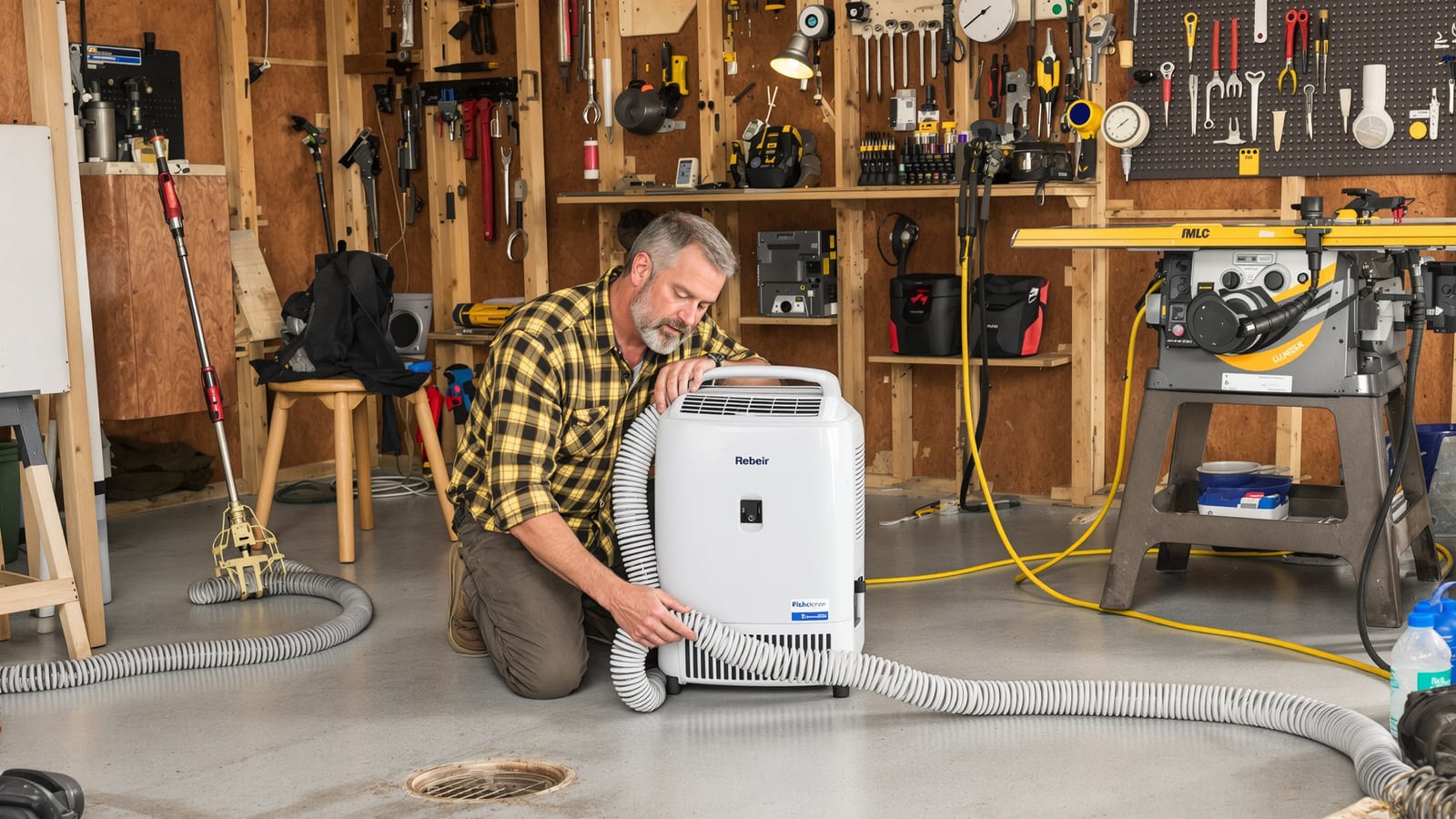
Quick answer: Buy a cheap hygrometer first, because the unit's job is to hold a number, not to run. Then pick a dehumidifier rated for cold, give it a drain hose so the bucket can't shut it off, and seal the garage door so you aren't drying the whole neighborhood.
A man runs a dehumidifier in his two-car garage from May through September. It hums. The bucket fills. By August there's a rust bloom on the cast iron top of his table saw and a pair of pliers has gone the color of a penny.
He did everything he thought he was supposed to do. The machine ran. So what failed?
Usually one of four things. The unit lost its nerve in the cold, the bucket filled and shut it off, the garage leaks humid air faster than the unit can remove it, or nobody ever checked what the humidity actually was. Fix those four and the rust stops.
Measure first, because "running" proves nothing
A dehumidifier that's on tells you the plug works. It doesn't tell you the air is dry.
Get a digital hygrometer. Plenty are sold for a few dollars, and one with a min/max memory is better, because it shows you the worst night, not just the number when you walked out to look. Put it where the tools live, not next to the dehumidifier. The air by the machine is always the driest air in the room.
Steel starts to rust when the air near it stays damp, and most guidance puts the trouble zone above roughly 50 to 60 percent relative humidity. Aim for 45 to 50. Lower than that costs electricity and buys you nothing.
Read the hygrometer for a week before you change anything. If it sits at 70 with the unit running, you've found your problem, and it isn't bad luck.
The cold problem
Most household dehumidifiers are compressor units. They pull air across a cold coil and the water condenses out, same as the glass of iced tea sweating on the porch.
Garages get cold. When the air drops, the coil gets cold enough to frost over, and a frozen coil dries nothing. Cheap units either run uselessly, cycle off, or sit there icing up. Check the manual for the minimum operating temperature. Some stop somewhere in the 40s.
One more trap on the box. Since 2019, the federal test for pint ratings has used 65°F air instead of 80°F. A unit rated under the older method looks bigger on paper than it performs in a cool garage. Compare like with like, and be suspicious of a deal on a "70-pint" unit that's really an old rating on old stock.
You have two honest choices:
- A compressor unit built for low temperatures, with auto-defrost. This is the right answer for most garages that stay above freezing.
- A desiccant unit. It uses an absorbent wheel instead of a cold coil, so it works in freezing weather. The trade-off is that it draws more power and puts out a bit of warmth. For a garage that drops below freezing and holds a workshop, it's worth it. For most, it's overkill.
The bucket problem
Here's how a lot of garage units quietly fail. The bucket fills overnight and the machine stops. Your tools sit in damp air until you come out and dump it. If you travel, or work late, or simply forget, that can be days.
Use the continuous drain. Nearly every unit has a hose port. Run a garden hose from it, downhill, to a floor drain, a utility sink, or out under the door to the driveway. Gravity does the job. Keep the hose from kinking and keep it sloping the whole way.
If there's no downhill, a small condensate pump fixes that. Some units have one built in, and they're worth a little extra if your floor is flat as a pool table.
Skip the bucket-only model for a garage. It's fine for a basement bedroom. It's wrong for a place you visit three times a week.
The leak problem
If the unit runs constantly and the hygrometer doesn't budge, the garage is probably breathing faster than the machine can dry it.
Look at the bottom of the main door. If you can see daylight under it, you're pulling in outside air by the cubic yard. Replace the bottom seal. It's a cheap part and a Saturday morning job. Check the side and top seals too, and the weatherstripping on the service door.
Then size honestly. Manufacturers publish square-footage charts, so check the one for your model against your actual garage. A two-car garage is a lot of air and usually a lot of leakage. Undersized, the unit runs forever and wins nothing. Oversized costs more but cycles off, which is fine if the humidistat does its job.
Habits matter too. A garage door open all afternoon while you work undoes a day of drying. Close it behind you when you can.
If you want the hygrometer on your phone, a Wi-Fi model will send an alert when humidity climbs. Make sure the garage actually gets a signal first. Our piece on the home internet numbers that matter covers the easy fix if it doesn't. And if you're building out sensors anyway, smart home kit that earns its place is a good gut check on what's worth buying.
What we'd buy, what we'd skip
Buy:
- A compressor unit with a low-temperature rating and auto-defrost, if your garage stays above freezing.
- A built-in humidistat you can set to 45 to 50 percent.
- A continuous drain port, with a pump if the floor is flat.
- A washable filter you'll actually wash.
- A separate hygrometer. Never trust the display on the machine alone.
Skip:
- Bucket-only models for a garage.
- A unit with no stated minimum temperature.
- Tiny "cabinet" units for a whole garage. They work in a gun safe or toolbox, not a two-car bay.
- Anything where the rating isn't clear about the test temperature.
The belt-and-suspenders part
A dehumidifier lowers the odds. It doesn't make steel immune.
Put paste wax on bare cast iron surfaces, like a saw table or jointer bed, and buff it. Wipe it again every few months. Rust-inhibiting paper or a few desiccant packs in a toolbox cover the hand tools. Wipe a blade with a light oil after use.
One trick almost everyone misses. Cold steel in warm, damp air collects condensation like a cold can on a summer porch. If a tool has been sitting out in a cold truck, or the garage warms up fast on a spring afternoon, wipe it down before it goes into the drawer. Putting it away wet is how a perfectly dry garage still grows rust.
And clean the filter every month. Dump and rinse anything that holds water. A dehumidifier that smells like a swamp is a dehumidifier that's about to quit.
A good set of tools should pass from you to your son, or your neighbor's kid who's finally learning to build something. A forty-year-old hand plane that's still sharp and bright is one of the best gifts a man can hand down. A box of orange dust is a lesson, but not the one you meant to teach.
Dean Shaw
Gear & Garage
Reads the warranty, the parts list and the long-term owner reviews before anything else. Trucks, tools, watches, and the cheap version that costs more.

Watch
Worth an hour of your evening
More from Gadgets.
From channels we rate. Plays on YouTube.
Read next