What actually makes a boot last a decade
Not the brand and not the leather. It's how the sole is attached, and it's printed on almost nothing.
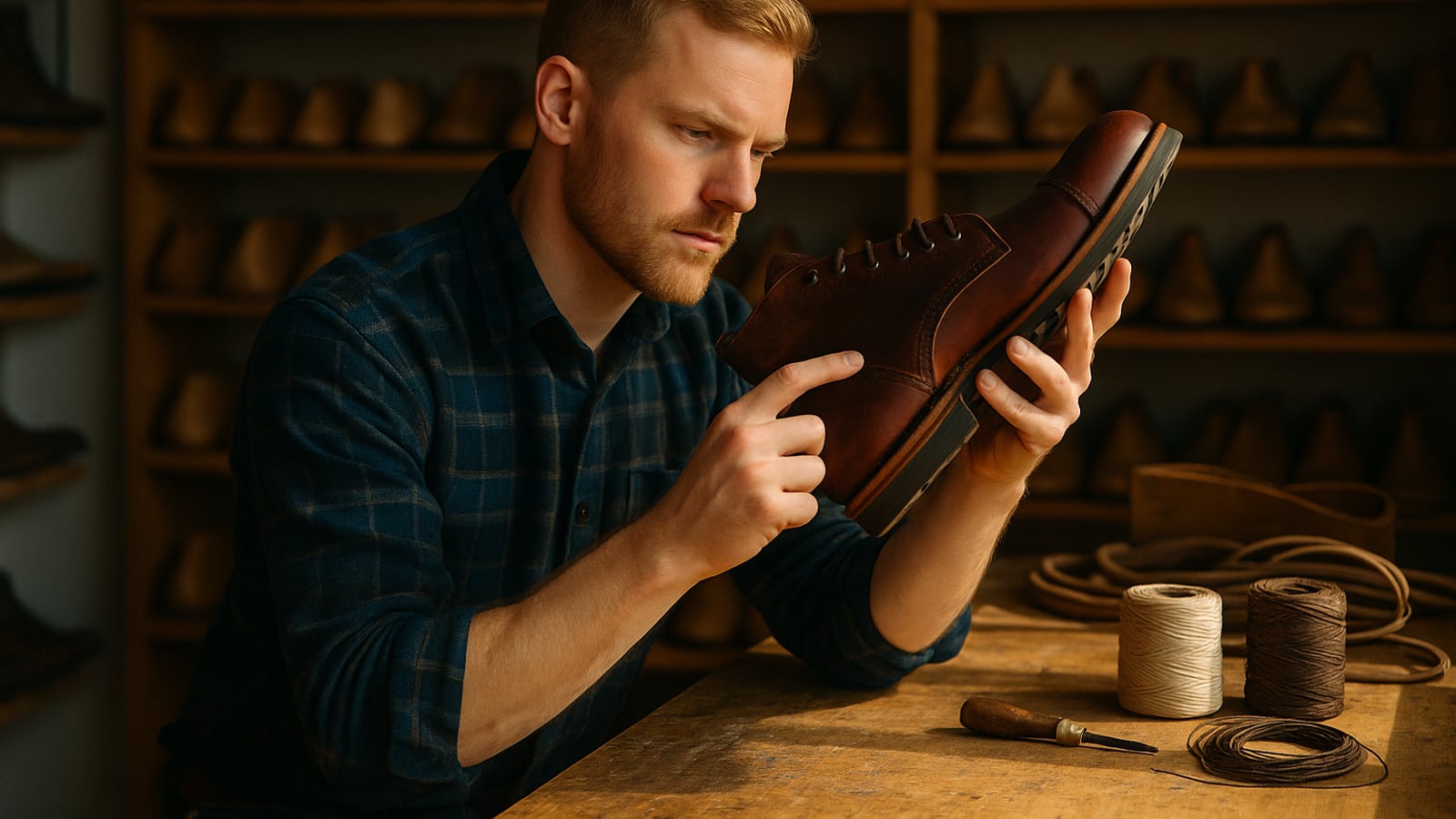
Two boots on a shelf can look identical, cost the same, and one of them is landfill in eighteen months while the other is repairable forever. The difference is the construction, and almost nobody mentions it on the box.
The three constructions
Cemented. The sole is glued on. Cheapest to make, lightest, and fine — until the glue lets go, which it'll, and then the boot is finished. The overwhelming majority of boots sold are cemented.
Goodyear welted. A strip of leather (the welt) is stitched to the upper and the insole, and the outsole is stitched to that welt. A cobbler can cut the outsole stitching and put a new sole on without touching the upper. Done repeatedly, for decades.
Blake stitched. Stitched straight through from insole to outsole. Slimmer and more flexible than welted, still resoleable, but needs a cobbler with the specific machine — fewer have one.
If you want a boot for ten years, you want welted. If you want a boot that looks sharp under trousers, Blake is the better shape.
How to tell in the shop
Turn it over.
Look at the edge where the sole meets the upper. On a welted boot there's a visible line of stitching running around the outside of the sole, set in from the edge. Run a thumbnail across it — you can feel the thread.
No stitching, or fake stitching moulded into the rubber, means cemented. Moulded fake stitching is common and it's worth knowing it exists.
Leather matters less than you think, but
Full-grain is the outer layer of the hide with the grain intact — strongest, develops a patina, and what you want. "Genuine leather" is, counterintuitively, near the bottom of the quality ladder: it's a legal term meaning leather of some kind, usually a split layer with a finish sprayed on.
The hierarchy, roughly: full-grain, then top-grain, then "genuine leather", then bonded (leather dust and glue, avoid entirely).
The maintenance is fifteen minutes a month
- Brush the dirt off. Dried mud pulls moisture out of leather.
- Condition them every month or two — more in winter. Leather is skin, and it cracks when it dries.
- Cedar shoe trees when they're off. This is the underrated one. They absorb sweat and hold the shape, which stops the deep creases across the vamp that eventually split.
- Never dry wet boots on a radiator. It cooks the leather and it'll crack. Stuff them with newspaper and leave them somewhere normal.
- Rotate. A boot needs a day to dry out properly. Wearing the same pair every day roughly halves its life.
The honest arithmetic
A good welted boot costs perhaps three or four times a cheap one, and resoling costs roughly what a cheap pair costs.
Over ten years: the cheap boot, replaced every eighteen months, works out considerably more expensive — and you spend a fortnight breaking in a new pair every time.
That said: if you're hard on boots in a way that destroys the upper — chemicals, heat, genuine abuse — the resoleability is worth nothing, and the cheap ones are the right answer. Know which you're.
BRO earns commission on some links. It doesn't affect what we recommend.
Dean Shaw
Gear & Garage
Tests things until they break, then reports what broke first. Trucks, tools, watches, and the cheap version that costs more.

Watch
Worth an hour of your evening
More from Gear.
From channels we rate. Plays on YouTube.
Marques Brownlee22 Sept
The Apple Watch Has a Problem
Marques Brownlee16 Sept
iPhone 18 Pro Review: All About that Chip
Marques Brownlee12 Sept
iPhone Duo: What We Missed!
Read next