The cheap earplugs beat the expensive muffs you didn't wear
Foam plugs cost pennies and outperform most muffs if you roll them right. Everything else in the hearing and eye protection aisle is about whether you'll actually use it.
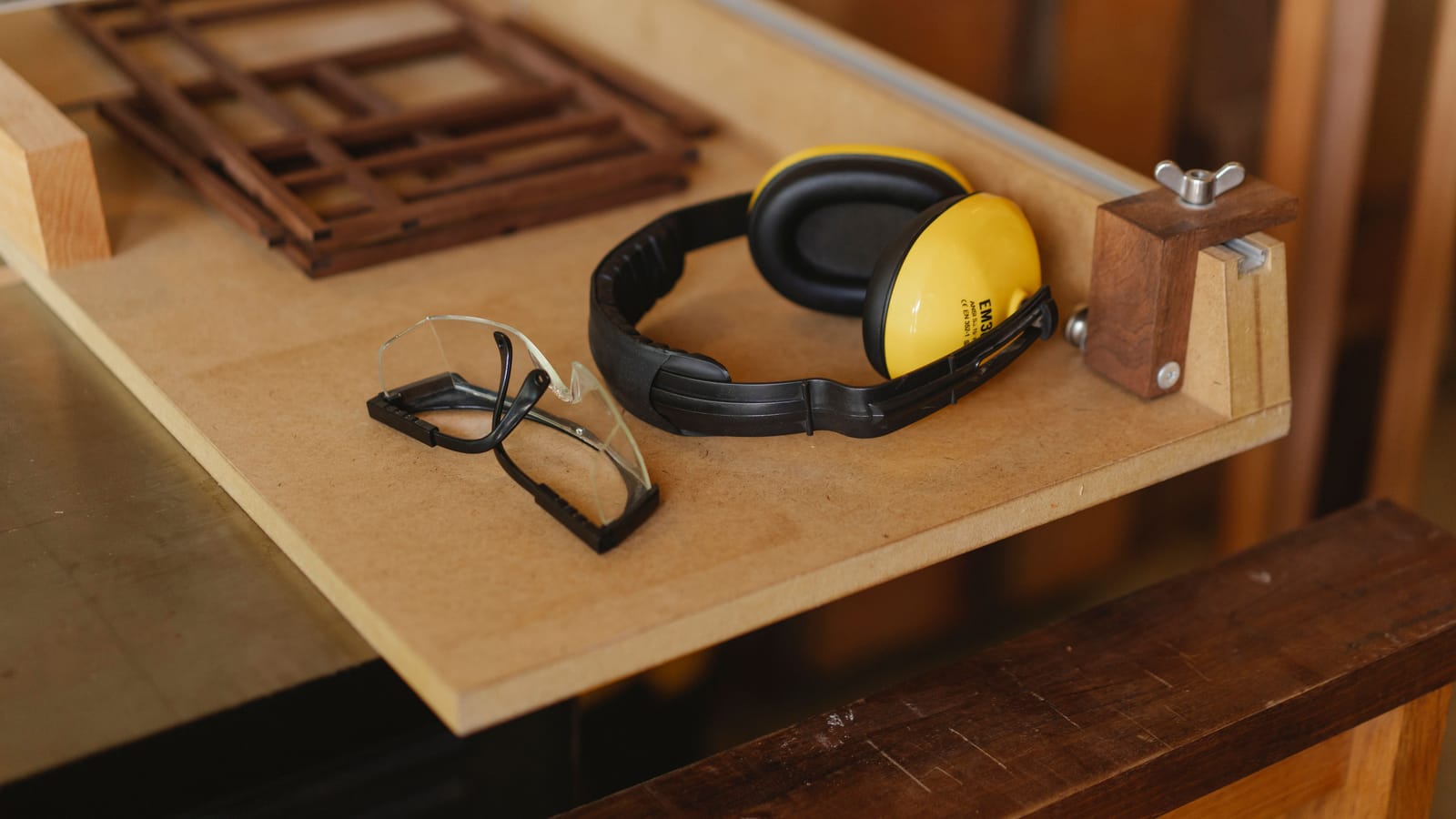
A pair of foam earplugs costs less than a stick of gum, and rolled down properly they'll shut out more noise than the fifty-dollar muffs sitting on your workbench. That's the whole argument in one sentence. The best protection is the protection you have on your head at the moment the compressor kicks on, and foam is cheap enough to stash in every toolbox, every truck console, every range bag, every coat pocket.
Buy them by the two-hundred-pair tub. The 3M E-A-Rsoft yellow ones are the default for a reason. They compress small, they expand slow, they seal in almost any ear canal. A tub runs less than a tank of gas and will outlast the project.
The catch is that almost nobody inserts them correctly, and a badly seated plug is theater.
Roll, pull, hold
Roll the plug between your fingers until it's a thin cylinder. Not a squished lump. A cylinder. Then reach over your head with the opposite hand, pull your ear up and back to straighten the canal, and push the plug in deep. Hold it with your fingertip for twenty seconds while it expands.
You'll know it worked because your own voice goes muffled and boomy in your skull. If you can still hear the shop radio clearly, pull it out and do it again. Second attempt, every time, until it becomes automatic.
That twenty seconds of holding is the step everybody skips. It's also the step that makes the difference between real attenuation and a piece of yellow foam decorating your ear.
NRR is a laboratory number, not a promise
Every package lists a Noise Reduction Rating. Foam plugs typically claim 32 or 33 decibels. Muffs land somewhere between 22 and 31. Those figures come from controlled lab testing with trained subjects and perfect fits, which isn't what's happening in your garage at 9 p.m.
OSHA tells employers to knock half the rating off when estimating real-world protection. NIOSH goes further and derates by product type, cutting formable foam plugs by half and muffs by a quarter. The honest read on a 33 NRR foam plug is that you're getting something in the high teens on a good day.
That matters because gunfire isn't ordinary loud. A rifle shot clears 160 decibels at the muzzle. Even a .22 pushes past 140. Hearing damage from impulse noise isn't a slow accumulation you can feel happening. One unprotected shot indoors can leave you with ringing that never fully leaves.
Nobody repairs that. There's no rebuild kit for a cochlea. If your ears already ring at night, go get a baseline hearing test from an audiologist and stop guessing.
Where the muff earns its money
Muffs win on convenience, and convenience is protection. You can throw them on in two seconds to run the miter saw for one cut, and you'll actually do it, where you'd have skipped the plugs.
They also win in cold weather, when foam turns stiff and stubborn, and on jobs where your hands are filthy and you don't want to put your fingers in your ears.
For an indoor range, wear both. Plugs under muffs. You don't add the two ratings together, but you do get meaningfully more than either alone, and indoor concrete bays are brutal in a way outdoor lanes aren't. Anyone who's watched a brake in an enclosed bay knows.
Passive muffs from Howard Leight, Peltor or Walker's in the twenty to thirty dollar range are honest products. The expensive passive muff is mostly buying you a slimmer cup and a nicer headband.
The one upgrade worth paying for
Electronic muffs. Around fifty dollars gets you a set that amplifies normal conversation and clamps down the instant a shot goes off. The Howard Leight Impact Sport and the Walker's Razor are the two that live in most range bags in America.
Why they're worth it: you can hear the range officer, hear your kid asking a question, hear the guy walking up behind you. With passive muffs, people lift a cup to talk. That lifted cup is when the guy two lanes over touches off a magnum.
Under a hundred dollars, you get slim cups that work with a rifle stock and batteries that last a season of casual shooting. Over a hundred, you're paying for better sound quality, gel cups, and Bluetooth. Real, but not necessary.
Cheap electronics fail in one specific way: the amplification hisses, and the cutoff has a lag you can hear. Annoying. Not dangerous.
Z87+ or it's just sunglasses
Eye protection has one marking that matters, and it's printed small on the lens and the frame. Z87+ means the lens passed ANSI's high-velocity impact test. Plain Z87 without the plus passed only the basic drop test. No marking at all means somebody's fashion sunglasses are standing between your retina and a piece of hot steel.
Look at the temple arm right now on whatever's in your shop drawer. If there's no Z87, throw it out.
For anything involving a firearm, step up to glasses built to the military ballistic spec, MIL-PRF-32432. ESS Crossbows and Oakley M Frames sit in that range, usually sixty to eighty dollars, and the difference is fragment resistance rather than a bigger impact number.
The five-dollar safety glasses are genuinely fine
This is the spot where cheap wins outright. A Z87+ rated pair from Pyramex, Dewalt or 3M costs five to ten dollars. Buy six pairs. Put one in the truck, one by the lathe, one in the lawn mower shed, one in the kitchen junk drawer, two spare.
Scattered cheap glasses beat one nice pair you have to go find. Every eye injury story I've heard starts with "it was one quick cut."
What you give up at that price is clarity and coating. Cheap lenses scratch fast, and cheap anti-fog is worthless in twenty minutes. Spending twenty-five dollars on a pair with a real anti-fog treatment is a legitimate upgrade if you work hot, wear a respirator, or move between a cold garage and a warm house.
If you wear prescription glasses, get proper OTG frames. Perching safety glasses on top of your regular ones is how the seal breaks and how the arms dig into your temples until you take both off.
The face shield people skip
A grinder throws a cone of sparks and, occasionally, a piece of the wheel. Glasses protect your eyes. They don't protect your face, and they don't stop something coming in from underneath.
Get a shield. Wear the glasses underneath it, always. The shield is a splash and spall barrier, not impact protection on its own, and no shield manufacturer claims otherwise.
Set the bin by the door
Here's what changes behavior more than any product: a bin at the shop entrance with plugs, spare glasses and one set of muffs for whoever shows up. Nephews, neighbors, your wife coming out to see what you're building.
Kids need their own smaller muffs, and they need them before they start asking. A child's first trip to the range shouldn't include the moment where he learns what a flinch is.
Hand somebody protection at the door and they wear it. Ask them if they want some and half of them say no.
The tub of foam plugs has been sitting in my shop for three years. Roughly a hundred pairs left. Best money I've spent on gear that isn't a tool.
Wes Dunbar
Country & Skills
Grew up on an acreage and never quite left. Covers trucks, trades, land, and how to do the thing yourself.

Watch
Watch how it's done
Picked for this article.
From channels we rate. Plays on YouTube.
Doctor Cliff, AuD
How to use FOAM Hearing Protection and Ear Plugs - Proper Insertion Technique
National Institutes of Health (NIH)
Hearing Protection: How to Use Formable Earplugs
Read next