

Fat iron shots start before you ever swing
You hit the ground first and blame your head. The real cause is usually at address, and three quick checks will find it.
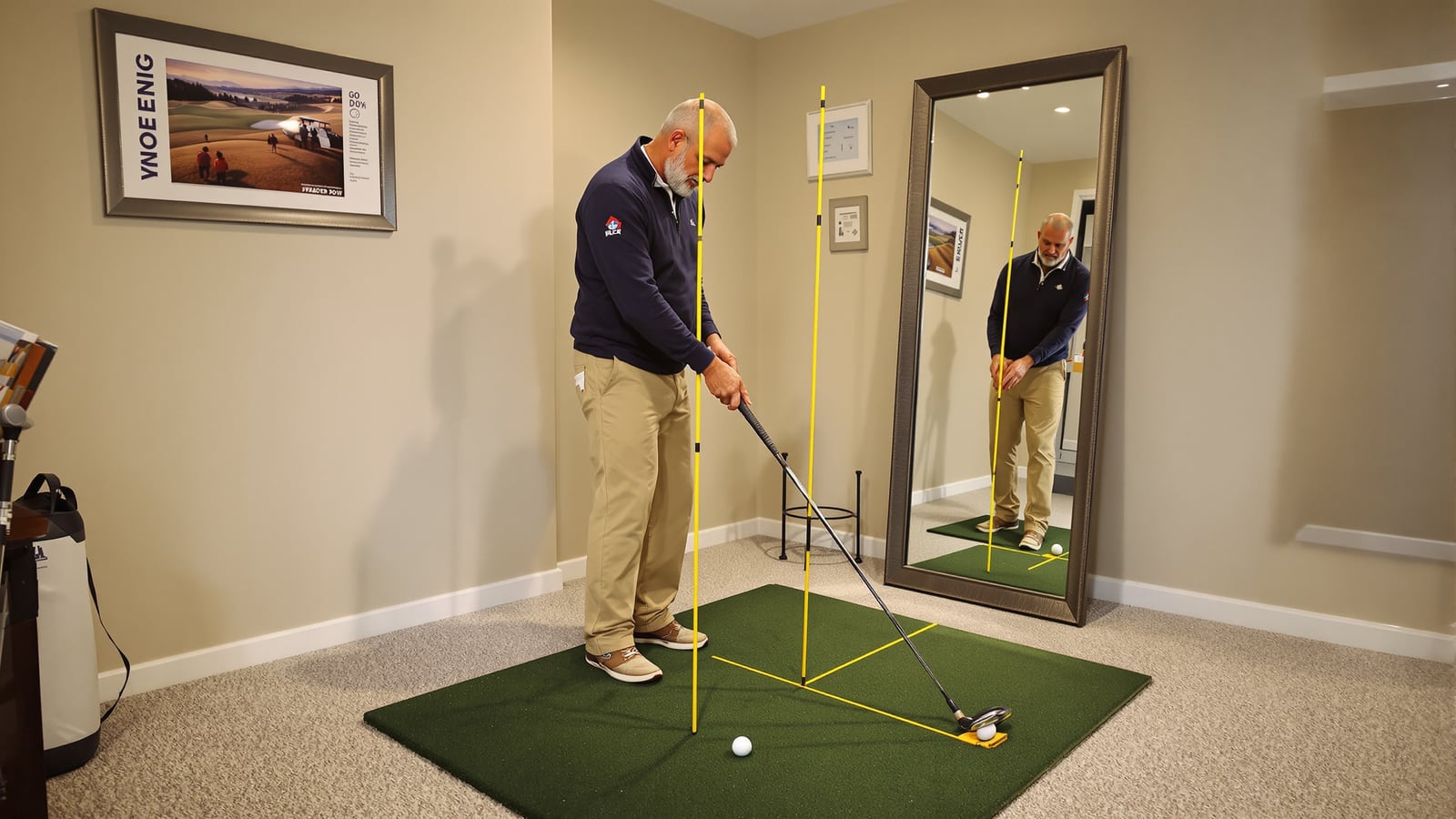
Quick answer: A fat shot means the club bottoms out behind the ball. Three setup faults put it there: the ball is too far forward, your weight is hanging back, or your hands are behind the ball. Each takes about a minute to check.
You've got 145 yards to a flat green, a clean lie, and a 7-iron. The ball goes 90 yards and the divot looks like a dinner plate. So you tell yourself you lifted your head.
Probably not. The mistake was made before the club moved.
Find the low point first
Every swing has a lowest spot, the place where the club bottoms out. With an iron off the fairway you want that spot a few inches in front of the ball, so the club hits the ball and then the turf. If it sits behind the ball, you hit dirt first and the ball dribbles forward.
Your setup picks that spot far more than any swing thought does.
Start with a simple test. Hit five 7-irons off real grass and look at where each divot begins. If it starts behind the ball, or you can't tell where the ball was, you're fat. If it starts at the ball and runs forward, you're doing it right. A shallow divot just past where the ball sat is what you want to see.
Mistake one: the ball is too far forward
Most weekend golfers play every iron off the lead heel, because that's where the driver goes. It's the right spot for a driver. It's wrong for a 7-iron.
For wedges and short irons, play the ball in the middle of your stance. For a mid-iron, the middle or one ball width forward. Hybrids and fairway woods creep forward from there, and only the driver lives off the lead heel.
The drill: Take your normal stance with no ball. Lay a club on the ground at a right angle to your target line, running straight out from your belt buckle. That's the center. Put your 9-iron and wedge balls on that line. Put your 7-iron one ball width ahead of it. Hit ten and watch the divots.
One concession. If you overcorrect and go behind center with a mid-iron, you'll start hitting low, hooking pulls. The goal is center to slightly forward, not hiding the ball by your back foot.
Mistake two: your weight is on your back foot
This one feels natural, which is the problem. You want the ball in the air, so you lean back and scoop. Standing with 60 percent of your weight on your trail side and your chest behind the ball moves the low point backward with you.
The loft on the club gets the ball airborne. You don't have to.
At address with an iron, your weight should favor the lead foot slightly, around 55 percent, with your breastbone roughly over the ball. Don't hunt for a perfect number. You just shouldn't feel like you're sitting in a chair.
The drill: Start with your feet together and the ball in front of you. Make a short backswing, and as the club starts down, step your lead foot out to shoulder width and swing through. You'll feel your weight move forward by itself. Do it ten times, then hit five shots from a normal stance and try to keep the same feeling in your lead foot.
It looks silly. It also works, and nobody at the range will remember it.
Mistake three: your hands are behind the ball
Look at a photo of yourself at address. If the grip end is even with the ball, or behind it, the club has to travel up and then drop in, so the sole slaps the ground before the face meets the ball.
With a 7-iron the shaft should lean a little toward the target, with the butt of the grip pointing at your lead thigh. Your hands sit a couple of inches ahead of the ball. That small forward lean makes the club arrive on a descending path.
Don't overdo it. Push your hands far ahead and you'll de-loft the club, close the face, and start hooking it low. A slight lean is the whole move.
The check: Prop your phone against your bag, facing you, and film one address position. Pause it. Draw a line down the shaft in your mind. Does it point at your lead thigh, or at your belt buckle or beyond? Adjust and film again. It takes two minutes, and it shows you what the mirror can't.
Put it together with a line in the grass
The fastest feedback is a line. On the range, draw one across the turf with a tee or the edge of a club, perpendicular to the target. Set the ball on it. Now your goal is simple: the divot starts on the line or in front of it, never behind.
Run ten balls through this checklist:
- Ball position: center for wedges, one ball forward for a 7-iron
- Weight: slightly favoring the lead foot, chest over the ball
- Hands: slightly ahead, grip end at the lead thigh
- Divot: starts at the line or just after
Fix one fault at a time. If you change all three in the same bucket of balls, you'll lose track of what worked.
It's also worth admitting that a bad setup isn't always the cause. A wet fairway, a tight lie on hardpan, or a swing that's lunging at the ball can all produce fat shots too. But a bad setup is the cheapest thing to fix and the first thing to rule out. If you're working toward the number on your scorecard, The Five Changes That Get You Under 100 puts this kind of fix in context. And if the same chunky contact shows up around the green, The Chunk and the Skull Are the Same Bad Chip covers the short-game version.
Replace the divot
Once you start hitting the ball first and the turf second, you'll be taking divots, which means you owe the course something. Pick up the piece of turf, set it back in the hole, and press it down with your foot. If it shattered, use the sand-and-seed mix on your cart, if there is one. Leave the fairway better than you found it. What Nobody Tells Beginners About Pace, Silence and Pitch Marks covers the rest of the housekeeping.
The first time the divot starts in front of the ball, the shot feels strange. It feels like nothing. Almost no effort, and the ball just goes.
That's the feeling you were chasing the whole time.
Dean Shaw
Gear & Garage
Reads the warranty, the parts list and the long-term owner reviews before anything else. Trucks, tools, watches, and the cheap version that costs more.

Watch
Worth an hour of your evening
More from Golf.
From channels we rate. Plays on YouTube.
Read next