

Shorten your backswing until the club stops fighting you
Most weekend golfers swing back farther than they can control. Cut it to three-quarters and watch the mishits shrink.
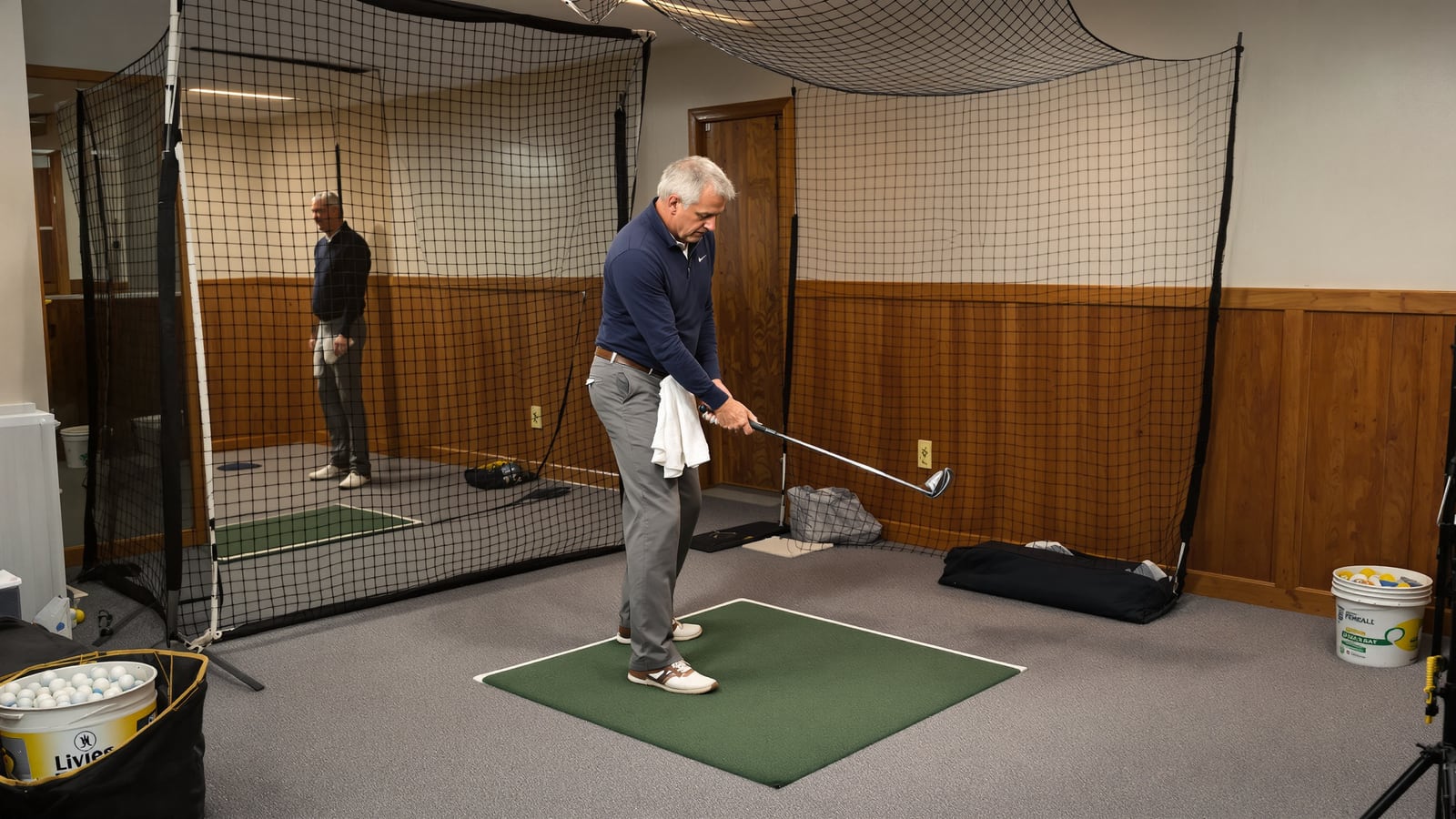
Quick answer: For most players shooting 95 to 105, the best backswing ends when your lead arm is about parallel to the ground and your hands are near shoulder height. Past that point you're adding length you can't control, and the club only gets farther from the ball at impact.
Watch the next guy on the range who's hitting driver. At the top of his swing the shaft dips past parallel and points somewhere behind the target line, toward the parking lot. His lead elbow has folded. His grip has loosened. And then he has about a quarter of a second to find the ball from there.
He usually doesn't. He gets one pure one out of every six, remembers it, and spends the other five wondering what went wrong.
What went wrong is the backswing. Not its shape, its length.
Why longer feels better and plays worse
A big backswing feels powerful. It looks like what you see on TV. But the pros you're copying have flexibility, years of reps and a downswing sequence that's been grooved a hundred thousand times. Their long backswing is a product of a controlled body, not a cause of good golf.
You, on a Saturday, have a body that's sat in a chair all week. When you try to take the club back as far as a tour player, the extra distance doesn't come from your shoulders turning. It comes from your arms lifting and your lead elbow bending. That's the stuff that wrecks contact.
The longer the club travels, the more things have to happen in the right order on the way down. A shorter swing has fewer moving parts to get wrong. That's the whole argument.
And contact is where your strokes are. Moving from a thin shot to a solid one is worth more than any ten extra yards of carry. If you're working toward breaking 100, the five changes that get you under 100 are mostly about this kind of boring consistency.
What three-quarters looks like
Right-handed, with a 7 iron, here are the positions to know:
- Full: The club is roughly parallel to the ground at the top, pointing at the target.
- Three-quarter: Your lead arm is parallel to the ground or a touch higher. Your hands sit around shoulder height. The clubhead points up toward the sky, short of parallel.
- Past parallel: The shaft drops and aims behind the target. Stop. That's the one to fix.
Your shoulders should turn well past your hips in all three. The length comes from the turn, not from the arms reaching.
Three drills that fix it
1. The pause test. Prop your phone down the line, behind you and level with your hands. Make a normal swing and freeze at the top for a full second. Check the video. Where does the club point? If it's past parallel, that's your number. Repeat until your normal swing stops short of it without trying.
2. Nine to three. Picture a clock face with you in the middle. Take the club back until your lead arm points at nine o'clock, then swing through to three o'clock on the other side. Hit twenty 7-irons that way. They'll look small. They'll also fly straight, and they'll surprise you.
Then add a little. Ten o'clock back, two o'clock through. Stop adding the moment your contact slips. That's your real length.
3. The ten-and-ten test. Hit ten balls with your regular swing and ten with your shortened one. Don't count distance. Count how many you'd be happy to have on a real fairway. For most players the shorter swing wins that count, and it's not close.
The driver is where it hurts most
The driver is the longest club in your bag, so it's the easiest to overswing. A 45-inch shaft that you're trying to whip past parallel is a recipe for a slice, or a hook, or a pop-up.
Try choking down an inch. It shortens the club and your backswing along with it, and most players find they hit the center of the face more often. You lose a little distance. You gain a lot of fairways.
If you're fighting the driver specifically, check the shaft length and weight with a fitter before you buy anything new. A shaft that's too long and too light will invite exactly this swing.
When you shouldn't shorten it
There are exceptions.
Some players have naturally slow, smooth tempos and a long swing they control. If your contact is good and your shots go where you aim them, leave it alone. This advice is for the rest of us.
And if your backswing is short because you can't turn your shoulders, don't chase length by lifting your arms. That makes the swing longer without making it better. Work on mobility instead, and a PGA teaching professional can tell you what your body can actually do. That's an individual call and a pro should make it.
What it fixes downstream
A shorter backswing helps in places you might not expect.
It tends to slow your transition. A swing that feels like it's racing to the ball from the top is usually a swing that went back too far and is now trying to catch up. Shortening it gives your body time to start the downswing in order.
It also cleans up short-game contact. If you're fighting the fat and thin chips, the chunk and the skull are the same bad chip, and the cure there's also less motion, not more. Same principle, smaller scale.
And when you're hitting it more solidly, the ball you play starts to matter a little more. Once you're consistent, it's worth reading the golf ball you should be playing if you shoot 95.
Make it stick
You'll feel like you're cheating the first week. The swing will look too short, especially next to a buddy who's taking the club back to his shoulder blades. Ignore him. Watch where his ball goes.
Give it three range sessions with the nine-to-three drill before you judge it. Warm up with it before every round, five or six swings, so your first tee shot doesn't revert to the old habit with a crowd standing behind you.
The scorecard doesn't have a column for how far back you took it.
Dean Shaw
Gear & Garage
Reads the warranty, the parts list and the long-term owner reviews before anything else. Trucks, tools, watches, and the cheap version that costs more.

Watch
Worth an hour of your evening
More from Golf.
From channels we rate. Plays on YouTube.