

Stop Perfecting Your Pitch and Learn Three Distances
From 100 yards in, a swing that goes the right distance beats a pretty one that doesn't. Build three lengths, learn your numbers, and stop guessing.
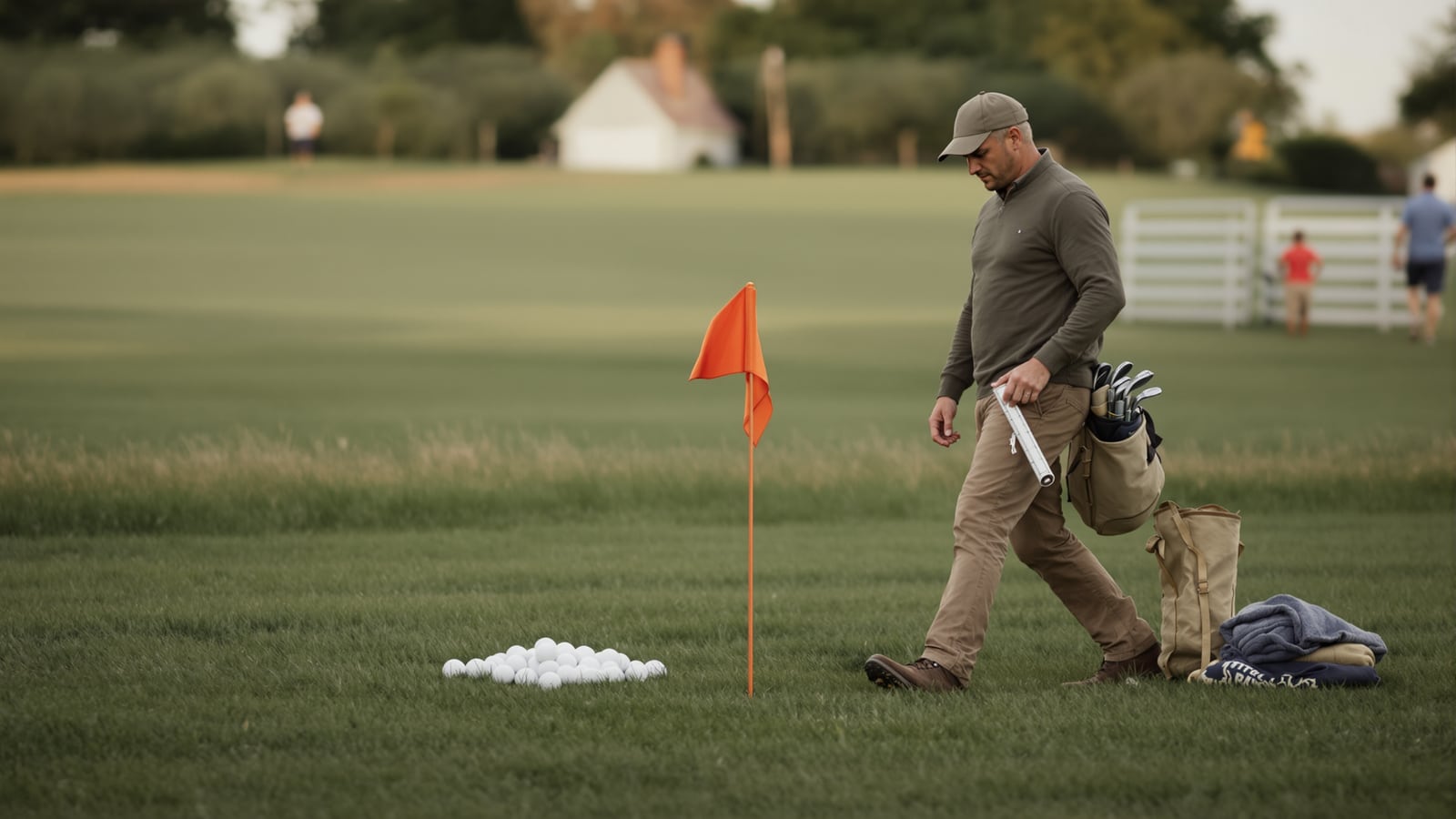
Quick answer: Pick three backswing lengths (hip-high, belt-high, chest-high) and keep the same tempo for all of them. Learn how far each one carries with each wedge. Then stop guessing on the course.
You're 78 yards out. The pin's tucked back right, and the front of the green is guarded by a bunker the size of a swimming pool. You pull the sand wedge, take a swing that feels about right, and get scared halfway down. You decelerate. The club bottoms out two inches behind the ball and the shot dribbles into the sand.
Your technique wasn't the problem. You'd never decided how far that swing was supposed to go.
You own one swing and ten situations
Most weekend golfers have a full swing and a "feel" swing. The full swing goes a known distance. The feel swing goes wherever it goes, and the distance changes with your mood, your lie and how badly you want to be close.
That's why the pitch shot costs so many strokes between 100 and 40 yards. You're not bad at it. You're improvising it, every time, with a club that has a very strict opinion about contact.
A tour player can rely on touch because he's hit a hundred thousand of these. You've got a Saturday round and a half-hour on Wednesday. So replace touch with a system.
Build three swings
Think of your lead arm as the hand of a clock, with you at the center.
- Hip-high. Your lead arm points at about 7:30. Hands reach roughly pocket height. This is your short pitch.
- Belt-high. Lead arm at about 9:00, parallel to the ground. This is your middle pitch.
- Chest-high. Lead arm at about 10:30. This is the longest swing you'll use without it turning into a full swing.
Three rules make it work.
- Same tempo every time. The backswing gets longer. The rhythm doesn't speed up.
- Finish matches the backswing. Hip-high back means hip-high through. If the follow-through is shorter than the backswing, you're decelerating, and that's the chunk.
- Never try to hit it harder. If a swing is too short for the shot, move up to the next length. Don't muscle it.
Then stay with it. A pitch that's one length of swing, one club and one tempo gives you a repeatable distance. Your technique can look a little ugly and it'll still work.
Find your numbers
Go to the range or the practice area with one wedge and ten balls. Hit ten shots with the hip-high swing. Note where each one lands, not where it stops. Throw out the best and the worst. The middle of what's left is your carry for that swing with that club.
Do the same for belt-high and chest-high. Write the three numbers on a card or in your phone. Then repeat with your next wedge.
Yours will differ from anyone else's. Maybe your sand wedge carries 30, 50 and 70 yards. Maybe it's 25, 40 and 60. Neither is wrong. What matters is that you know them.
Carry matters more than total distance because the green changes the roll. A 50-yard carry into the front of a soft green stops fast. The same carry onto a firm, sloping one runs out another ten or fifteen yards. Know the carry, then read the ground.
The towel drill
Bring a towel to practice. Lay it flat on the turf at the distance of one of your carry numbers, say 50 yards. Hit ten balls with the belt-high swing and count how many land on the towel or within a club length of it.
Don't judge it against a tour pro. Judge it against last week. If you got three of ten, aim for four. When you're hitting five or six, move the towel to a new distance and use a different swing length.
A few rules that keep the drill honest:
- Hit all ten with the same club and the same swing. No tweaking in the middle.
- Don't rake over your mistakes with a second ball. Move on.
- Finish the drill with a few balls to a number you haven't practiced. Pick a random distance, decide which swing fits, and see how close you get. That's the real course test.
Twenty minutes of that beats an hour of beating balls at nothing in particular.
The gear question
Look at the loft stamped on your wedges. A lot of modern pitching wedges are quite strong, which puts them in the mid-40s of degrees. A sand wedge is usually 54 to 56. If you've got a big hole between them, you've got a distance you can't cover cleanly.
The fix is a gap wedge, usually around 50 degrees. Space your wedges roughly four to six degrees apart and the gaps close up. Carrying three wedges and learning three swings each gives you nine distances. That's plenty.
A few honest notes:
- Skip the 60-degree for now. It's a precision tool for a golfer who already strikes the ball cleanly. For most of us it turns a bad pitch into a worse one.
- Check your grooves. Worn wedges lose spin and consistency. If yours are old and shiny, a new one will help more than a new driver.
- Buy the loft you need, not the name you like. A used wedge in the right loft beats a new one in the wrong one.
If your ball flies off the face thin or sticks in the turf, fix contact first. Distance control assumes you can hit the ball. And if you're still working on the bigger picture, the five changes that get you under 100 put pitching in context.
On the course
Pick a landing spot, not the flag. Look at the green and decide where the ball should hit. Then choose the club and swing that carry to that spot. The ball finishes wherever the rest of the shot takes it.
Aim for the fat part of the green. Missing 15 feet from the middle is a fine result. Missing 15 feet short-sided in the bunker is a double bogey.
And if you're not sure between two swings, take the longer one with the shorter club. A smooth chest-high pitch beats a nervous belt-high one every time.
Leave the place better than you found it. Rake the bunker you dug up, and repair your pitch mark and one more besides. Nobody tells beginners about this stuff, but the groundskeepers notice and so do your playing partners.
Where this advice breaks down
Technique does matter. If you can't make clean contact, no swing system will save you. And in tight lies, deep rough or wet sand you'll need a different shot than your three standard pitches.
But most weekend golfers aren't losing strokes to a flawed wedge swing. They're losing them to not knowing how far it goes. Fix that and the rest tends to sort itself out.
Next Saturday, you're 78 yards out with the bunker in front. You know your belt-high sand wedge carries 55. You pick a spot 60 yards away and swing at one tempo. The ball lands soft, rolls out and stops 15 feet from the pin.
That's a par putt. Write the numbers down.
Dean Shaw
Gear & Garage
Reads the warranty, the parts list and the long-term owner reviews before anything else. Trucks, tools, watches, and the cheap version that costs more.

Watch
Worth an hour of your evening
More from Golf.
From channels we rate. Plays on YouTube.