

Samuel Morse Didn't Invent the Telegraph. He Made It Work.
A portrait painter with no electrical training spent six years begging Congress for $30,000. The wire he strung changed how fast a nation could think.
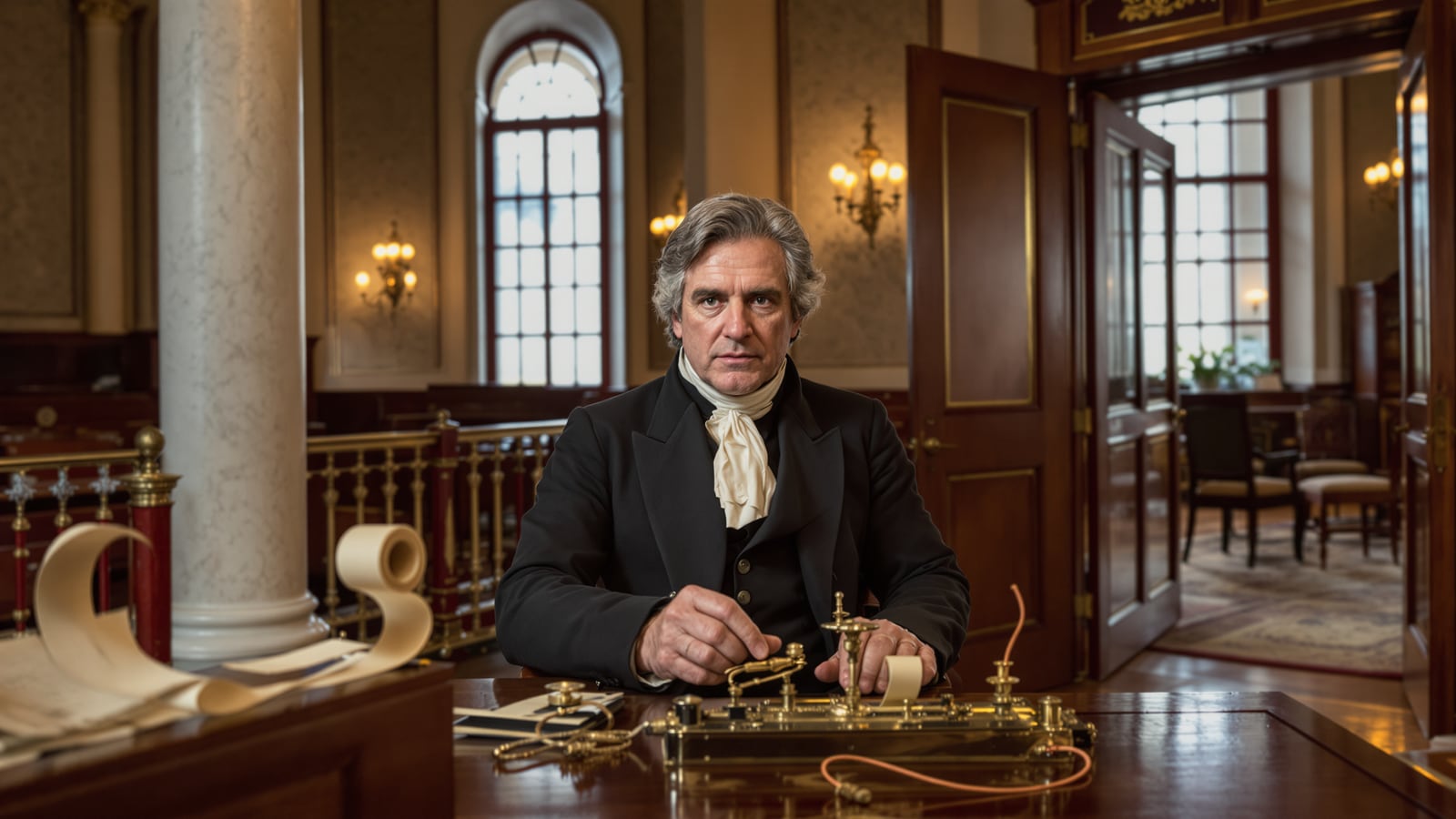
On May 24, 1844, a man sat in a room in the Capitol with a wire running out the door and forty miles down the line to Baltimore. He tapped out a short message. A few seconds later his partner in Baltimore tapped it back.
The message was "What hath God wrought." Annie Ellsworth picked it. She was the young daughter of the Patent Commissioner and the one who'd brought Samuel Morse the news a year earlier that Congress had finally paid up. He'd promised her the honor of the first words. He kept his promise.
Morse was fifty-two. He was a painter.
The man who wasn't an electrician
Morse was born in Charlestown, Massachusetts, in 1791, and went to Yale. His real ambition was art. He studied in London, came home, and spent years painting portraits and grand historical canvases that didn't sell the way he needed. In 1826 he helped found the National Academy of Design and became its first president.
Then came the worst week of his life. In February 1825 he was in Washington painting the Marquis de Lafayette when a letter reached him saying his wife, Lucretia, was gravely ill. By the time he got back to New Haven, she was already buried. She was twenty-five.
Seven years later, in 1832, he was crossing the Atlantic on the packet ship Sully, coming home from Europe. A fellow passenger talked about electromagnets and how electricity could pass instantly over any length of wire. Morse, who knew little about it, started sketching in his notebook. He was forty-one and nearly broke. He had no training in the field, and nobody was asking him for a telegraph.
What he didn't invent
Say this plainly, because Morse himself sometimes didn't. Electric telegraphs already existed. Gauss and Weber had one running in Göttingen in 1833. Cooke and Wheatstone were patenting theirs in England in 1837. And an American, Joseph Henry, had shown in 1831 that an electromagnet could ring a bell over a mile of wire. Henry's work on electromagnets and relays is part of the foundation under Morse's whole system.
Henry felt Morse never gave him enough credit. He had a point.
So what did Morse do? He built a system that worked in a country that needed one. And he refused to let it die.
The partner and the code
Morse's early design was clumsy. His first code assigned numbers to words, so an operator would need a dictionary to send a sentence. The recording device was a pencil on a moving strip of paper.
What rescued it was other people. Leonard Gale, a chemistry professor at New York University, helped him fix the weak signal over distance. And in 1837, Alfred Vail, a young man whose family ran the Speedwell Ironworks in Morristown, New Jersey, put up money and shop space and did serious machine work.
The letter-by-letter code came out of Morse and Vail working together. Historians still argue over who deserves how much. The tradition says Vail went to a local print shop and counted how many of each letter were in the type cases, so the most common ones got the shortest signals. That's why E is a single dot. Whether or not that visit happened exactly that way, the logic holds up. Nobody wants to tap six times for the letter you use most.
Six years in the hallway
In 1838 Morse demonstrated the system at Speedwell, then in Washington for President Van Buren's cabinet. Everybody was impressed. Nobody wrote a check.
He lobbied Congress for years. He was laughed at. He lived on almost nothing. In 1843, on the last night of the session, a bill for $30,000 to build an experimental line between Washington and Baltimore came up at last. It passed the House 89 to 83, with dozens of members not voting at all. The Senate got it done just before the session ended.
Think about that margin. Six years of work and the whole thing hung on a handful of congressmen. If they'd voted the other way, we'd have a different name on the code.
The building itself was a mess. Ezra Cornell, a farmer's son working for Morse, designed a plow to bury the wire in lead pipe. After about ten miles, the insulation was found to be failing. They quit, strung the wire on poles, and finished the line. Cornell later made a fortune in telegraph companies and founded Cornell University.
What a wire did to the country
Within days, the telegraph earned its keep. When the Democratic convention met in Baltimore that May, Silas Wright was nominated for vice president. He was in Washington. He declined by wire. The delegates didn't believe a message could travel that fast, so they sent a committee to Washington to check. It was true.
That's the story of the technology in one scene. A piece of news that would have taken a day by train arrived in moments. And people didn't trust it because it had never happened before.
Morse offered to sell the whole patent to the government for $100,000. Postmaster General Cave Johnson turned him down, doubting it could make money. So private companies built it. By the 1850s, wires ran across the East and the Midwest. In October 1861, the line reached California, and the Pony Express was done within days. Railroads used it to run trains safely on single track. Newspapers used it to stop waiting on the mail. Lincoln spent a good part of the Civil War in the War Department's telegraph office.
In 1854, in O'Reilly v. Morse, the Supreme Court upheld his patent on the telegraph itself. It also struck down his broadest claim, the one that tried to own any use of electromagnetism to print marks at a distance. That's a ruling that still gets cited when someone tries to patent an idea instead of a machine.
The hard parts
Honest history means not skipping what's ugly.
Morse had a dark streak in public life. In the 1830s he wrote anti-Catholic tracts, claiming a foreign plot against American liberty. He ran for mayor of New York in 1836 on a nativist ticket and lost badly. That prejudice was wrong, and it hurt real families.
During the Civil War he wrote a defense of slavery. He was a lifelong Democrat who opposed Lincoln. Slavery was a moral evil, and he was on the wrong side of it. Calling that wrong doesn't erase the telegraph, and the telegraph doesn't excuse it.
He also fought bitter credit disputes with Charles Jackson, who claimed the original idea, and with Henry, who claimed the science. Morse could be proud and prickly.
He died in New York on April 2, 1872, a wealthy man.
What to take from him
The man didn't create the idea, the science, or even all of the code. What he supplied was staying power. He kept showing up in the Capitol, with a prototype and a bruised ego, until the vote went his way.
If you want to know what the Wright brothers and Morse had in common, read the Wright brothers' story. Both were amateurs who ignored the people who said it couldn't be done. And the men who built your ordinary Tuesday is full of people like Cornell, who dug trenches nobody thanked them for.
Plenty of men had the idea. Morse was the one still standing in the hallway when the vote came.
Marcus Vale
Editor-in-Chief
Twenty years in magazines, most of it deciding what to cut. Writes about work, discipline and the decisions that compound.

Watch
Worth an hour of your evening
More from History.
From channels we rate. Plays on YouTube.
Read next