
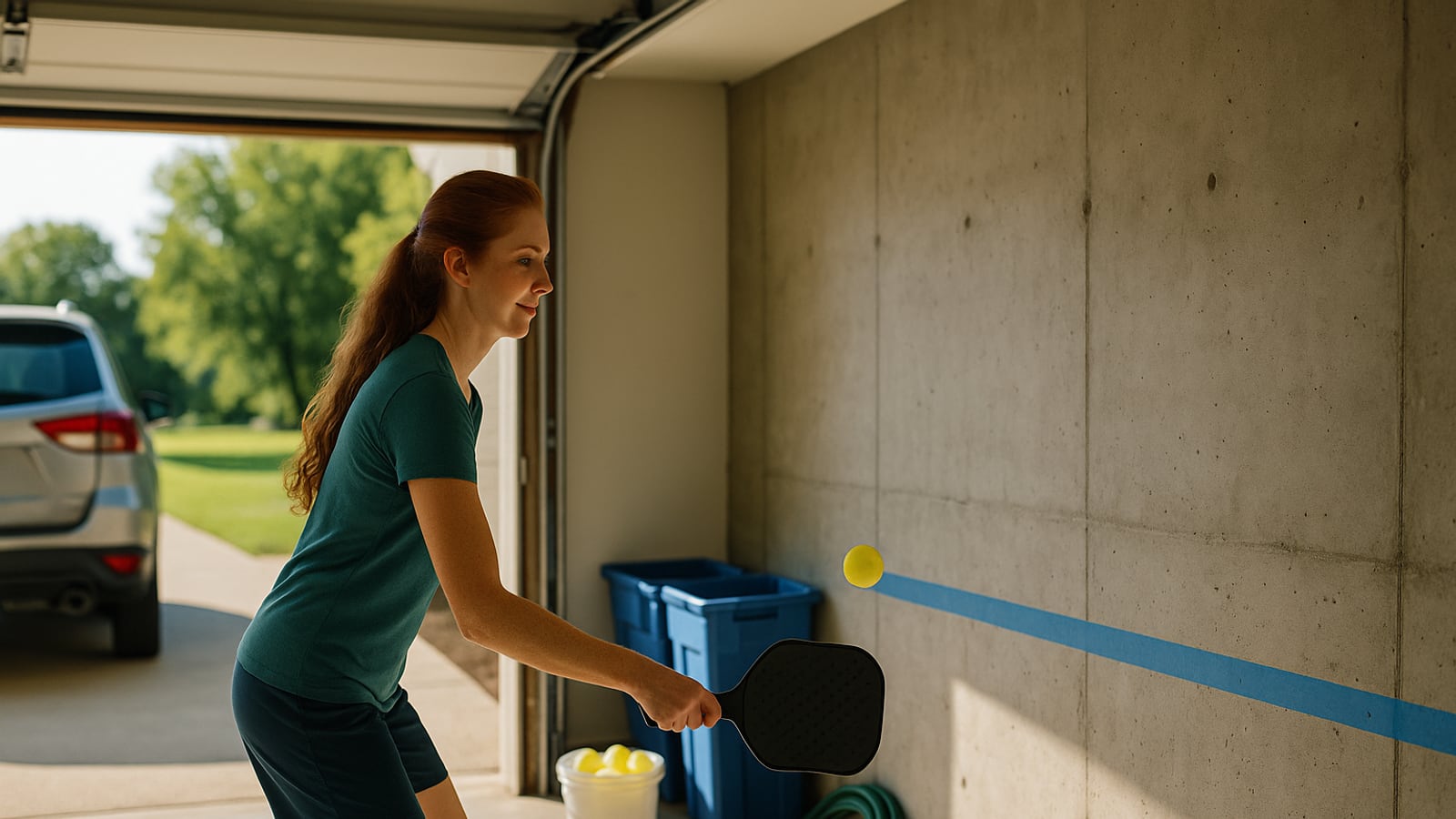
Quick answer: Tape a line 34 inches up a solid wall, stand seven feet back, and see how many soft dinks you can string together without a miss. Do that for fifteen minutes, three times a week, and you'll feel it the next time you're at the kitchen line with somebody who plays every day.
The first time you try it, you'll get about four in a row. The ball comes back faster than you expect, you swing at it like a tennis player, it slaps the wall at hip height and rockets past your ankles into the recycling bins.
That's the wall telling you something your open-play partners are too polite to say.
Most people who buy a paddle and find a flat surface use it to bang drives. It feels great. It sounds great. And it trains exactly the wrong habit, because at every level past total beginner, pickleball points get won with soft shots near the net. The wall is perfect for those, because it gives back precisely what you give it. Hit it soft and clean, and you get a soft, clean ball back. Hit it sloppy and you get chaos. No partner will ever be that honest.
Pick the right wall, and it's not the garage door
Poured concrete foundation, cinder block or brick. That's the list.
The garage door is off limits. Steel panels dent, the rollers rattle, and the whole door booms like a bass drum that your neighbors will hear at the dinner table. Drywall inside the garage is a patching job waiting to happen.
You need about ten feet of clear wall width and as much flat floor in front of it as you can get. Most two-car garages run about twenty feet deep, which covers everything in this piece except full baseline work. Pull the cars out onto the driveway and sweep. A stray pebble under your foot on a lunge is how ankles get rolled.
One more thing before you start. Pickleball is loud. That hollow pop carries. If you share a wall or a close fence line, walk over and tell the neighbor what you're up to, keep your sessions to reasonable hours, and bring them something the first time. People forgive a lot of noise from someone who asked first and showed up with cookies.
Ten minutes of setup
- The net line. Run a strip of painter's tape across the wall at 34 inches. That's the height of a pickleball net at center. Everything below it is a ball in the net.
- The pop-up line. A second strip about two feet above the first. Anything above that on a real court is a ball your opponent gets to smash.
- The kitchen line. Tape on the floor seven feet from the wall. The non-volley zone on a real court is seven feet deep, so this puts you where you'll actually stand.
- The deep line. Another floor strip as far back as your space allows, ideally fifteen feet or more.
- Balls. Use an indoor ball like the Franklin X-26 or the Onix Fuse Indoor. They're softer, with bigger holes, and they come off concrete slower and quieter. Outdoor balls like the Franklin X-40 are built to fly, and off a block wall they fly too much for a beginner to control. Keep six or more in a bucket so you practice instead of chasing.
Wear your court shoes. You'll be moving more than you think, and garage floors are unkind to flip-flops.
Drill one: the dink count
This is the drill. If you only do one, do this one.
Stand on your seven-foot tape. Knees bent, paddle out in front, face slightly open. Push the ball gently so it hits the wall between your two tape lines, comes back, bounces once in front of you, and gets pushed again.
Count every clean one. The count resets if the ball hits below the bottom tape (net) or above the top tape (pop-up). Your first goal is 20. Then 50. When you can do 100, you'll have hands that a lot of weekly players don't.
The motion comes from your shoulder, like a pendulum. Not your wrist. If you catch yourself flicking, your count will tell you before you notice it yourself. And stay low. The moment you stand up straight to rest your back, the ball starts going into the wall at a flatter angle and your count dies.
Drill two: backhand only
Same drill, backhand only.
Your number will be embarrassing. Everyone's is. That's the point. At open play, the smart players find your backhand within three shots and live there. Give it the same reps as your forehand, and for the first few weeks, give it more.
Drill three: the drop from deep
Go back to your deep tape. Hit a soft, arcing shot that lands on the wall just above the bottom line. Now watch where the ball lands coming back. If it's dying before it reaches your seven-foot tape, you hit it soft enough. If it bounces past you, you hit it like a drive with manners.
After each good one, take two steps forward and hit again from there, working your way in to the kitchen line. That's the real pattern on a court: drop, move up, drop again, arrive at the net. If the third shot drop is new to you, this breakdown of the dink and the drop explains why it matters so much.
This is the hardest drill here. It's also the one that'll change your game most.
Drill four: drive, then reset
Hit one firm drive at the wall. When it comes screaming back, don't swing. Soften your grip, let the paddle absorb it, and push it back gently between the tape lines. Then go right into dinking.
That's the reset, the shot that turns a point you were losing into one you're back in. Most beginners panic when a hard ball comes at them and swing harder. The wall teaches you to do the opposite, a hundred times in a row, until it's automatic.
Drill five: the hands battle, in small doses
Step up to about five feet. Paddle up at chest height, and volley the ball back before it bounces, over and over, as fast as you can stay in control.
It's the most fun drill in the garage. It's also the one people do for forty minutes while skipping everything else. Cap it at five rounds of thirty seconds. It builds quick hands and a compact swing, and it's a good reward at the end.
A thirty-minute session
- 5 minutes: forehand dink count
- 5 minutes: backhand dink count
- 10 minutes: drops from deep, moving forward
- 5 minutes: drive and reset
- 5 minutes: hands battle
Write your best dink counts in your phone after every session. Watching a backhand number go from 6 to 31 over a month is its own kind of satisfying.
Three sessions a week beats one long Saturday. Thirty focused minutes beats ninety tired ones, because tired reps are sloppy reps and you're just teaching yourself the sloppy version.
Where beginners go wrong
Hitting too hard. Ninety percent of wall mistakes start here. If the ball's coming back faster than you can control, you're the one sending it.
Standing tall. Your knees are your volume knob. Low body, soft ball.
Forehand forever. It's the shot you like, so it's the shot you practice. Flip that.
Practicing without a target. Anywhere on the wall isn't a target. Between the tapes is.
The wrong ball. An outdoor ball off concrete is a lively, frustrating thing. Save it for the court.
What the wall can't teach you
A wall doesn't hit angles. It doesn't put spin on the ball, poach your shot, or call the score. It won't teach you to read an opponent's paddle face or talk to a partner about who takes the middle. And it'll never tell you when your toe just touched the kitchen line on a volley.
So treat it as the gym, not the game. Get to open play once a week and use what you built. If you haven't been yet, start with the kitchen, the score and your first night of open play. And when you're done in the garage, pick up every ball, peel any tape that has to go, and sweep the floor cleaner than you found it before the cars come back in.
Some night soon, a hard ball will come at your feet at the kitchen line. You'll soften your hands without thinking and drop it gently back over the net, and the guy across from you will look genuinely surprised.
He won't know you learned that from a cinder block. You will.
Dean Shaw
Gear & Garage
Reads the warranty, the parts list and the long-term owner reviews before anything else. Trucks, tools, watches, and the cheap version that costs more.

Watch
Worth an hour of your evening
More from Hobbies.
From channels we rate. Plays on YouTube.
Read next