Two hundred dollars buys a real hand tool shop if you skip the set
Seven tools, one sharpening stone and a scrap of pine. That's all you need to start woodworking with your hands, and none of it plugs in.
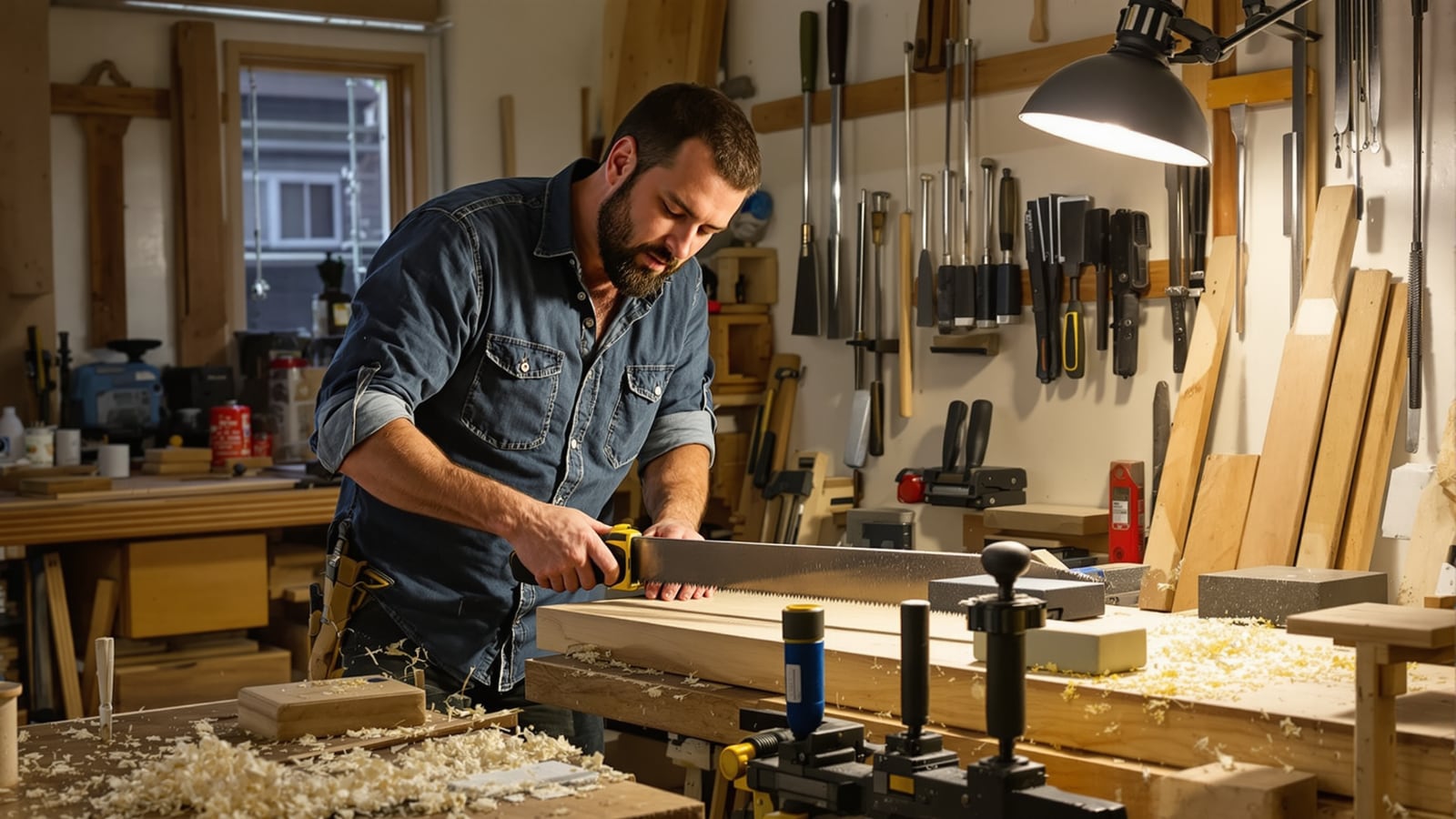
Quick answer: Buy a Japanese pull saw, a combination square, three chisels, a sharpening stone, a mallet, a marking knife and two clamps. Budget about $175 for the lot and $20 for pine. Skip the 30-piece boxed sets. Your first project is a bench hook, and you'll build it with the tools it helps you use.
Why hand tools hook people
Quiet, mostly. You can saw a board at 9 p.m. with the baby asleep down the hall and nobody wakes up. There's no dust cloud, no extension cord, no ear protection, and no garage big enough to hold a table saw you can't afford anyway.
The other reason is the shavings. A sharp plane or chisel peels off a curl of wood so thin you can read through it. Do that once and you'll understand why men have been doing it for a few thousand years. It's also a hobby you can do beside your kids. A ten-year-old with a handsaw and a clamped board is a happy ten-year-old.
What to buy, with a budget for each
These are budget targets, not quotes. Prices drift, so check the shelf before you check out.
- Japanese pull saw, double-edge (ryoba), about $30. Gyokucho and Z-Saw are the names you'll see most. Pull saws cut on the pull stroke, so the blade is thin, steers easily and forgives a shaky hand. One side cuts across the grain, the other along it.
- Combination square, 12 inch, about $20. This is how you mark a line that's actually square. Check it against a factory edge before you trust it. Cheap ones can be off, and it's better to find out at the store.
- Marking knife, about $10. A knife line gives your saw a groove to sit in. A pencil line is a suggestion. A knife line is a rail.
- Three bench chisels, about $40. Get 1/4 inch, 1/2 inch and 3/4 inch, sold separately or as a small set. Narex and Irwin Marples are common starting points. Don't buy the 10-piece set. You'll use three of them for a year.
- Combination sharpening stone, about $35. A waterstone around 1000 grit on one side and 6000 on the other. Add a flat piece of scrap and you're set. A cheaper route is wet-dry sandpaper stuck to a scrap of plate glass or a granite tile, for around $20.
- Wooden mallet, about $15. Don't hit chisel handles with a steel hammer. A mallet saves the handle and your patience.
- Two bar or F-clamps, about $25. Wood has to be held still. Everything else depends on that.
That's $175. Add $20 for a couple of eight-foot pine boards from the lumber aisle, and you're at $195 with a tape measure and pencil you already own.
What you're skipping, on purpose
A block plane belongs on the list. It's the next purchase. The new budget ones need real tuning, and a used Stanley block plane from a flea market or estate sale often comes cheaper and better. Get your first chisels sharp before you add something else that needs sharpening.
Skip the hand drill, the router plane, the wooden-handled everything-kit. Skip the hardwood, too. Pine is cheap and soft, and every mistake you make in it costs about two dollars.
Your workbench is a sturdy table, a pair of sawhorses, or the tailgate of a truck. You'll clamp a board to it and go. Real benches are lovely. You don't need one to start.
The first three things to do this week
1. Sharpen one chisel until it's actually sharp. Do this before you build anything. A dull chisel is the one tool that's dangerous, because you push harder and it slips. Flatten the back on the 1000 side, then raise a burr on the bevel, then polish on the 6000. Test it on the end of a pine board. A sharp one slices a clean, shiny shaving. A dull one crushes and tears. If you struggle, watch a few free videos from woodworkers who teach sharpening, then do it again. Everybody's first edge is bad.
2. Saw ten straight lines. Take a scrap of pine. Mark a line with the square and knife. Cut it. Check the cut against the square. Do it ten times. You'll feel your saw wander, and you'll learn to correct it. Nobody tells you this part: your first dozen cuts won't be square. That's normal. That's what the practice is for.
3. Build a bench hook. It's a flat board with a cleat on the front and a cleat on the back. You hook the front cleat on the edge of your table, push your work against the back cleat, and saw safely against it. Cut it from pine. Glue and screw the cleats, or just glue and clamp them. It takes an afternoon. It's the one jig you'll use on every project for the rest of your life.
The mistakes everybody makes
Buying tools before skills. The hobby's marketing wants you to believe the next purchase is the key. It isn't. Sharpening and sawing straight are the key. Both are free.
Cutting toward your hand. Keep both hands behind the cutting edge of a chisel, always. If your off hand is where the chisel could land, move it. Clamp the work. Slow down.
Working with dull edges. You'll feel productive and slightly furious. That's the sign. Stop and sharpen.
Skipping clamps. A board that moves is a cut that wanders. Two clamps feel like a lot of money until the first time one saves a ruined board.
Starting with a big project. Don't build a dining table. Build a bench hook, then a small box, then a cutting board, then a step stool. Each one teaches the next.
Finding your people
Woodworkers are some of the most generous teachers going. Most would rather show you than watch you struggle.
- Woodworking guilds. Search your state or city name plus "woodworkers guild" or "woodworking club." Many meet monthly, and most welcome beginners.
- Woodcraft and Rockler stores. Both chains run classes and often host local meetups.
- Community college continuing education. A six-week evening course costs less than most power tools.
- Men's sheds and community workshops. Some towns have shared shops where you can use bigger machines and learn from the people who run them.
- Habitat for Humanity ReStore. Cheap lumber, cheap old tools, and a good chance you'll meet somebody who builds for fun.
And when somebody lets you borrow a clamp or a plane, bring it back sharper than it came, with the shavings swept off the bench. Leave the shop cleaner than you found it. That's how you get invited back.
If you like the idea of making things with sharp edges and patience, leatherworking uses much of the same discipline. And if you've got a building bug and a free corner of the house, a model railroad fits on a sheet of plywood. Or build the box for your first beehive with the saw you just bought.
Start with the bench hook. Sharpen the chisel first.
Dean Shaw
Gear & Garage
Reads the warranty, the parts list and the long-term owner reviews before anything else. Trucks, tools, watches, and the cheap version that costs more.

Watch
Worth an hour of your evening
More from Hobbies.
From channels we rate. Plays on YouTube.
Read next