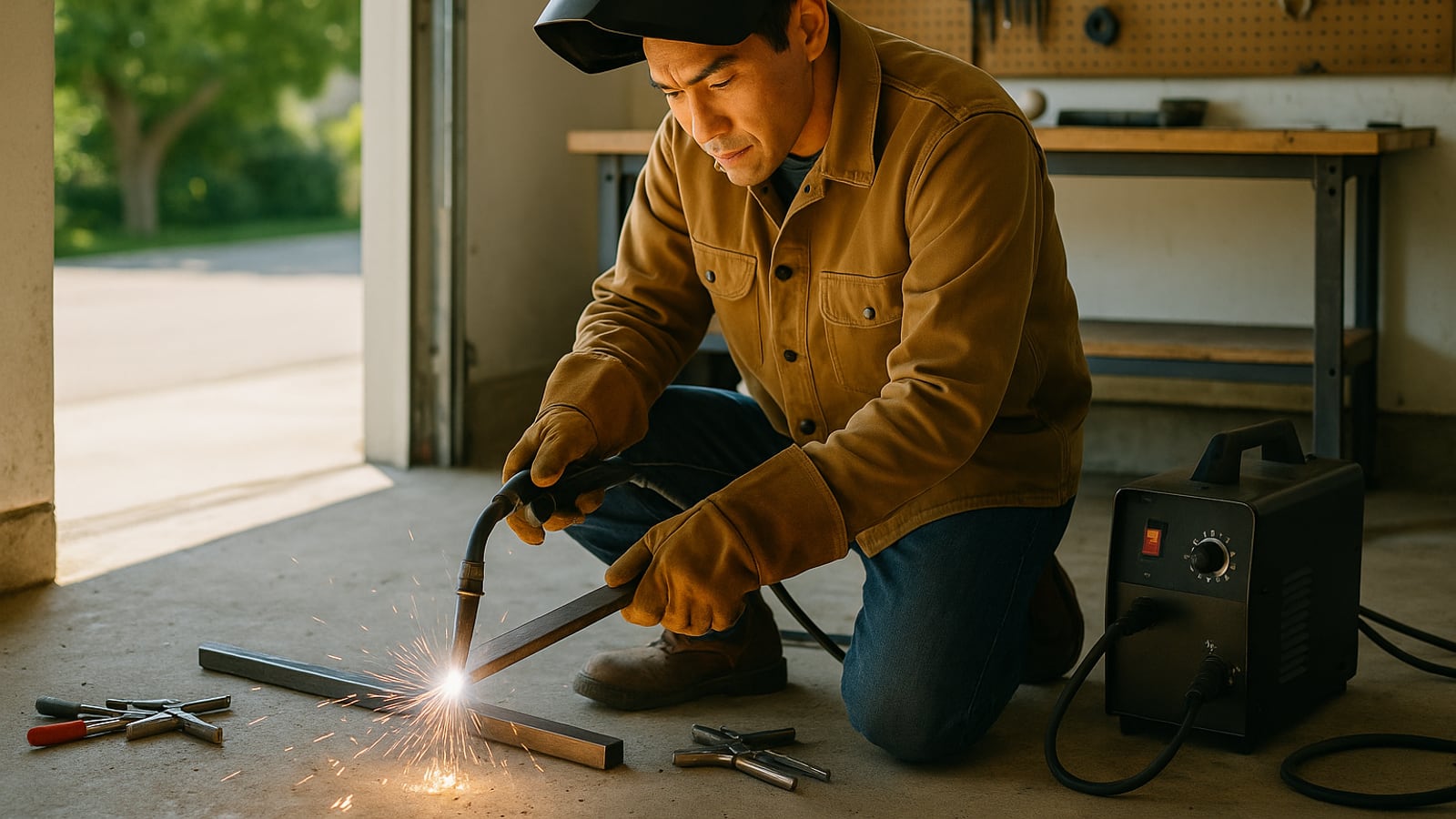
A good weld sounds like bacon frying. That's the whole feedback loop. When the sound goes ragged and popping, you're too far away or moving wrong. When it settles into a steady sizzle, you're laying down metal that will outlive the guy who laid it.
That's the hook, and it gets people fast. Wood glues, screws, and eventually lets go. Steel welded properly is one piece. You didn't attach the shelf bracket to the post. There's no shelf bracket and no post anymore, just a thing that has a shelf on it now.
The way in is a flux-core wire machine, 120 volts, plugged into the outlet you already have in the garage.
What flux-core is and why it's the right start
Wire-feed welding pushes a spool of wire out of a gun at a set speed. The wire touches the steel, the arc lights, and the wire melts into the puddle. You steer the puddle.
That molten puddle has to be shielded from the air or it turns porous and weak. In a MIG setup you buy a tank of argon mix, rent it, refill it, and haul it around. Flux-core skips the tank. The wire has flux packed inside it, and it burns off into a shielding gas right where you need it.
The trade-off is real. Flux-core leaves a crust of slag on top of every bead that you chip and wire-brush off. It spatters. It's uglier. And it doesn't like thin sheet metal, so car body work is off the table for a while.
What it does beautifully is outdoor work and anything 1/8 inch or thicker, which happens to be almost everything a beginner wants to build. Gate hinges. Trailer repairs. Racks and stands and frames. A breeze won't blow your shielding away, because it's built into the wire.
What it costs to get to your first spark
Buy the protective gear before the welder. Every time.
- Auto-darkening helmet. The Antra AH6-660 and the Harbor Freight Vulcan both land in the $50 to $90 range and are plenty for a hobbyist. Lincoln's Viking 1740 runs closer to $180 and is genuinely nicer to look through. Don't buy a fixed-shade helmet for twelve dollars. You'll nod it down, lose your spot, and hate the hobby by Tuesday.
- The machine. Harbor Freight's Titanium Easy-Flux 125 sits around $170 and will absolutely teach you to weld. YesWelder's small flux machines run similar money. Step up and the Hobart Handler 140 or Lincoln 140HD are in the $550 to $700 neighborhood, better duty cycle, and convertible to gas MIG later if you catch the bug.
- Angle grinder. Non-negotiable. A Bauer or Ryobi corded 4.5-inch is around $50. Buy a pack of cutoff wheels and a twisted wire cup brush with it.
- Gloves, jacket, pliers. Leather MIG gloves around $20. A leather or flame-resistant cotton welding jacket, $40 to $70. Welpers (welding pliers) about $15 and worth every cent.
- Wire. E71T-GS flux-core, .030 diameter, 2-pound spool. Roughly $20 to $30. Get the name-brand spool, not the mystery roll. Cheap wire feeds badly and you'll blame yourself.
- Steel. A 20-foot stick of 1/8 by 1 inch flat bar from a local steel supplier is cheap, usually well under $30, and far cheaper than the cut pieces at the big-box store.
- ABC fire extinguisher. Around $30. Buy it. Mount it where you can grab it without stepping over the project.
Call it $350 to $400 to be genuinely equipped at the budget end. That's a mid-range grill.
Three things to do this week
One: set up the burn zone. Sweep a 10-foot circle down to bare concrete. Move the gas can, the paint thinner, the folded tarp, the sawdust. Sparks travel farther than you think and they smolder for twenty minutes before they decide to be a fire. Stay in the shop for half an hour after you stop welding.
Two: check your polarity. Flux-core wire needs DC electrode negative. Most machines ship wired for gas MIG, which is electrode positive. The lead swap takes thirty seconds inside the side panel and the manual shows you exactly where. Skip it and your welds will spatter like popcorn and look like bird droppings, and you'll conclude you have no talent. You have a wiring problem.
Three: run beads on flat plate. No joints. No project. Cut your flat bar into 6-inch coupons, grind them to bare shiny metal, clamp the ground directly to the workpiece, and drag beads across the surface. Set the machine to the chart on the inside of the door and trust it. Aim for about 3/8 inch of wire sticking out of the nozzle, tip angled back maybe 15 degrees, dragging away from the finished weld. Listen for the bacon. Do forty of them before you build anything.
What goes wrong for everybody
Moving too fast is the number one sin. Beginners are nervous about heat and they run. A cold, tall, narrow bead sitting on top of the steel like a caterpillar isn't welded to anything. You want it flattened and tied into both edges.
Dirty metal is number two. Mill scale, rust, and paint all cause porosity. Grind to shiny, an inch either side of the joint, every time.
Never weld galvanized steel. The zinc coating burns off as a fume that will make you seriously ill for a day or two, and it's entirely avoidable. Grind the coating off first or buy plain hot-rolled.
Wear cotton or leather, never polyester. Synthetic fabric melts onto skin. Wear leather boots and no cuffs on your pants, because a spark lands in a cuff and stays there. Button your collar. And if you get careless once and take an arc flash to the eyes, you won't feel it until three hours later when it feels like sand under the lids. Sunglasses, a dark room, and a call to an eye doctor.
Your first five builds
Start with a welding table, roughly 2 by 3 feet, out of 2-inch angle iron with a 1/4-inch plate top. It's forgiving, you'll use it forever, and every ugly weld on it's hidden underneath.
Then a firewood rack. Then a stand for the bench grinder. Then the trailer gate your neighbor gave up on. Then something with no function at all, a coat rack or a scrap-steel figure for the garden, because building something purely because it pleases your wife is a legitimate use of a Saturday.
Somewhere in there, hand your kid the wire brush and let them chip slag. Twelve-year-olds can run a decent bead under supervision, and there's no substitute for the look on their face the first time the arc lights.
Where the people are
Community colleges run night welding courses, typically one evening a week for a term, often $150 to $400 with the booth and steel included. That one class is worth six months of videos, because an instructor standing behind you will fix your gun angle in four seconds.
Makerspaces are the other route. Many have a metal shop with a MIG machine, and a membership plus a safety checkout gets you access without owning anything.
Walk into your local welding supply store, the one that isn't a chain hardware aisle. The counter staff weld, they know who teaches, and they'll tell you which machine they see come back broken.
The American Welding Society has local sections that hold meetings open to anybody curious. Farm country has informal shop nights. County fairs have metal art people who love talking to beginners.
Your first twenty welds will be bad. Grind them off and do it again. Steel forgives you completely, which is more than the wood in your garage ever did.
Dean Shaw
Gear & Garage
Tests things until they break, then reports what broke first. Trucks, tools, watches, and the cheap version that costs more.

Watch
Worth an hour of your evening
More from Hobbies.
From channels we rate. Plays on YouTube.
Read next