Look for a piece of the animal, not the animal
Binoculars, patience and a seat on the right ridge will show you more game than miles of walking. Here's how to find it before it finds you.
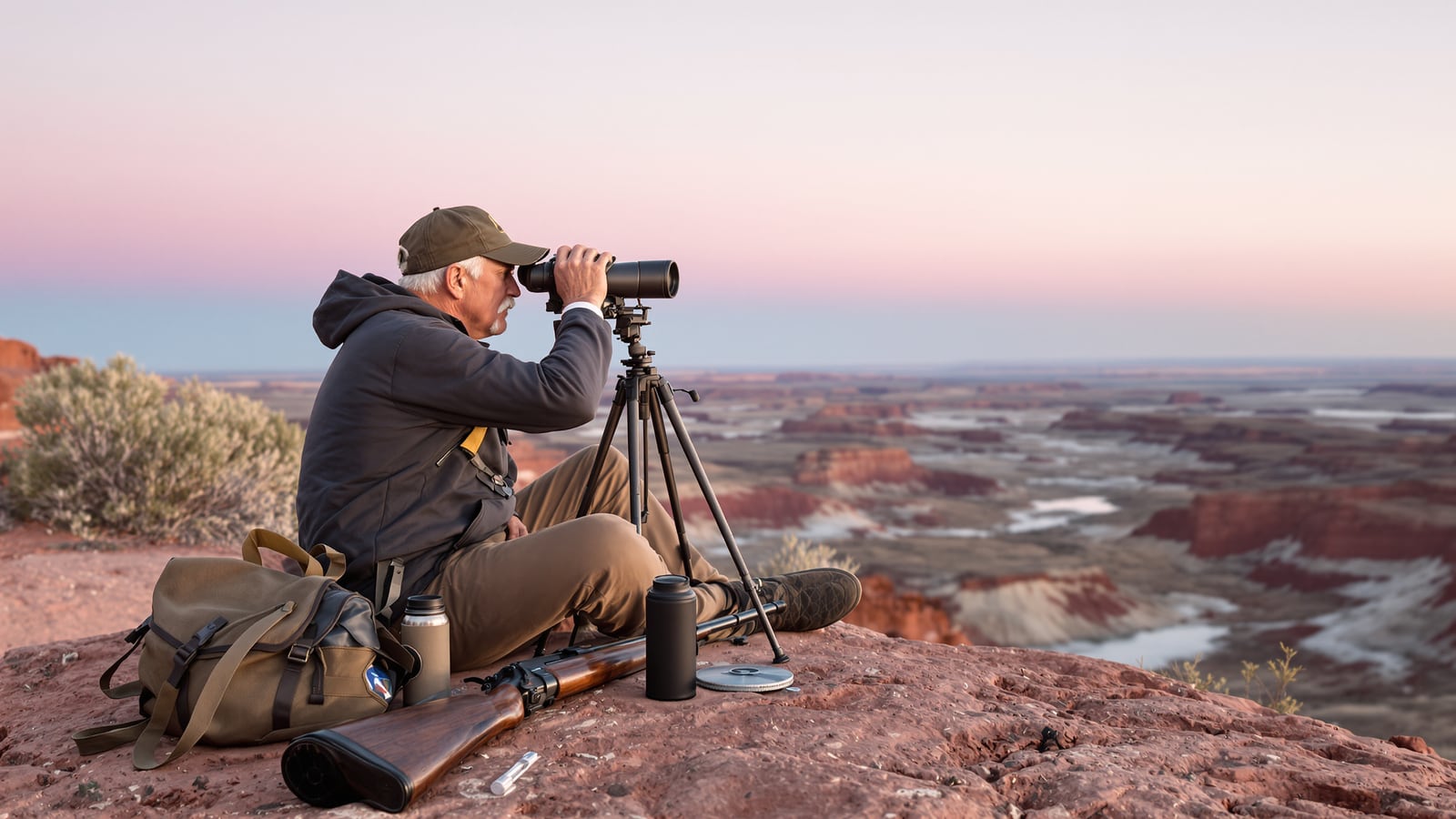
Quick answer: Get up high before first light, sit down, and glass in small slow sections. Hunt for an ear, a leg, a horizontal line in a vertical forest. Don't hunt for a whole animal. Leave the rifle scope in its case for this job.
You won't find an elk. You'll find a piece of one.
Most beginners sweep a hillside the way you'd scan a parking lot for your truck. They're looking for a whole elk, standing broadside, labeled. That elk doesn't exist.
What exists is a patch of tan in the wrong place. A pale rump the color of dry grass, but too clean. A set of dark legs under a spruce where no stump should be. A tine tip catching light. An ear flicking at a fly.
Train your eye to find things that don't fit the hillside:
- Horizontal lines. Timber is vertical. A back, a belly line or a neck stretched out is not.
- Odd color. Elk read tan, with a darker head, neck and legs. Mule deer run grayer and show a white rump. Your eyes will pick up the difference faster than the shape.
- Movement. A tail, an ear, a head coming up. Animals that hold perfectly still can vanish in front of you. They almost never stay still for long.
Once you've seen it, look at the same patch for a full minute. Half the time one animal turns into four.
Pick the ridge before you pick the optics
You want a seat that does three things. It looks across a basin or down a drainage instead of straight at one slope. It breaks up your outline, so you're against rock or brush and never on the skyline. And it puts the wind in your favor.
On wind: morning air generally slides downhill as the ground cools, and in the afternoon it climbs as the slopes warm. So in the morning you'll often want to sit above the animals, and in the evening below them or level. Local terrain bends all of this, and a puff of powder or a strip of lightweight thread tied to your pack tells you more than any rule.
Get there before the light, or at least before the animals are done feeding. You want to be settled and quiet when the first gray shows up. Walking a ridge at 7:30 with the sun on your back is how you push every animal in the drainage into the next county.
Sun matters too. In cold weather, animals move onto slopes that just caught the sun. In warm weather they hold in the shade. Glass the lit slopes first in the cold, the dark timber edges first in the heat. Always look at the edges, where feeding ground meets cover. That seam is where animals stand at the start and end of the day.
The method: small boxes, slow passes
Here's a system simple enough to run when you're cold and tired.
- Scan once, fast, with your naked eye. You're catching movement or a color that's off.
- Pick the nearest section and glass it first. Animals close to you are the ones most likely to see you, and the ones you'll miss if you start far.
- Work in strips, left to right, then drop down a strip and come back. Think mowing a lawn. Overlap a little.
- Slow down in cover. Open grass takes seconds. A stand of aspen or a dark pocket of timber takes minutes. Look into the shadows, not at the leaves.
- Move out, then come back to the near ground. Animals often step out while you're looking far.
Give each section a real look before you leave it. If you glassed a slope in under a minute, you didn't glass it. You looked at it.
Gear that matters, and gear that doesn't
A 10x42 binocular is the common workhorse for a reason. It gives you reach without shaking your eye to pieces. Bigger magnification looks like a bargain until your own pulse blurs the picture.
The thing that does the most for the least money is a tripod or some kind of rest. Hand-holding a binocular for an hour wears your arms out and fills the view with wobble. A rest steadies the image, and a steady image is how you catch that one ear. Yes, it's another piece of gear on your back. If you're hiking miles, you'll feel it. If you're going to spend the morning in one spot, bring it.
Next, a small pack-top pad or a foam seat. You're going to be there a while. Comfort is a hunting skill, because the guy who's comfortable stays put.
Last, a rangefinder, to turn "that looks close" into a number you can trust. Distance on a mountain lies to you constantly.
If you're still sorting out your gear list, the piece on your first hunting rifle and the optic that earns its keep covers where the money goes.
The safety line you don't cross
Don't glass through your rifle scope. It's tempting. It's already on your back, already magnified. But looking through a scope means pointing a firearm at whatever's in view, and that might be another hunter, a hiker, a house or a rancher on a four-wheeler. Binoculars exist for exactly this reason. You identify first, and the rifle only comes up for a shot you've already decided is safe and legal.
A few more lines that are worth drawing now:
- Know your boundaries. A ridge with a perfect view of a herd may sit next to private ground. Check a current map and the posted signs before you ever plan a stalk. Where to hunt when you don't own a single acre covers public access in more detail.
- Know the rules where you hunt. Legal shooting hours, antler restrictions, tag types, blaze orange requirements and limits on using electronic aids all differ by state, province and unit, and they change from year to year. Some places restrict drones for scouting or locating game. Read the current regulations from the agency that manages the land, and if a rule is unclear, ask them before you go.
- Wear the orange the law asks for, even when it feels like it spoils the camouflage. Elk and deer don't see it the way people do. Other hunters do.
- Tell someone your plan. Where you're parked, which ridge, when you'll be back. Phones lose signal in the places elk live.
Glass first, then decide
The best part of glassing is that it gives you choices. You can watch a herd for an hour and decide it's the wrong bull, the wrong angle, or the wrong side of a fence. You can see that a stalk means a ravine you'd have to cross at noon, or a pack-out you can't manage alone. If the shot doesn't feel right when you get there, you already have your answer.
Glassing also reads the country the way sign does, only in real time. Sign tells you what was there. The binocular tells you what's there now.
Before you leave your seat, pack out every scrap. Leave the ridge the way you'd want to find it, with no wrappers, no flagging, no scuffed-up flat spot that says someone sat here. The next hunter will glass that same rock, and the animals will thank you for the quiet.
Sit still a little longer than feels reasonable. That's usually when the ear flicks.
Wes Dunbar
Country & Skills
Grew up on an acreage and never quite left. Covers trucks, trades, land, and how to do the thing yourself.

Watch
Worth an hour of your evening
More from Hunting & Shooting.
From channels we rate. Plays on YouTube.
Read next