

Your service record is worth more to you after you leave
On active duty, your record is the Army's, Navy's or Marine Corps' paperwork. Once you separate, it's your proof, and nobody else is keeping it for you.
Quick answer: Before you out-process, get copies of your full personnel file and your medical records, and check every line of your DD-214. Fixing an error now takes a visit to the personnel office. Fixing it ten years later takes a board and a lot of patience.
Whose paperwork is it?
While you serve, the record is the service's problem. A clerk keeps it. A board reads it. You glance at it when a promotion packet comes around and mostly trust it.
After you separate, that flips. The VA doesn't know what happened to you at a duty station in 2008. A lender doesn't know you earned eligibility for a home loan. A federal hiring office can't see your veteran preference unless you hand over the paper. Your family can't claim anything on your behalf if they can't find what proves you served.
Your branch has its own name for the thing. The Marine Corps has its Service Record Book. The Army has the Enlisted Record Brief, which is a summary, not the full file. The Navy keeps an electronic service record. Whatever yours is called, find out what the complete file contains and how to get a copy before you leave. Your personnel office can tell you which portal your branch uses. Army soldiers can pull documents from iPERMS.
The file turns into evidence
Picture a veteran in his fifties filing a disability claim for a back that quit on him. He remembers the fall off a truck tailgate in his second year. He remembers the corpsman or medic who wrapped it. He doesn't have one page showing it happened.
That's the usual story. The injury is real, the memory is honest, and the record has a hole where the sick-call entry should be.
The reverse happens too. A veteran whose file shows exactly where he was and when, with deployment orders and a clean medical history, can lean on that file. Since the PACT Act passed in 2022, presumptions for certain illnesses depend partly on where and when you served. Those dates and locations have to be on paper and correct.
Records matter for more than disability claims:
- Home loan eligibility. The VA needs proof of service to issue your Certificate of Eligibility.
- GI Bill. Your service dates and character of service decide what you qualify for.
- Retirement pay. If you stay twenty, your file drives the math. See what military retirement pay actually comes to.
- Federal hiring. Veterans' preference requires documentation, and the DD-214 is the usual one.
- Burial benefits. Your widow or your kids will need your discharge papers to arrange them, and they'll need them in a bad week.
- Your resume. What you actually did, and when, is in the file. More on that in turning your military record into a resume civilians can read.
What to do before you out-process
Start early. The 18 months before you take off the uniform is the right window, not the final week when everybody's rushing you through a checklist.
1. Read your DD-214 line by line. Check your name, Social Security number, dates of service, job specialty, awards and decorations, and the character of service. Missing awards are common. So are wrong dates. If something's off, fix it while you're still in uniform and the people who can correct it are down the hall.
2. Get the full personnel file, not the summary. Evaluations, orders, award citations, training records, counseling statements, line-of-duty determinations. If you can pull it electronically, do it and save everything.
3. Get your medical records. Request your service treatment records and the results of your separation physical. Go through them. If you were hurt, treated, or sent to sick call for something that isn't there, say so before you leave and write down the date and place.
4. Don't downplay at the separation physical. Plenty of good people tell the doctor they're fine because they want to get out on time. A condition that's undocumented on the way out is harder to connect to your service later. Tell the truth about what hurts. That's not complaining. It's keeping honest books.
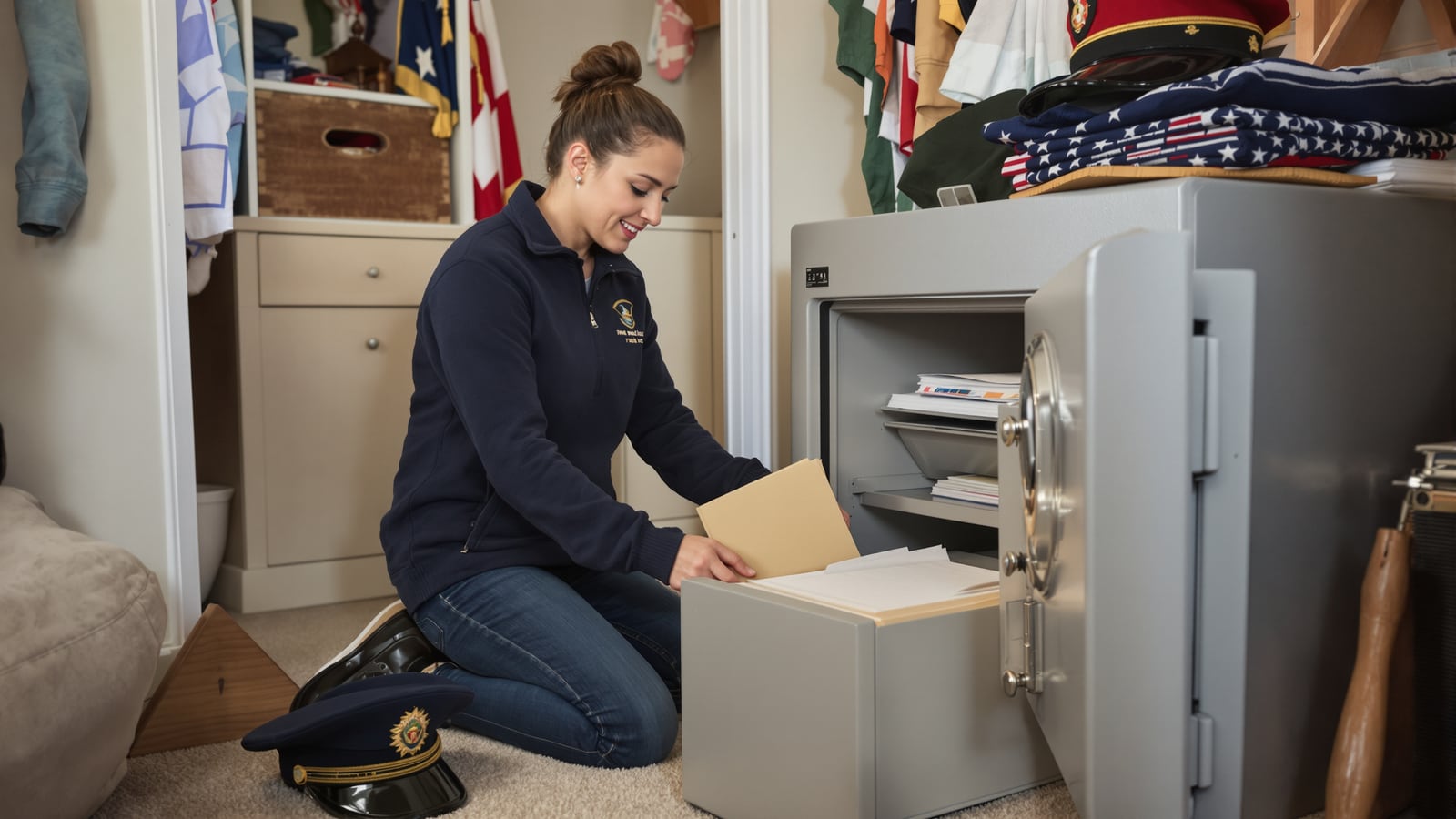
5. Make copies and put them in three places. Keep a scanned set in cloud storage you control, a paper set in a fireproof box at home, and one copy with a trusted family member. The DD-214 has multiple copies for a reason. Use them.
6. Tell your wife where everything is. She shouldn't have to hunt for it. Show her the box, the folder and the logins. If you don't come home one day, or you can't speak for yourself, she'll be the one dealing with the paperwork. Leave it in better order than you found it.
If your records are already gone or wrong
Lots of veterans read this too late. That's fine, and it's fixable.
Once you separate, your official file is generally held by the National Personnel Records Center in St. Louis, part of the National Archives. You can request your records through the Archives' veterans' service records page at archives.gov/veterans. A veteran can request his own file, and next of kin can request a deceased veteran's. Expect to wait weeks, sometimes longer.
A 1973 fire at that center destroyed a large number of Army and Air Force records from the mid-twentieth century. If you're digging for a father's or grandfather's file, you may get a letter saying it burned. Ask what substitute records exist, because the VA can often work with other documents.
If your DD-214 has an error, you can apply to correct it using a DD Form 149 through your branch's Board for Correction of Military Records, or request a DD-215 correction for administrative mistakes. If you believe your discharge characterization was unjust, the Discharge Review Board accepts applications for up to fifteen years after separation. Both processes take time and paperwork. Start at the official sites, not on a forum.
Get free help, and watch for the other kind
You don't need to pay anyone to file a VA claim. Accredited representatives from groups like the American Legion, VFW and DAV, or a county veterans service officer, will help at no charge. The VA's own site, VA.gov, lists how to find an accredited representative and verify one.
Be wary of anyone who wants money upfront to "unlock" your benefits. Federal law restricts what claim help can cost, and the people who prey on veterans count on you not knowing that. If someone's asking for a fee before the VA has even made a decision, walk away and call an accredited rep.
Nothing here replaces a VA-accredited representative, an attorney, or your personnel office for the details of your own case. Ask them.
One last thing to do tonight
Find your DD-214. Not the folder you think it's in. The actual page. If you can put your hand on it in under two minutes, you're ahead of most. If you can't, you've got your first job for the weekend.
Ade Fisher
Young Men
Teaches the trades intake at a community college. Writes the manual he wishes his students arrived with.

Watch
Worth an hour of your evening
More from Military & Vets.
From channels we rate. Plays on YouTube.
Read next