

Grandpa could tell you when he bought every wrench
A pegboard full of tools bought one job at a time beats any 200-piece set, and the notebook behind it's the part worth copying.
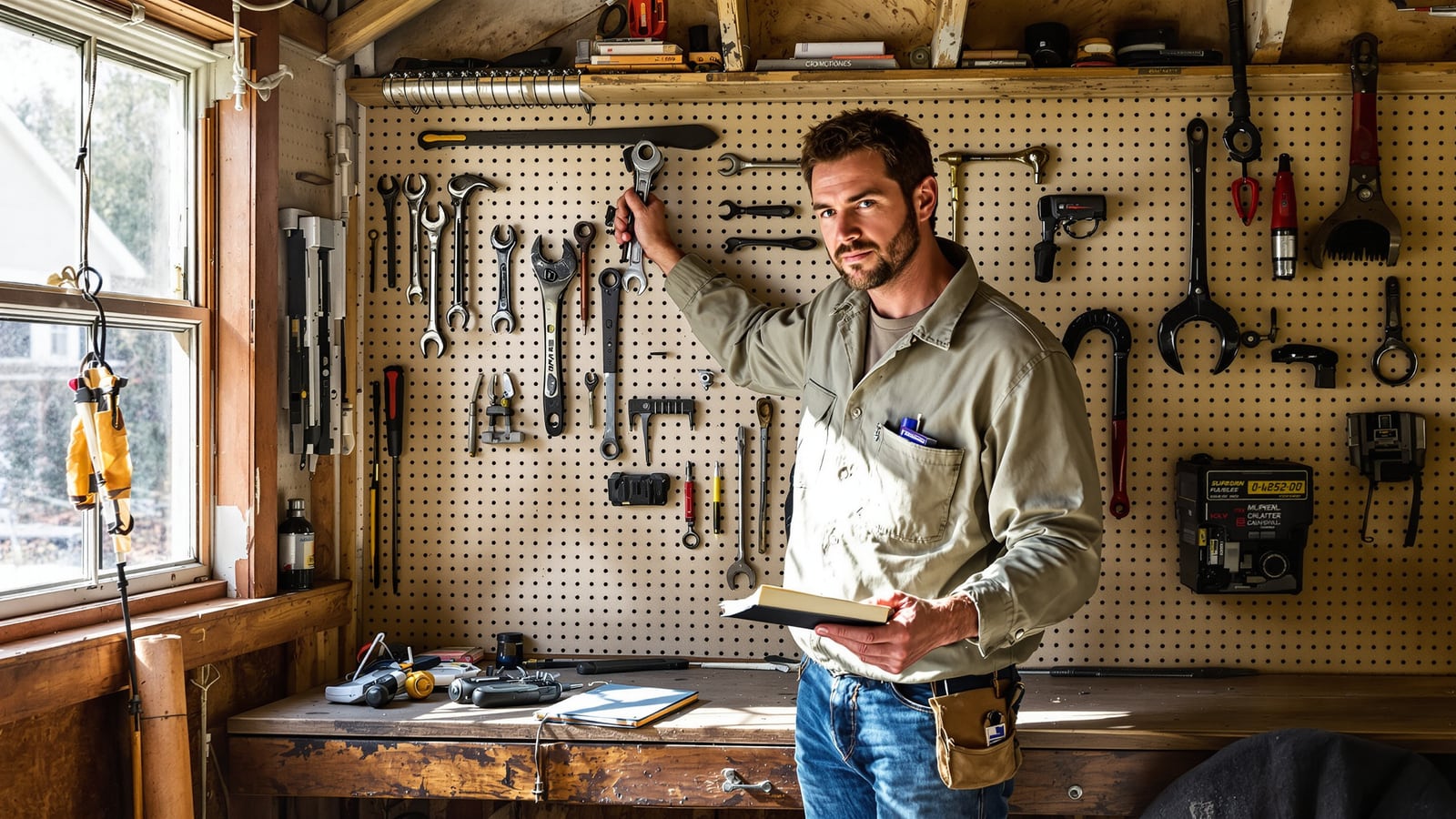
My grandfather owned one 9/16 combination wrench, and he could tell you the whole story of it. A water heater, a stripped fitting, a Saturday in the fall, and the hardware store he'd driven to because the first one was closed. He'd also tell you he overpaid.
He could do this with nearly everything on the wall. The torque wrench. The pipe cutter with the tiny wheel. The strange hooked tool nobody else in the family could name. Every one came with a date, a job and a small grudge about the price.
I thought it was just an old man's memory. It wasn't. It was a system, and you can run it this week.
Nothing came in a set
The shed wasn't built by shopping. It was built by breaking things.
Grandpa's rule was simple: you don't buy a tool until a job is standing in front of you. The faucet drips, so you buy the wrench that fixes the faucet. The fence leans, so you buy the post-hole digger. The tool arrives with a purpose already attached, and it gets used the day it's bought.
Compare that to the gift set. A few hundred pieces in a molded case, forty of which you'll never touch. Half the sockets are sizes no car you'll ever own uses, and the ratchet that came with them is the weak link. You pay for the case, the count and the bragging rights.
He wasn't against sets. He bought a good socket set, once, after he'd borrowed a neighbor's for the third time and felt it. That's the other half of his rule. When you've borrowed the same tool three times, you've been told what to buy.
The trade-off is real. Buying one job at a time means the first few repairs are slower. You'll make a store run in the middle of a project and lose forty minutes. He accepted that. A shed full of tools you chose beats a shed full of tools you were sold.
The notebook behind the pegboard
The part nobody copies is the record. Grandpa kept a spiral notebook on a nail beside the door, the kind with a cardboard cover gone soft at the corners. Every purchase got a line: the date, the tool, the job, the store, what he paid.
Some lines had notes.
Returned the first one. Handle cracked.
Should have bought the longer one.
Lent to Walt, got it back sharper.
That notebook did three things. It stopped him from buying the same tool twice, which happens more than you'd think when a tool disappears into a drawer. It told him which brands held up, because he'd written down which ones didn't. And it settled arguments. When somebody swore they'd lent him a hammer, he could flip back and check.
Start yours with an index card if a notebook feels like too much. Tape it inside the toolbox lid. One line per tool, written the day you buy it, while you still remember what annoyed you.
What to buy first, and why
You don't need grandpa's whole wall. You need the tools that the first ten household jobs will actually ask for. Let the work order them for you, but expect the early buys to look something like this:
- A 16-foot tape measure. The hook on the end slides a little on purpose, to account for its own thickness on inside and outside measurements. It's not broken. Don't "fix" it.
- A claw hammer you can swing all afternoon. Hold a few in the store. The balance matters more than the label.
- Slip-joint pliers and an adjustable wrench. Between them they get you out of most small jams, though neither is the right tool for a hard bolt.
- Two screwdrivers that fit. Phillips and flathead, with tips that match the screws. A tip that's too small chews the screw head and starts a bad afternoon.
- A basic socket set with 6-point sockets. Six points grip the flat sides of a nut and resist rounding it off. Twelve-point sockets slide on easier in tight spots but slip more under real force. Grandpa owned both and reached for the 6-point first.
- A level. A picture frame that's off by a quarter inch will bother you for years.
Everything past that, wait for the job. A tile cutter can sit in the store until the bathroom floor needs one.
The part about the wall
His pegboard had outlines. He'd traced each tool in marker, so you could see at a glance what was missing and who had it. Nobody ever had to ask where the hammer lived.
It looks like fussiness. It's the opposite. It takes ten minutes to set up and saves a hundred wasted ones.
He had habits around the tools, too:
- Wipe them down after the job. Dirt and moisture are what turn a good wrench into a rusty one.
- A drop of oil on moving parts and a rag over the blades.
- Sharpen the edge before you put it away, not before you need it.
- Put it back on its outline. Every time, even when you're tired.
He hated the phrase "I'll deal with it later." Later was how a chisel ended up in the yard through a winter.
Lend them like you mean it
A shed with a notebook becomes a neighborhood asset. Grandpa lent tools freely, and he wrote every loan down, not out of distrust but so nobody had to carry it in their head.
And he held to the old code from the other side. If he borrowed a ladder, it came back clean, with a note of thanks. If he borrowed a saw, it came back sharper than it left. He said a man who returned a tool in worse shape had borrowed it, and a man who returned it better had been trusted with it. That's a difference people notice for thirty years.
If you want more on that kind of neighborliness, the front porch piece gets at why it mattered, and the habit of making things last is the same one behind waste nothing, feed everyone, clean as you go. The money side of it, paying cash for the tool when the job calls for it, fits right in with the old cash rule.
What I did with his notebook
When he stopped working out in the shed, he handed me the pegboard, the toolboxes and the notebook. I took the notebook first.
The wrenches are good, and I use them. But I've read every page, and I know now that he bought the pipe cutter the winter a line froze, the same winter he got behind on the oil bill and paid it off in March. I know which hammer he regretted. I know the day he bought the 9/16, and I know he'd have told you it wasn't worth the money.
Buy your first tool when the first job shows up. Write down the date. Somebody's going to want to know.
Nina Castellan
BRO for Her
Runs the women-facing desk. Same standard, same tools, written for a different reader — not a softer one.

Watch
Worth an hour of your evening
More from Old School.
From channels we rate. Plays on YouTube.
Read next