
Quick answer: They didn't plan parties. They picked one night, kept it forever, and made it so cheap and easy that showing up was simpler than skipping. You can start the same thing this month with a deck of cards and a pot of coffee.
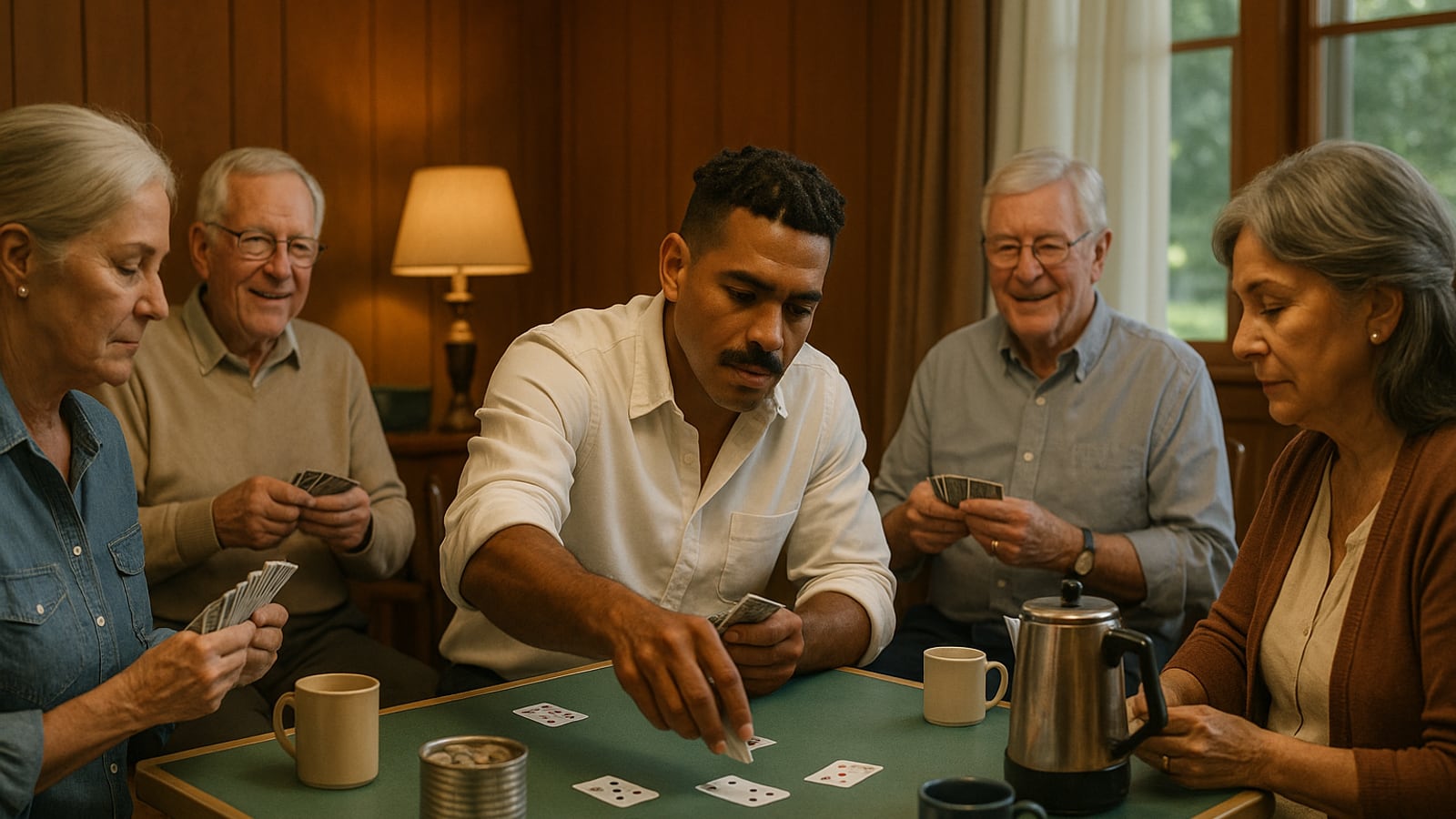
My grandparents played pinochle on the second Saturday of every month for thirty-one years. Same three couples. Same folding card table from Sears, with a vinyl top that stuck to your forearms in July. A Folgers can of nickels sat in the middle. Somebody always brought lemon bars.
I was eight before I realized not every family had this. I thought the second Saturday was a holiday.
The date was the whole trick
Nobody in that group ever said "we should get together sometime." That sentence is where friendships go to die. It sounds friendly and commits you to nothing.
They'd made the decision once, back in the Kennedy administration, and never made it again. Second Saturday. Seven o'clock. Hosting rotated in the same order every month, so you knew in January that April was yours.
If one couple was down with the flu, the other three played anyway. If two couples couldn't make it, the remaining two played a different game. The night didn't get canceled. It got smaller.
Compare that with how most of us try to see friends now. Six people, four calendars, a group text that starts with real enthusiasm and dies somewhere around "does the 14th work for anybody?" Nobody's lazy in that thread. The problem is you're asking busy people to make a fresh decision every time. My grandparents' crowd removed the decision. That's all it was.
Cheap on purpose
The stakes were a nickel a game. In a bad month you might go home down eighty cents, and you'd hear about it for weeks.
The food rule was just as modest. Whoever hosted put on coffee and made one dessert. Not dinner. Never dinner. Dinner means a grocery run, a clean oven, and a wife who's worn out before anybody rings the bell. Dessert and coffee means you can host on a Tuesday budget.
And nobody deep-cleaned. Grandma's line was, "If you have to scrub the baseboards for them, you invited the wrong people." The house was picked up, the dog was put out, and that was the whole preparation.
This is the part people get wrong when they try to revive the idea. They make it an event. Charcuterie boards, a theme, a new tablecloth. It's lovely once. Then it's exhausting, and it quietly stops. A standing night has to be cheap enough to survive a bad month.
Potlucks and the dish with tape on the bottom
Potlucks were the same idea, bigger. The fire hall supper, the Fourth of July at the lake, the family reunion in somebody's pasture. Every woman in the county had a strip of masking tape with her last name on the bottom of her Pyrex. Without it, your dish was gone for good.
The unwritten rules, as my grandmother taught them:
- Bring what you're known for. If people ask for your baked beans, don't show up with an experiment.
- Bring enough for your own family plus a few more. Somebody always comes empty-handed. Cover for them without comment.
- Stay to clean up. The people who stacked chairs at the end were the people who got invited to everything.
- Never return a borrowed dish empty. If a neighbor sent over a casserole when you were sick, her dish went back with cookies in it. Every time.
That last one kept a whole street connected. A dish going back and forth is a reason to knock on a door, and nobody ever had to say anything sentimental. The same waste-nothing thinking ran the kitchen too. Leftovers got divided up before anybody left, which is its own art, and Waste Nothing, Feed Everyone, Clean As You Go covers it better than I can.
The porch visit had a clock on it
The drop-in visit had rules so precise you'd think they were printed somewhere.
You stopped at the bottom of the steps until you were waved up. You brought something, even if it was three tomatoes or the sports section you'd finished. You stayed fifteen or twenty minutes. If they offered a second cup of coffee, you said no the first time and yes only if they asked again.
The porch light did the rest. On meant come on up. Off meant not tonight, and nobody took it personally.
Grandpa had a line for all of it: "Leave while they still want you." Ben Franklin said the same thing less politely, that fish and visitors stink after three days. A short visit you can repeat every week beats a long one that makes people hide when your truck pulls in. There's more on why the porch worked in The front porch did a job the group chat can't do.
Starting your own this month
You don't need a card table from Sears. You need a night and the stubbornness to keep it.
- Pick a night you can hold for a year. First Friday, third Sunday afternoon, whatever. Put it on the calendar through next December right now.
- Get two people to commit before you invite anyone else. Two yeses make it real. Then invite enough to fill a table or two.
- Choose a game that teaches in ten minutes. Spades, euchre, hearts, rummy. Cribbage if it's just two couples. Save bridge until you're sure you still like each other.
- Rotate hosts in a fixed order. Host does drinks and one dessert. Nothing more.
- Keep the stakes silly. A coffee can of quarters is plenty. Some groups let the can build all year and spend it on pizza in December.
- Bring the kids. I learned to add by moving pegs on a cribbage board. Kids who grow up around a card table learn to lose gracefully and talk to adults, which is half of good manners. My grandmother's version of the rest is in The Manners My Grandmother Drilled In Still Open Doors.
- Set an end time and keep it. Ten o'clock, cards away, everyone helps with dishes and folds chairs. Leave the host's kitchen cleaner than you found it.
- It happens if four people show up. It happens if two show up. It only dies if it gets canceled.
Some nights were dull, and that was fine
I won't pretend every second Saturday was magic. One of the men once spent most of an evening describing his gallbladder surgery in more detail than anyone asked for. A couple moved to Arizona. Another dropped out for a year after a falling-out over a card game, and came back like nothing had happened.
If you start one, expect the same. Some months it'll feel like an obligation. You'll be tired and want to text an excuse. Go anyway. The boring nights are the price of the ones that matter.
I found out what those Saturdays were worth the spring Grandpa had his heart surgery. Grandma never made a single phone call. The lawn got mowed. Casseroles appeared with tape on the bottom. One of the men drove her to the hospital every morning for two weeks and sat in the waiting room doing the crossword. Three hundred and some Saturdays of nickel pinochle had built something you couldn't buy in a crisis at any price.
After Grandpa passed, Grandma kept the Folgers can on her kitchen shelf. There was four dollars and sixty cents in it. Thirty-one years of cards, and nobody ever got rich.
Nobody was trying to.
Nina Castellan
BRO for Her
Runs the women-facing desk. Same standard, same tools, written for a different reader — not a softer one.

Watch
Worth an hour of your evening
More from Old School.
From channels we rate. Plays on YouTube.
Read next