

Two Saturdays a year kept Grandpa's house standing
My grandfather walked his house every spring and fall with a flashlight and a notebook. Here's the route, and why it beat every repair bill.
Quick answer: Pick the two weekends the clocks change. Walk the house top to bottom with a flashlight, a screwdriver and a notebook, and write down every drip, crack and soft spot while it's still a ten-minute fix.
My grandfather kept a spiral notebook on a nail by the basement stairs. A pencil stub hung beside it on a piece of string. The cover was soft as cloth from forty years of handling.
Twice a year he took it down, put a flat-blade screwdriver in his back pocket, and walked the house. Every inch, in the same order, grumbling at it like a man inspecting a horse he already owned. He called it "the walk." It took most of a Saturday. My grandmother called it "the day Walt's unbearable," and she'd leave him a sandwich on the porch rail.
He never had a burst pipe or a ceiling come down. The neighbor two doors up, who "didn't believe in fussing," had both. The house was nothing special. The difference was the walk.
Why the clocks
Grandpa did his walks the first warm Saturday of spring and the first cold one in fall. You don't need to guess. Do them when the clocks change, in March and November.
A date you can't dodge beats a plan you intend to get to. It's also when the fire department tells everyone to test smoke alarms, so the walk and the batteries ride together. Nobody has to remember anything. The clock tells you.
Start outside, and start high
Water ruins houses. Fire and wind get the headlines, but water is patient. Grandpa's saying was "water always wins, it just takes its time." So the walk is mostly a hunt for where water is going that you didn't send it.
Start at the roof line, from the ground. If you've got binoculars, use them. Look for shingles that are curled, cracked or missing, and for the metal flashing around the chimney and vents. Don't climb a steep roof to get a better look. A roofer's fee is cheaper than a hospital bill, and the notebook entry is enough: "flashing at chimney, left side, looks lifted."
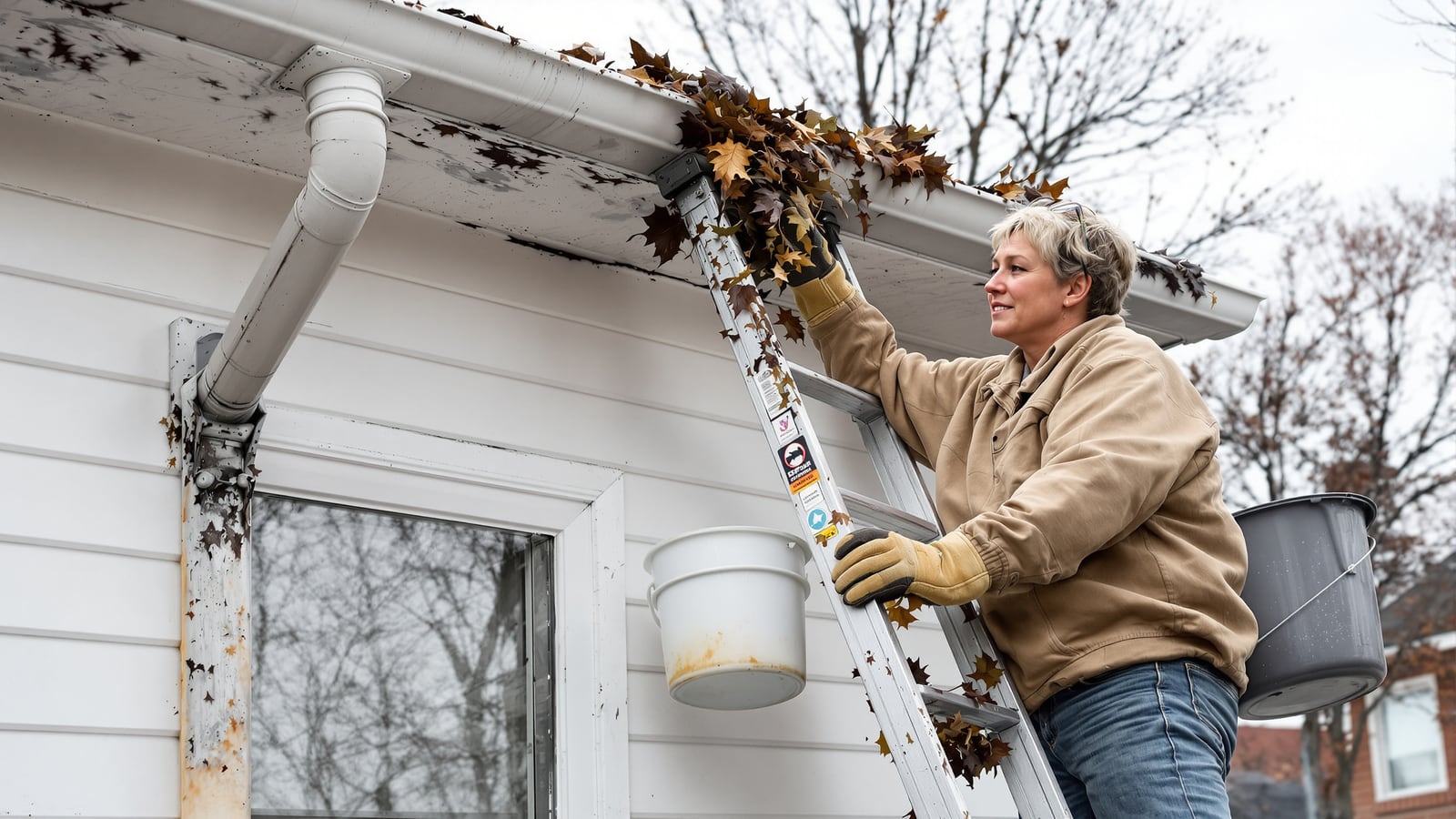
Then gutters. Pull the leaves out by hand in a work glove and flush with a hose. Watch the water go. If it spills over the edge, pools at a seam or drips from a joint, write it down. Downspouts should dump water at least five or six feet from the foundation. If yours empty at the wall, buy an extension. It's one of the cheapest fixes in the house and one of the most valuable.
Then the dirt
Look at the ground against the foundation. Builders aim for it to drop about six inches over the first ten feet, so rain runs away from the house. Over the years, soil settles and flower beds creep up. If water would run toward the wall, add soil and re-slope it.
Grandpa did this part on his knees with a spade. Then he checked the brick or siding where it meets the ground, and pushed the screwdriver into the wood trim, the door frames and the deck posts. Sound wood pushes back. Rotten wood lets the tip sink like it's cheese. When it sinks, you write it down, and you fix it this month, not next year.
Fall has its own outside jobs:
- Unhook the garden hoses and drain them. A hose left attached can freeze and split the pipe behind the wall.
- Shut off and drain the outdoor spigot if your house has a separate indoor valve for it.
- Check the caulk around windows and where siding meets trim, and recaulk the gaps you can slip a fingernail into.
- Trim any branch hanging over the roof.
Spring is the reverse. Look for what winter did. Cracks in the driveway, a heaved walkway, shingles in the yard, and any new wet stain on a wall.
Inside, where water hides
Take the flashlight to the attic first if you can get there safely. You're looking for three things: daylight where there shouldn't be any, dark stains on the wood, and insulation that's flattened and damp. Any of them says a roof leak, or a vent that's blowing wet air where it shouldn't.
Then work your way down, always the same order. That's the secret to a walk. If you do it differently each time, you skip the corner you hate.
Under every sink, run your hand along the pipes and the back of the cabinet. Dry is good. Damp is a slow leak, and it's cheap to fix before the cabinet floor goes soft. Look at the hoses behind the washing machine. If they're bulging, cracked, or older than you can remember, replace them. A washer hose that lets go while you're at work is a flooded house.
In the basement or crawl space, look for water lines on the walls and white powder on the concrete. If there's a sump pump, pour a bucket of water into the pit. It should kick on and empty. If it doesn't, you found out in October instead of during the storm. Also find your main water shutoff and make sure it turns. Grandpa made every grandchild put a hand on that valve. He said you don't want to learn where it is while the kitchen's filling up.
Check the furnace filter and swap it if it's gray. Check the manual for the water heater, because most call for an annual flush. Spring is also when you run the air conditioner for a few minutes to make sure it works, before the first hundred-degree weekend.
The part that can hurt you
Some of the walk isn't about money.
Press the test button on every smoke alarm and carbon monoxide alarm. Flip each one over and read the date. Smoke alarms are generally replaced after ten years, and CO alarms often sooner, so go by what the label says. Check the gauge on the fire extinguisher in the kitchen. The needle should sit in the green.
Clean the lint trap and look at the dryer vent hose. A hose packed with lint is a fire waiting for a hot afternoon. If you heat with a fireplace or wood stove, a chimney sweep once a year is the old rule and it still holds.
Know your limits. Electrical panels, gas lines and steep roofs belong to licensed people. Your job is to spot and write. Theirs is to fix.
The notebook is the whole trick
Every item went in the notebook with the date. At the end of the walk, Grandpa sorted the list into three piles: do today, do this month, call somebody. He never let the list sit longer than a season, because the next walk would be on top of it.
Over the years that notebook became a history. He could tell you the water heater went in the spring of a certain year and the roof was patched twice. It made him hard to cheat. When a contractor said a repair was urgent, Grandpa would flip back a few pages and ask how long that had been brewing.
The notebook also fed a savings habit. Every "call somebody" meant a number he'd need to have on hand. It's the same logic as the old cash rule: money set aside for the house is cheaper than money borrowed for the emergency.
If you rent
Do a lighter version and send it in writing. A text with a photo and a date to your landlord creates a record, and it protects your deposit. Skip anything involving a ladder or a wrench that isn't yours. Test your alarms, check under the sinks, look at the windows. A dripping pipe you reported in March is the landlord's problem. One you ignored until August can become yours.
Make it a team sport
Grandpa's walk always ended with the same question: "Anything over at your place I should look at?" He'd carry the ladder next door and hold it steady while a neighbor checked the gutter. They'd swap a favor for a favor. The front porch did a job the group chat can't, and a Saturday with a neighbor and a ladder is part of that job.
Afterward he'd leave the spring-day gutter scoop cleaned and back on its hook. That's how he did everything. He wouldn't leave a borrowed ladder with mud on the feet.
When Grandpa died, the house sold in four days. The inspector walked through with a clipboard of his own, flipped through the notebook I'd left on the counter, and shook his head. "Whoever wrote this," he said, "I'd have liked to shake his hand."
I keep the notebook now. It's on a nail by my basement stairs, and the last entry in my grandfather's handwriting is the one he never got to cross off: "Replace the washer hoses." I did it that same week.
Nina Castellan
BRO for Her
Runs the women-facing desk. Same standard, same tools, written for a different reader — not a softer one.

Watch
Worth an hour of your evening
More from Old School.
From channels we rate. Plays on YouTube.
Read next