

Cornhole is a waiting game. Spikeball isn't.
Cornhole has you throwing, then standing around. Spikeball keeps four people moving until someone's out of breath, and a backyard is all it needs.
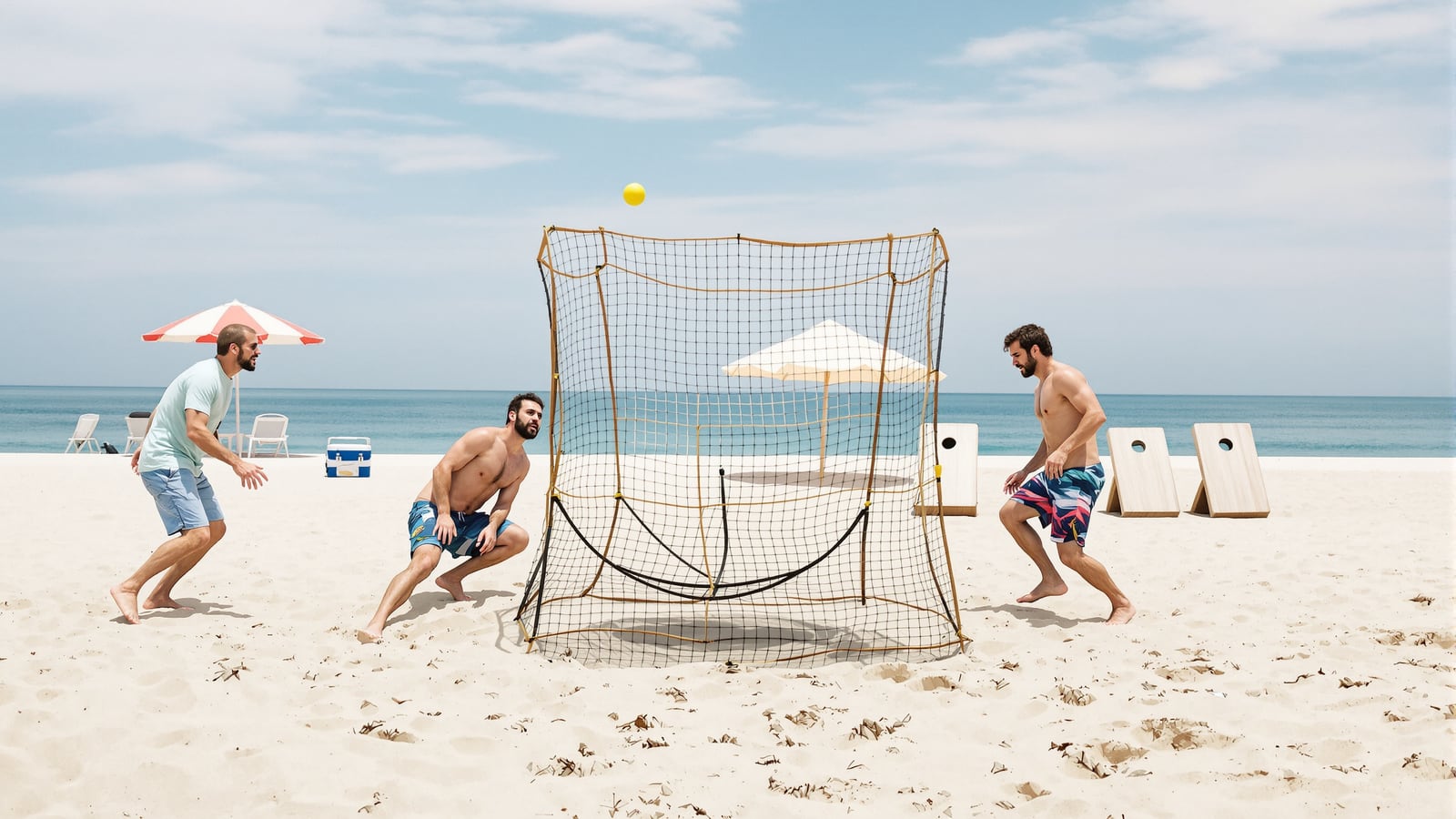
Quick answer: Two teams of two, a small net low to the ground, and a rally that doesn't stop until someone misses. Set it up on flat, mowed grass with about ten feet clear on every side. Play to 21. Rotate partners so nobody gets stuck with the best player forever.
Cornhole boards sit twenty-seven feet apart. A bag weighs about a pound and goes about as far as your wrist wants it to. Then you stand and watch the other guy throw.
That's the whole rhythm. Throw, wait, throw, wait. It's a fine rhythm for a cooler and a long conversation, and I'll defend cornhole for exactly that. But if you've ever looked around at a cookout and noticed three of the four players holding a drink and checking their phones between turns, you've seen the weakness.
Spikeball doesn't have turns. It has a ball in the air, and everybody's in it.
What actually happens in a rally
The net is a small round trampoline, about three feet across, sitting low on its frame. The server hits the ball down onto the net so it bounces up and across to the other team. After that, the receiving team gets three touches to send it back, and the ball has to hit the net on or before the third. There's no out of bounds. You can stand anywhere in a full circle around the net, so you're constantly moving to cover your side of it.
Two rules cause most of the arguments. The ball can't land on the rim, and you can't catch or hold it. It has to be a clean hit every time.
A good rally runs twenty or thirty seconds, which doesn't sound like much until you're in the middle of one, diving for a ball that skipped sideways off the net and landed an inch from the grass. Then you pop up laughing with a green knee. A game to 21 is over before anybody gets bored.
The setup mistake that kills it
Most backyard sets die after one afternoon because the net went up on a lumpy patch near the fence. Take five minutes first.
- Walk the area barefoot, or at least slowly, and look for sprinkler heads, holes, rocks and the dog's chew toys.
- Pick the flattest spot, even if it's in the middle of the lawn and you'd rather it be in the shade. A slope makes the ball behave badly and your ankles pay for it.
- Clear roughly a ten-foot circle around the net. That's where you'll be running and diving.
- Pull the net taut when you set it. If it sags, the ball dies on contact and the game goes flat. It should snap back when you hit it.
- Wear sneakers. Sandals and a diving save are a bad combination.
Wind matters more than you'd think. A light ball in a steady breeze will drift off the net, so turn the set so the wind runs along your serving line, not across it.
Make it work for the whole family
Here's where Spikeball earns its keep or loses it. The game is built for two evenly matched teams of athletic twenty-somethings. Put your twelve-year-old nephew and your father-in-law on the same net as a college soccer player and nobody has a good time.
Fix it with house rules.
Rotate partners every game. The strongest player takes the weakest as a teammate, then switches. It stops the scoreboard from turning into a verdict on anyone.
Give beginners an extra touch. Four touches instead of three for the newest player's side. They'll earn their way back to three in a week.
Let the server have a do-over. Nothing ruins the first hour like six missed serves in a row. Give everybody a second try until the motion comes naturally.
Keep score loose with kids. Play to 11. Stop when someone needs water.
And look out for knees. If you haven't done anything athletic since the last time the Olympics were on, the first game feels easy and the next morning doesn't. The piece on going back to your old sport at forty has the sensible version of the warmup. Five minutes of walking and easy lunges before the first serve is cheap insurance.
Where cornhole still wins
Be honest about it. Cornhole is better for a grandmother in a lawn chair. It's better when you want to talk about something that matters while you play. It's better on a tailgate with the whole group of twenty drifting in and out of the game. Anyone of any age or fitness can play it well enough in five minutes.
Spikeball asks for energy. It doesn't care if you're tired. If the group is mostly adults who'd rather sit, bring both. Spikeball goes up first while everyone's fresh, and cornhole takes over when the sun goes down and the burgers are done.
Make it a standing thing
The first game is easy. The fifth one is where it either becomes a habit or a dusty bag in the garage. Pick a day. Text the same three people. Say "Saturday, 4 o'clock, my yard" and mean it. I wrote about why somebody has to start the weekly game themselves, and nothing about that changes because the game has a net.
It also works for a father and a grown son who don't know how to spend an afternoon together. There's no silence to fill when you're both sprinting after the same ball. If that's your situation, read the easiest way back to your father is a three-hour game. Spikeball is a very good three-hour game.
One last thing. When you bring it to somebody else's place, leave the grass the way you found it. Fill any divots, pick up your water bottles, and take the set home with you. A host who gets asked back to the same yard every summer is a host who got treated right the first time.
The net weighs next to nothing. The ball fits in a cooler. You don't need a league, a court or a permit, and you can be playing in ten minutes.
Go set it up.
Marcus Vale
Editor-in-Chief
Twenty years in magazines, most of it deciding what to cut. Writes about work, discipline and the decisions that compound.

Watch
Worth an hour of your evening
More from Play.
From channels we rate. Plays on YouTube.
Read next