Horseshoes will outlast every cornhole set you'll ever buy
Two stakes, four steel shoes and a box of sand will survive rain, kids and your brother-in-law. Here's how to set up a pit that lasts.
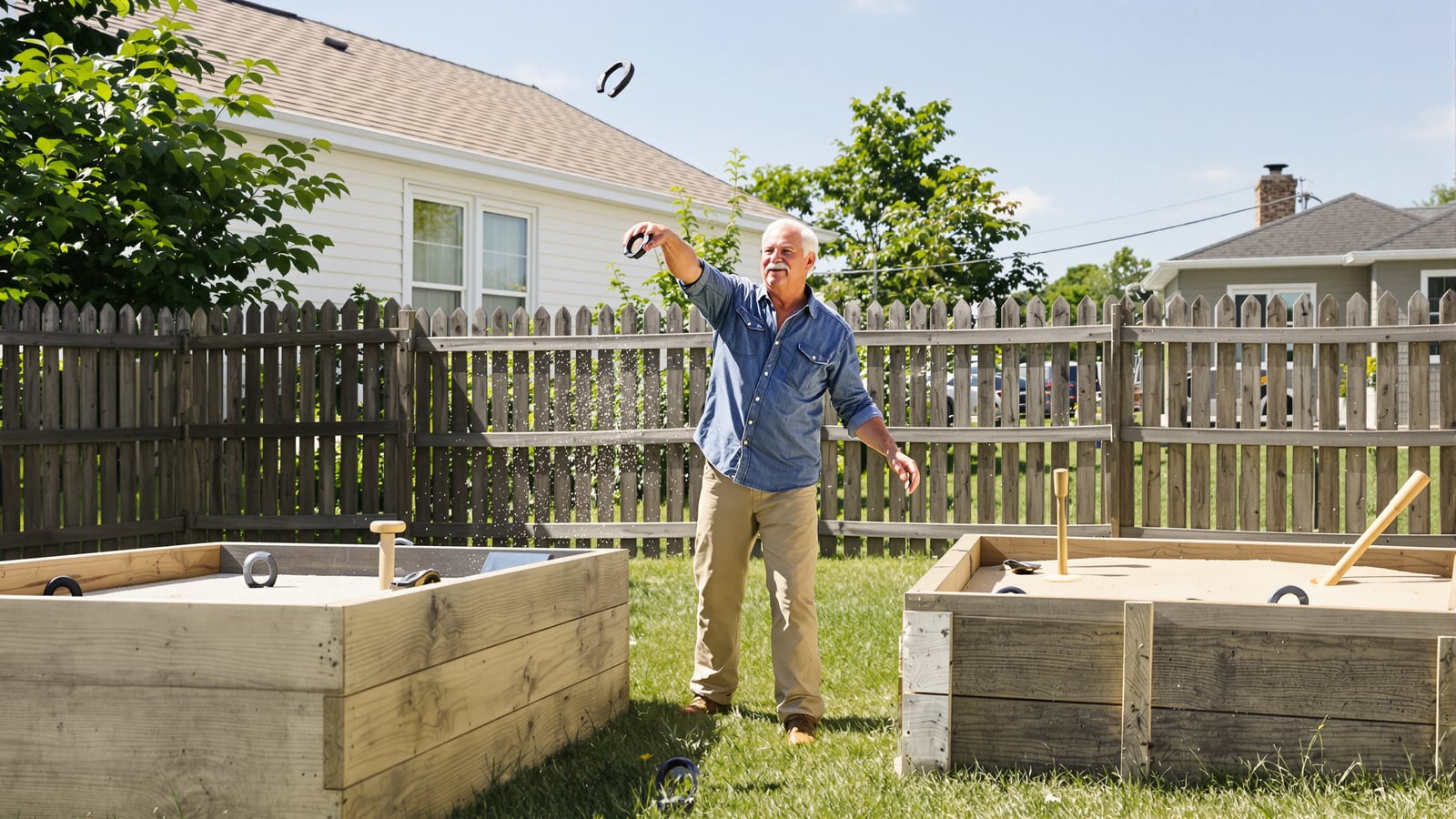
Quick answer: Drive two stakes 30 to 40 feet apart, with 14 inches showing above the ground. Frame a sand box around each one. Buy a set of forged steel shoes. Then leave the whole thing outside year-round, because nothing in it can be ruined by weather.
Try that with cornhole. Leave a set out through one wet October and see what you get: boards that swell at the seams, a finish that peels, and bags that grow a smell. Then the dog finds a bag. Cornhole is a fine game, but it's furniture that thinks it's equipment.
A horseshoe is a hunk of forged steel. Rain makes it rust a little. The next throw rubs the rust off. That's the entire maintenance schedule.
What you're actually building
A horseshoe pit is simple, and the simple version is the one that lasts.
- Two stakes. One-inch steel rod works. So does a purpose-made stake from a hardware or farm store. Sink it a foot or more into the ground so it doesn't lean after a month of ringers.
- Height and tilt. Official play puts the stake 14 inches above the surface, leaning a few inches toward the opposite stake. The lean helps a shoe that lands on it stay on it.
- Distance. Official pitching distance is 40 feet for men and 30 for women and juniors. In a backyard, use whatever fits. Thirty feet is a good default and keeps the game friendly for everybody.
- A box of sand around each stake. Roughly three feet by six, and several inches deep. Sand lets a shoe land and stay put instead of bouncing across the lawn. Clay is the traditional choice, but sand is easier to get and easier to fix.
- A backstop. A couple of treated boards set on edge behind the pit, or a fence or hedge. Without one, a missed shoe becomes a lawn-mower problem or a neighbor problem.
Frame the box with pressure-treated lumber and you've spent an afternoon and not much else. Landscape fabric under the sand keeps the weeds out. Pitch a tarp over it if you like, but you don't have to.
What goes wrong
The annoying part comes first: the stakes. People pound a stake in with the heel of a boot, call it good, and by the Fourth of July it's leaning the wrong way. Use a sledge. Check it with a level, or just step back and eyeball it against the other stake. Do it before the first game and not in the middle of one.
The sand migrates. It gets kicked out and scattered, and rain eventually packs it. Rake it loose and level before you play, the way you'd smooth a bunker. Every few months, add a bag.
Rust is cosmetic, but it'll stain a white shoe or a light-colored deck. Keep the shoes in a bucket by the pit and not on the patio.
And let's be honest about the other trade-off. Steel is heavy. A regulation shoe tops out around 2 pounds 10 ounces, and four of them in the hands of a nine-year-old is a safety conversation. Keep spectators behind the throwing line and well off to the sides. Nobody walks toward the pit until everybody has thrown. If young kids are playing, drop to the lighter rubber or plastic shoes. They won't last like steel, but they'll last longer than cornhole bags.
Buy once
Sets of four steel shoes are cheap next to what a decent cornhole set costs. Look for a one-piece forged shoe, not a thin stamped one. If the set comes with stakes, check that they're thick and straight, and replace them with a longer rod if they're short.
Skip the novelty sets: chrome-colored, oddly shaped, and sold as décor. They aren't built to be thrown.
Buy two pairs of colors so you can tell whose shoes are whose from forty feet. Paint a stripe on the heel of the ones that don't already have a color.
How to throw one
You don't have to learn the real technique to have a good time. But it's easy to improve fast.
Hold the shoe by one side of the open end, thumb on top. Stand beside the stake, not behind it. Step with the opposite foot, swing the arm like you're bowling, and release at about waist height. The shoe should turn over once and a quarter on the way, so the open end faces the stake when it lands. That's the classic flip. Others throw a slower turn-and-a-half. Pick one and repeat it, because consistency matters more than style.
Most beginners throw too hard. Smooth beats strong. If it's bouncing out of the sand, you're overthrowing.
Scoring that doesn't need a lawyer
The official game uses cancellation scoring: a ringer, which is a shoe that encircles the stake, is worth 3 points. A shoe within six inches of the stake is worth 1. If both players ring it, those cancel. Play to 40 points, or any number you like.
For a cookout, simplify. Closest shoe to the stake gets a point, ringer gets three, first to 21 wins. The rules are small enough to explain to a guest while he's already holding a shoe.
Why it earns its patch of lawn
Horseshoes make a better evening than cornhole for a reason that has nothing to do with steel. It's a slower game. You throw, you walk to the other end, you talk. You throw back. Somebody makes a ringer and the whole yard reacts. It doesn't need a speaker or a screen, and an eighty-year-old can compete with a twelve-year-old because the technique matters more than the strength.
That's why it works for the two things this section keeps coming back to. It's a perfect excuse to start a weekly game yourself, and it's a good reason to call your dad. A pit gives people something to do with their hands while they talk, and the easiest way back to your father is a three-hour game. Horseshoes fits that description better than most.
It also fits the old rule about leaving a place better than you found it. Rake the pit when you're done. Put the shoes back in the bucket. If you're playing at somebody else's house, show up with a bag of sand before the first game and not after the complaint.
Set it up this weekend. Drive the stakes properly. Throw badly for a month. Then watch what happens the first time you ring one from forty feet while your brother-in-law is watching.
Marcus Vale
Editor-in-Chief
Twenty years in magazines, most of it deciding what to cut. Writes about work, discipline and the decisions that compound.

Watch
Worth an hour of your evening
More from Play.
From channels we rate. Plays on YouTube.
Read next