Cornhole quits in November. Shuffleboard doesn't.
A driveway, a roll of tape, a push stick and eight discs. That's a game you can play in a jacket in January with your kids, your dad or the neighbor.
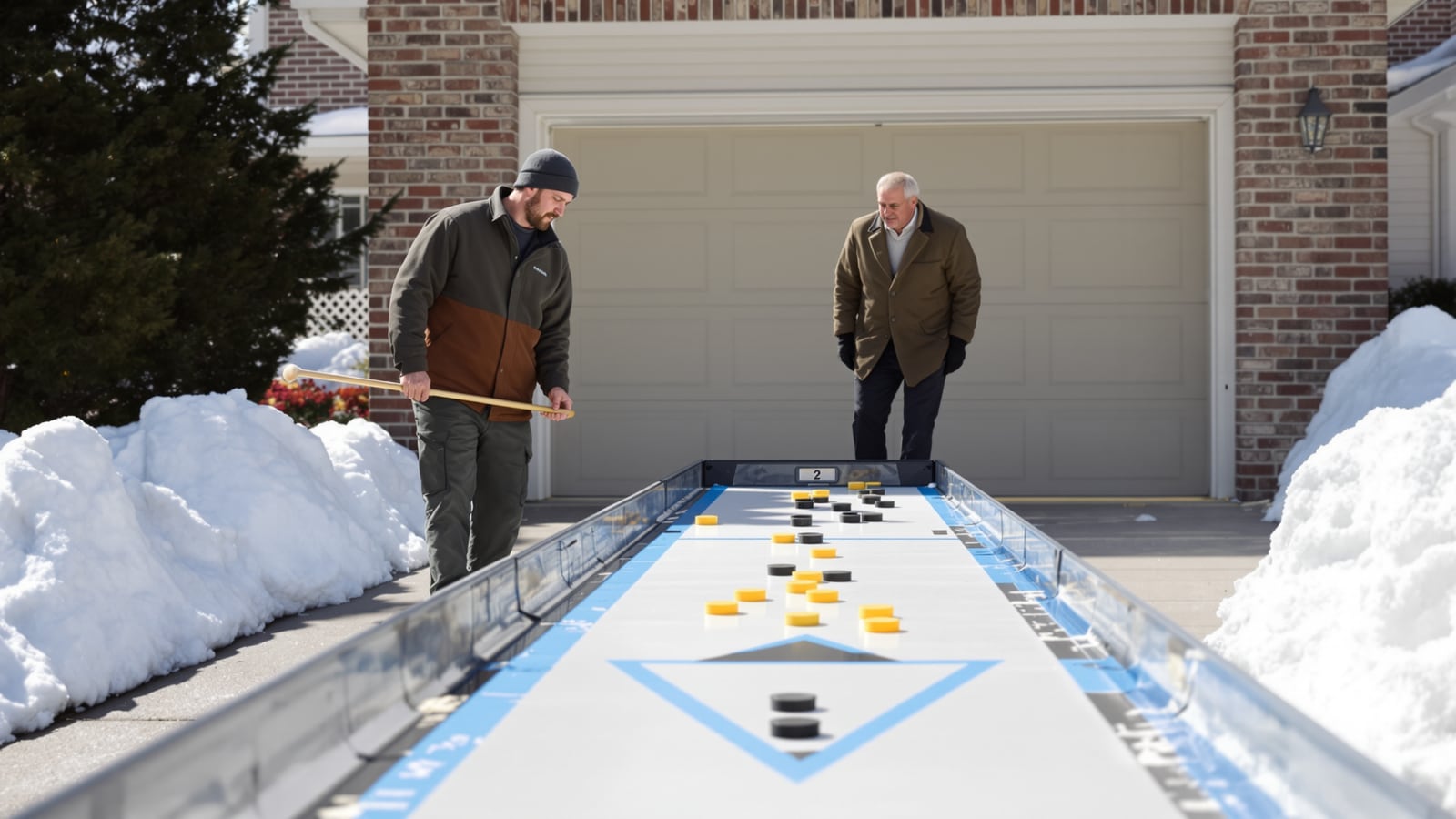
Quick answer: Tape a lane on a flat, smooth stretch of driveway, add a scoring triangle at each end, buy one set of cues and discs, and play to 50. Check the slope first, because a tilted driveway ruins the game.
Why the bags lose in winter
Cornhole is a fine game. It's also a fair-weather one. Bags soak up a drizzle and turn into small wet sandbags. In a hard cold they stiffen and stop sliding the way they should. The boards want a garage, and the whole rig wants a flat patch of lawn and a warm afternoon.
Shuffleboard asks for none of that. The discs are hard plastic or composite. Rain doesn't hurt them, wind doesn't move them, and a cold hand doesn't change how one slides. Your driveway is already a court. You just haven't marked it yet.
Is it better than cornhole in July at a tailgate? No. Cornhole travels, and a seven-year-old can sink a bag on the first throw. But you can play shuffleboard from March to December and, with a shovel and some sense, in the months between. Nothing else on your lawn can say that.
Check the driveway first
This is the step people skip, and it's the one that decides everything.
Set a tennis ball or one of the discs at the high end and let go. If it drifts to one side, or runs downhill and keeps going, the surface has a slope. A little pitch toward the street for drainage is normal and you can play through it. A lot of it turns every shot into a guess about gravity.
You also want smooth concrete or sealed asphalt. Broom-finished concrete with a rough texture grabs the discs and kills your slide. Cracks, oil stains and patches of gravel all change how a disc runs. Before every session, take a push broom to the lane. A single pebble can send a good shot sideways, and then you'll be arguing with an eleven-year-old about it.
Mark the court
Painters' tape or wide masking tape works, and it comes up when you're done. Sidewalk chalk works for a single afternoon. Paint is permanent, so use it only if the driveway is yours, the rules of your neighborhood allow it, and you've made your peace with a court on your driveway forever.
A regulation shuffleboard court is 52 feet long. You don't have that, and you don't need it. These are house dimensions, not official ones:
- The lane: about three feet wide, with as much length as the driveway gives you. Twenty to thirty feet is plenty.
- The shooting line: tape a line a few feet in from each end. You shoot from behind it.
- The scoring triangle: at each end, tape a triangle with the point toward the shooter. Split it into zones worth 10 at the tip, 8 in the middle and 7 at the base. Put a small "kitchen" zone just ahead of the 7, and give it a score of minus 10.
That kitchen is the whole personality of the game. It punishes the shooter who got greedy and slid one inch too far short of the triangle. Everyone loves it except whoever's in it.
What to buy
One purchase. Get a set of shuffleboard cues and discs, four discs of each of two colors. The cues are long push sticks with a curved head that catches the edge of a disc, and they're what let you shoot from a standing position without bending over.
You can spend more on nicer ones, but a basic set does the job. Skip anything labeled for tabletop play, because those discs are too small for a driveway.
You might see someone online recommend sliding hockey pucks or flat cans with a broom handle. Don't. You'll spend an hour fighting equipment that wanders off the lane.
How it's played
Two players, or two teams. Each side gets four discs. Players alternate shots from the same end, so you're shooting at the other player's discs as well as at the triangle.
A disc scores only if it sits completely inside a scoring zone and doesn't touch a line. Discs that land on a line don't count. After all eight discs are shot, you tally the points, then walk to the other end and shoot back the other way.
Play to 50 for a quick game. Play to 75 if you want the neighbors to stay a while.
The strategy is where it earns its keep. You have two jobs on every shot. You can land your own disc in the triangle, or you can knock a rival's out of it. Many first-timers take the second option too early. The better habit is to put a couple of discs in scoring position first, then spend the last shots defending them.
The last shooter of an end has a built-in edge, because he sees where everything is parked and gets the final say. Players call it the hammer. Alternate who shoots first, and nobody feels cheated.
Playing in the cold
A winter court is the best part of this. Shovel the lane, push-broom it down to bare surface, and tape your lines on dry concrete. Tape doesn't stick to a damp or frosty driveway, so wait for the afternoon sun, or use chalk.
Don't play on ice. A thin glaze you can't see is the real hazard, because the shooter takes steps while following his disc. Look at the surface before the first shot. Wear boots with a grip. If the lane isn't clear, call it a day and go inside.
Cold isn't a problem for the discs, but it makes your hands and the cue stiff. A pair of thin work gloves helps.
Where it pays off
Shuffleboard is a good game for a family, because a father and son or a mother and daughter can stand at the same end and play the whole thing without raising their voices. It's slow enough to talk during. Everyone has time to watch the shot unfold. And it doesn't favor the guy in the best shape, so a grandfather can beat a grandson without anyone pretending.
It's also an easy reason to get the neighbors over. If you want to play weekly, look at start the weekly game yourself, because nobody else will. If it's your own dad you've been meaning to spend a Saturday with, the easiest way back to your father is a three-hour game makes the case, and a driveway court gives you the game. And when the weather finally does shut you down, the board games that actually get played twice has the indoor backup.
Tape the lane this weekend. Give the first game to whoever's youngest, and tell him you let him win. Don't.
Marcus Vale
Editor-in-Chief
Twenty years in magazines, most of it deciding what to cut. Writes about work, discipline and the decisions that compound.

Watch
Worth an hour of your evening
More from Play.
From channels we rate. Plays on YouTube.
Read next