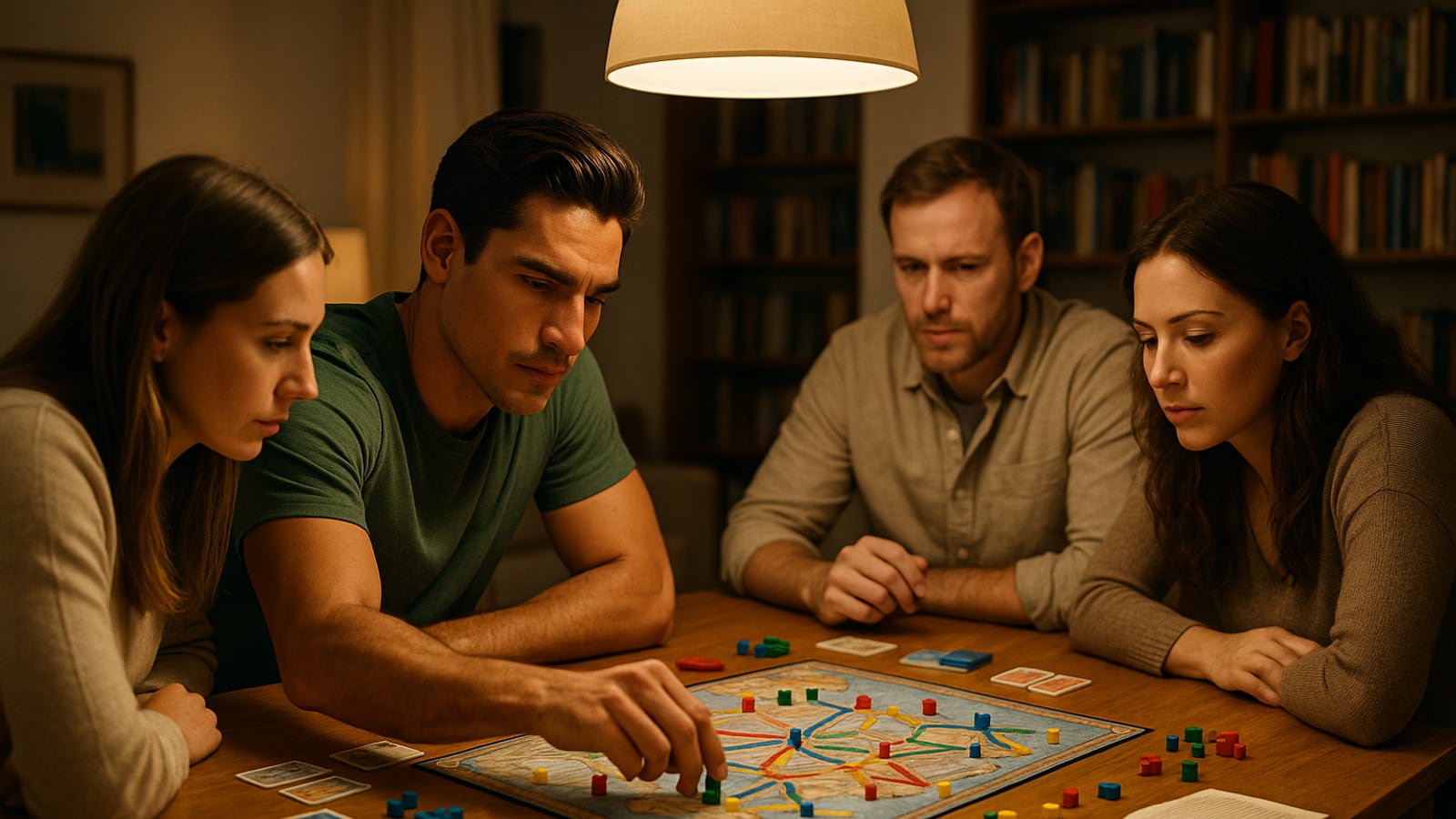
The only test that matters is whether it comes back out. Plenty of games will win one evening. Big box, good art, everyone's polite about it. Then it goes on the shelf and stays there, because nobody wants to relearn it and nobody wants to be the one who suggests it.
Three things kill a game. It takes forty minutes to explain. It takes four hours to play and nobody knew that going in. Or your choices don't feel like they matter, so the whole thing is just moving pieces until someone wins.
Fix those three and you'll build a shelf of eight games you play constantly instead of forty you own.
Count the real clock, not the box
The box says 60 minutes. That's the play time for people who already know the rules, playing at pace, with the pieces already sorted.
Your real number is teaching plus setup plus play plus the two conversations that break out halfway through. For a weeknight, you want the whole thing — from sitting down to standing up — inside two hours. For a Saturday you've got more room, but say so in advance. "This one's a three-hour game" is a completely different invitation than "want to play something?"
The other number to check is player count. Most games have one count where they sing and two where they drag. A four-player game played with six often means you're waiting three times as long between decisions. If your regular group is five, buy for five.
Two mechanics to avoid outright
Player elimination. Games where you can lose in the first hour and then watch. Classic war games do this, and so does the game everybody's parents owned about buying property. Losing is fine. Losing and then sitting there for ninety minutes isn't an evening.
Downtime with no decisions. If there's nothing to think about while other people take their turns, the phones come out and never go back in. Good games give you something to plan while you wait.
There's a third problem worth knowing by name: quarterbacking. It shows up in cooperative games, where everyone's information is open, so the most experienced player at the table ends up quietly telling everyone what to do. You can beat it with a house rule — you advise only when asked — but know it's coming.
Four games cover almost every evening
Not a shopping list. A shape. Fill each slot with one game you actually like and you're set.
The one for people who don't play games. Teaches in five minutes, plays in under an hour, and the decisions still feel like yours. Ticket to Ride is the standard for a reason: you're collecting cards and claiming routes, and the tension of holding a card one turn too long is the whole game. Azul does the same job with tiles and looks beautiful on a table. 7 Wonders scales up and finishes fast because everyone plays at the same time.
The one for eight people in a kitchen. Different animal. You want a game where the noise is the point. Codenames splits into two teams and runs on one-word clues, and it works with people who've never played anything. Just One is cooperative and takes about ninety seconds to explain. These are the games to reach for when the group is too big and too loud for anything with a board.
The two-player game. Underrated slot. This is the one you play with your wife after the kids are down, twice a week, for years. It has to set up fast and finish in half an hour. Jaipur is trading and pure tension. Patchwork is a quiet puzzle with real teeth. 7 Wonders Duel gives you a full civilisation arc in about thirty-five minutes. And don't dismiss backgammon — it's been holding up for a very long time, the rules fit on a card, and you can play it well for the rest of your life.
The heavy one. One game, planned in advance, where five or six hours is the point. Brass: Birmingham gives you canals, rails and an economy that punishes sloppy planning. Concordia is almost pure strategy with barely any luck. Terraforming Mars sprawls across the table and takes a while to set up, but the engine you build is deeply satisfying. Buy one of these, not three. Learn it properly. It becomes the game your group is known for.
The one nobody expects to love
Crokinole. A wooden board, wooden discs, and you flick them at a center hole while knocking your opponent's discs off the surface. No rules to learn beyond "you must hit an opponent's piece if there's one on the board."
It's the closest thing to a sport you can play at a kitchen table. It works with men who say they don't like board games, because it isn't really a board game — it's a skill you get visibly better at. A good board costs real money and lasts decades, and it gets played by grandparents and eight-year-olds without anyone adjusting the rules.
Teach it properly or don't bother
Never read the rulebook aloud at the table. You'll lose the room in four minutes.
One person learns the game beforehand. Properly. Set it up alone, play two turns as every player, find the bit that's confusing. Then teach it in this order:
- What you're trying to do. "You're building the best railway network in the Midlands. Most points wins."
- What you do on your turn. The three or four options, no exceptions yet.
- How you score. People play better when they know what's rewarded.
- The exceptions. Only the ones that'll come up in the first round.
Then play the first round with everyone's cards face up, offering advice freely. You lose a bit of purity. You gain four players who understand the game by turn three instead of turn nine.
Getting the kids in
The trick isn't buying children's games. It's finding real games with a low reading load and a short clock. Kingdomino has kids matching landscape tiles and doing genuine spatial planning. Carcassonne works at eight and works at forty. No Thanks is a tiny card game about when to take a bad number, and children beat adults at it regularly, which is the point.
Team play solves the rest. Put a seven-year-old on your side of a two-player game and let them make half the decisions. They learn faster with a hand on the wheel than watching from the sofa.
Run the night, don't hope for it
A fixed date beats a good intention every time. Second Thursday. Every month. People protect a slot that repeats.
Food that doesn't leave grease on cards — that rules out most of what you'd normally put out, so think crackers, nuts, cut fruit, and a cloth on the table. Start at a real time and say when you'll finish. Have the game already set up before the first person arrives, because forty minutes of punching out cardboard tokens isn't hosting.
And keep one short game in reach for when the main event ends early and nobody wants to leave yet.
My oldest beat me at Jaipur last spring, fairly, three games straight. He's been telling people about it since. That's not really about the cards.
Dean Shaw
Gear & Garage
Tests things until they break, then reports what broke first. Trucks, tools, watches, and the cheap version that costs more.

Watch
Worth an hour of your evening
More from Play.
From channels we rate. Plays on YouTube.
Read next