Going back to your old sport at forty without tearing anything
Your lungs come back in three weeks. Your tendons take three months. Most comeback injuries happen in the gap between the two.
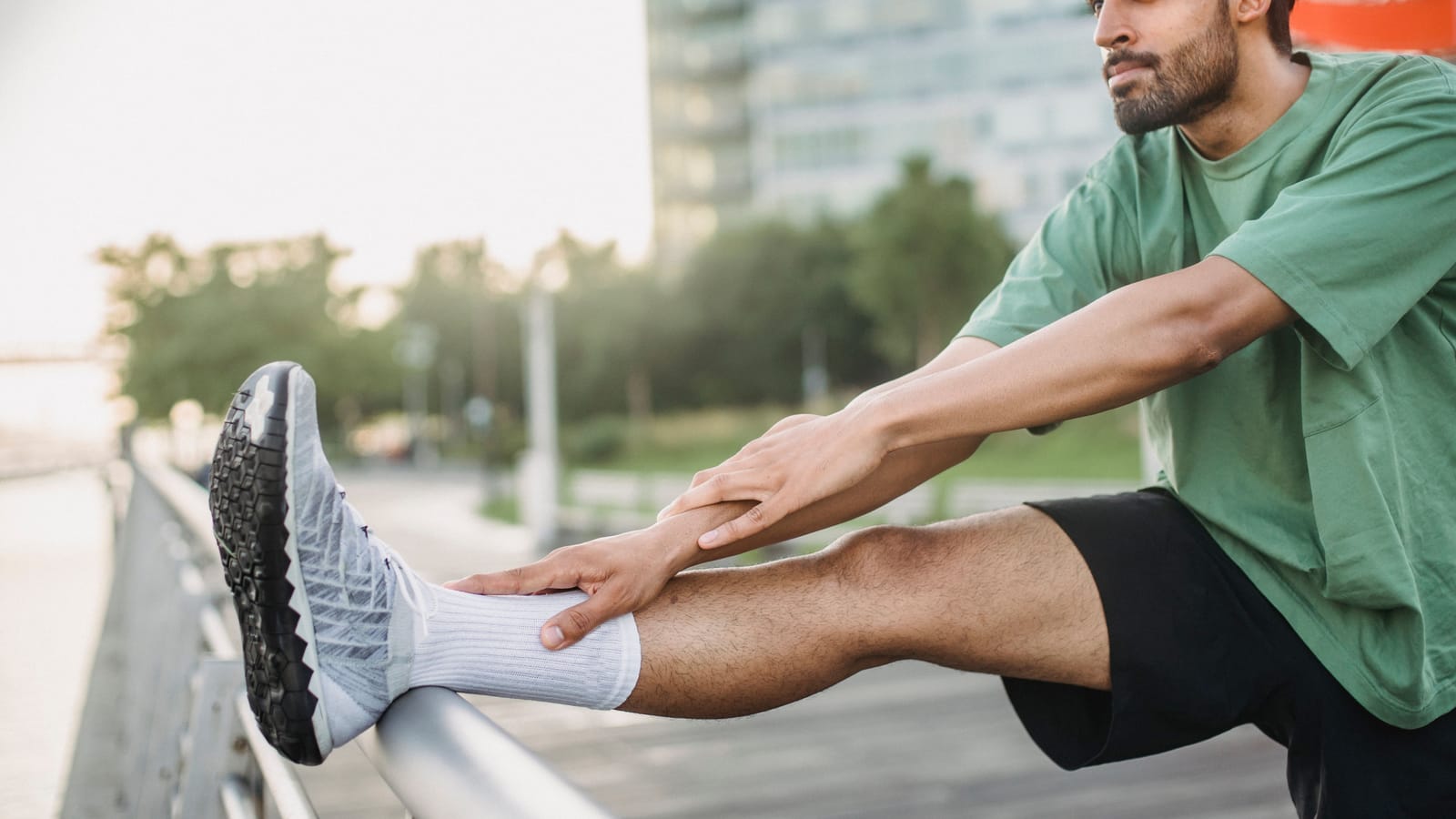
The injury that ends most forty-something comebacks happens somewhere between week three and week six. Not week one. Week one you're too unfit to hurt yourself badly. By week four your lungs have caught up, your touch has come back, and you feel like you did at twenty-five. Your Achilles tendon hasn't received that memo.
That's the whole problem in one sentence. Cardiovascular fitness adapts fast. Muscle adapts reasonably fast. Tendon, ligament and cartilage adapt slowly, and they don't send progress reports. So your engine writes checks your chassis can't cash, and you go down chasing a ball you had no business chasing.
Everything below is built around closing that gap on purpose.
Know what your sport actually breaks
Every sport has a signature injury, and it's almost always the thing that happens when a cold, tired, or over-keen body is asked to produce maximum force very suddenly.
- Basketball, soccer, squash, tennis: Achilles and calf. Sudden acceleration, deceleration, and jumping off one leg. Also ACL, usually on a plant-and-cut.
- Running: the slow-build injuries. Shin pain, plantar fascia, knee pain that arrives at mile four and goes away by mile one the next day, until it doesn't.
- Hockey, softball, cricket: groin and hamstring. Explosive sprinting from a standing start is the single most reliable way to tear a hamstring in adulthood.
- Jiu-jitsu and wrestling: neck, ribs, fingers, and whatever the training partner who won't let go of a submission decides to target.
- Overhead sports: shoulder and elbow, and they creep up over weeks rather than announcing themselves.
Pick your sport, find your signature injury, and spend eight weeks making that specific tissue strong before you ask it to perform under pressure. That's the plan. The rest is detail.
The eight-week on-ramp
Don't play a competitive game in your first month. This is the single hardest rule to follow and the one that saves the most seasons.
Weeks one and two. Twice a week, twenty to thirty minutes of the movement of your sport at maybe sixty percent. Dribble, hit against a wall, skate laps, jog easy, drill technique. No score. No opponent. You're teaching connective tissue that impact is back on the menu.
Weeks three and four. Add speed in small controlled doses. Six to eight short accelerations, fifteen or twenty meters, with full rest between them. Start at about eighty percent and build. This is how you inoculate a hamstring: brief, fast, fresh, and never when you're gassed.
Weeks five and six. Add change of direction. Shuttles, figure-eights, plant-and-cut drills at increasing speed. Add jumping and landing if your sport needs it, and pay attention to how you land, not how high you get.
Weeks seven and eight. Play, but on a leash. Half a game. Twenty minutes of light sparring. One set of tennis, not three. Leave while you still have something in the tank, every single time.
That's two months before your first real game. It feels absurd. It's far less absurd than eight months in a boot.
Two strength sessions a week, forever
This is the insurance policy, and it's not optional after forty. It doesn't need to be long. Thirty-five minutes, twice a week, covering four things.
Heavy, slow calf work. Standing calf raises and seated calf raises, three seconds up, three seconds down. Tendon responds to slow heavy loading better than to bouncing. If you play a jumping or sprinting sport, this is the highest-value exercise you can do.
Single-leg strength. Split squats, step-ups, single-leg deadlifts. Sport happens on one leg at a time and almost all of your asymmetries live here. You will discover your left side is noticeably worse than your right. Everyone does.
Hamstring work with a lengthening component. Nordic curls if you can manage them, Romanian deadlifts and slider leg curls if you can't. Hamstrings tear while being stretched under load, so train them that way.
Upper body pulling and pressing. Rows, pull-ups or assisted pull-ups, overhead press, push-ups. Shoulders that can't hold position get hurt, and a strong back makes falling less eventful.
Keep it to two or three sets of each. Stop a couple of reps short of failure. The point isn't a training log you can be proud of, it's tissue that tolerates Saturday.
Warm up like an adult
Twelve minutes, every time, no exceptions, and none of it is sitting on the floor pulling on a hamstring.
Five minutes easy movement until you're genuinely warm. Then leg swings, hip circles, lunges with a reach, ankle rocks. Then skips and lateral shuffles. Then three or four build-up sprints, the last one at close to full pace.
That last part is what most people skip, and it's the part that matters. Your first sprint of the day is going to happen either in a controlled warm-up or twenty seconds into the game while you're cold and someone's put a ball behind the defense. Choose.
Cap the dose before your ego does
Limit yourself to one competitive session a week for the first couple of months. Two hard days should never be back to back. Your recovery window at forty-five is longer than it was at twenty-five, and no supplement changes that. Sleep does. Eight hours is the actual performance intervention.
Then manage the specific moments that hurt people. The loose ball at minute fifty-five when you're already spent. The overhead smash you can't quite reach. The twenty-two-year-old who wants to go hard in your first week back on the mats. You're allowed to let all of those go. Nobody is watching, and the people who are don't care.
Over-35 and masters divisions exist because this problem is universal. They're also better company.
Soreness versus a real problem
General muscle soreness for a day or two, achy and diffuse, easing with movement: normal, and it improves as you adapt.
Get it looked at if you have swelling in a joint, pain right on the joint line, sharp pain at a single point you can put a finger on, a knee or ankle that gives way, pain that wakes you at night, or anything that made a popping sound at the moment it happened. A physical therapist or sports physician can sort a six-week problem from a six-month one, and the early version of that conversation is always cheaper. Don't buy a brace to manage something you haven't had diagnosed.
Gear, briefly
Shoes matched to your surface, replaced when the midsole is dead rather than when the upper looks bad. Court shoes for court sports; running shoes have no lateral support and that's how ankles roll. A mouthguard for anything with contact. Good socks. That's genuinely most of it.
What you're actually training for
The goal isn't this season. It's being the fifty-eight-year-old who still turns up on Thursday nights, still moves well, still gets picked.
That guy exists at every club. He's never the one who came back hardest in March.
Cal Brennan
Fitness
Strength coach. Trains fathers, tradesmen and desk workers, which means programs that survive a bad week.

Watch
Worth an hour of your evening
More from Play.
From channels we rate. Plays on YouTube.
Read next