Start climbing at the gym, end up on real rock
Rent the shoes, learn to belay, keep your fingers attached, and know exactly what the gym never taught you before you touch stone.
Rent the shoes the first time. They'll be a half size too big, they'll smell like every foot that came before yours, and they'll cost about five dollars on top of a day pass that runs $20 to $30 in most cities. Buy nothing else yet. The first session's only job is to tell you whether you enjoy being scared and exhausted at the same time.
What'll actually happen is this. You'll get up two easy walls feeling like an athlete. On the third, your forearms will swell, go hard as a two-by-four, and stop answering. That's a flash pump, every new climber gets one, and it means you're squeezing the holds like they owe you money. You're done for the day about forty minutes in. That's normal. Go home.
Ropes or boulders, and why it matters in week one
Bouldering is the short walls with the thick pads. No rope, no partner, 12 to 15 feet, problems marked V0 on up. It's social, it's immediate, and it's where new climbers wreck their fingers because every move is hard and there's no rest.
Roped climbing is the tall stuff. Most gyms have auto-belays, which are retractable devices you clip to your harness and climb solo. You'll use those more than you expect.
Do both, but lean on the ropes for the first couple of months. Long easy routes build the endurance and the footwork that make the hard stuff possible later. Bouldering will happily let you skip all of that and go straight to a finger injury.
Shoes first, and not the aggressive ones
When you decide you're staying, buy climbing shoes before anything else. A flat, comfortable pair — La Sportiva Tarantulace, Scarpa Origin, Black Diamond Momentum — runs roughly $90 to $120 and will outperform any rental you'll ever tie on.
Buy them snug. Not agonizing. Your toes should be flat or barely curled, and you should be able to stand in them for a full route without thinking about it. The downturned banana-shaped shoes in the display case are built for steep overhangs and people who already know how to climb. They'll teach you nothing except how to take your shoes off between burns.
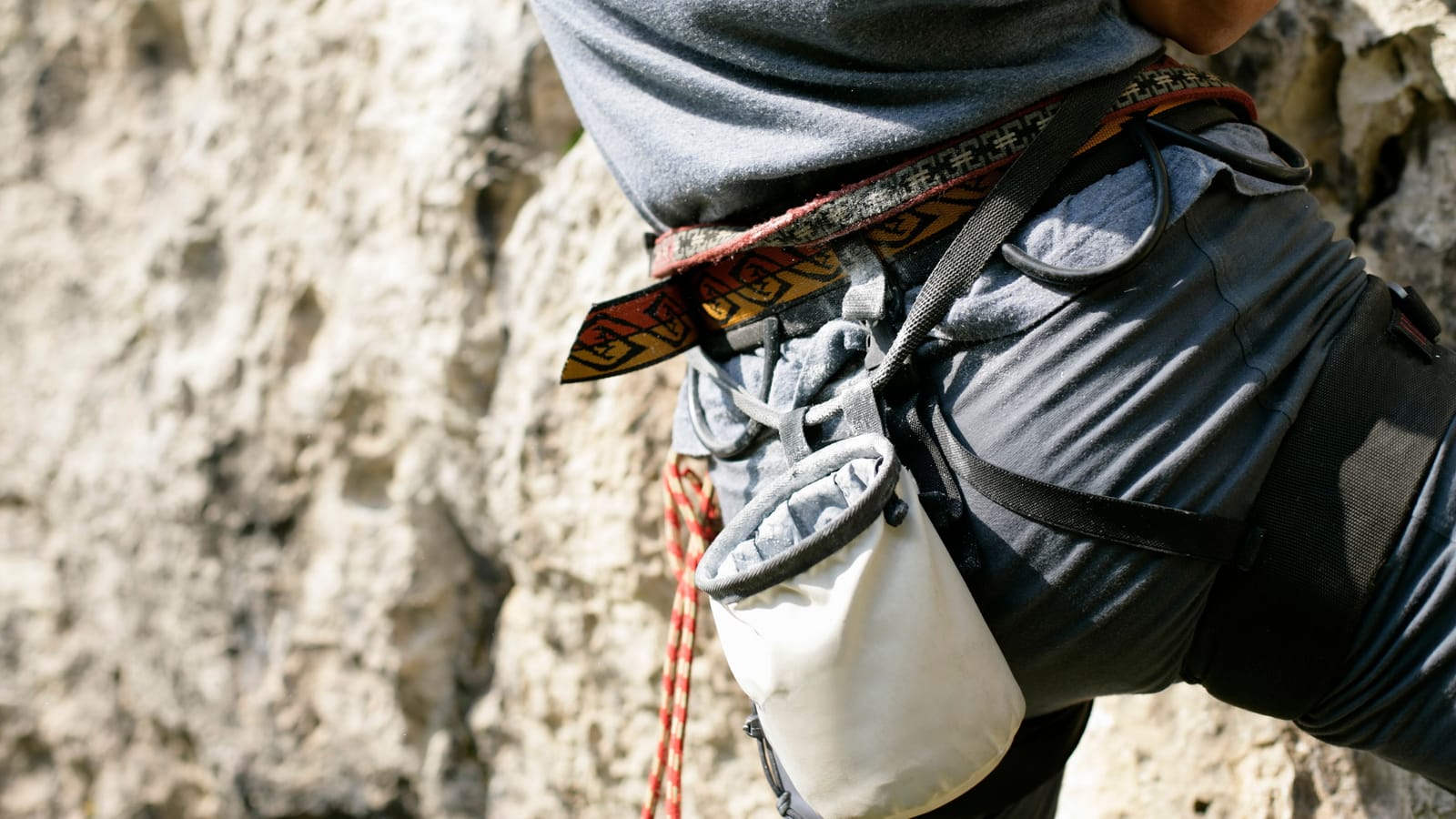
Chalk bag, about $20. Harness, $60 to $80 for something like a Black Diamond Momentum or a Petzl Corax. A belay device and a locking carabiner, another $30 for a tube style, closer to $100 if you go straight to a Grigri. That's the whole kit. You're under $250 and you own everything you need for two or three years of gym climbing.
Get belay certified in the first month
Every gym runs a belay test. It takes an hour, it's usually free or cheap with a membership, and it turns you from somebody who needs a partner into somebody who is a partner. That's the difference between climbing twice a month and climbing twice a week.
Learn on a tube-style device first. Learn to keep your brake hand on the rope always, to stand close to the wall, to watch your climber instead of your phone. Then get the Grigri and learn it properly, because the assisted brake makes people lazy and lazy belayers drop friends.
The best compliment in a climbing gym isn't about a grade. It's somebody asking if you're free Thursday because they trust your hands.
The skill is your feet
New climbers pull. Good climbers stand. Watch anybody who's been at it five years and you'll notice they're on straight arms most of the time, hanging off skeleton instead of muscle, and their feet land on a hold once and don't readjust.
Two drills that fix this fast:
- Silent feet. Climb an easy route without making a sound with your shoes. If you hear a scrape or a thud, you're dropping your foot instead of placing it.
- Straight arms. On every easy route, hang from locked-out elbows between moves. If you're pulled in at 90 degrees the whole time, you're burning your forearms for no reason.
Do those for a month on routes two grades below your limit. It's boring. It works.
Your tendons are slower than your muscles
Here's the injury nobody warns you about until it's happened. Your pulleys are the little bands that hold your finger tendons against the bone, and they take months longer to adapt than your arms and back do. Around month four you'll feel strong, you'll crimp something small and steep, and you'll hear a pop.
So: no hangboard, no campus board, no fingerboard, for the first full year. Climb on open hands where you can. If a finger aches for more than a couple of days, back off and see a doctor who treats climbers rather than asking the internet.
Two or three sessions a week with a rest day between them is plenty. Three months in you'll be climbing V2 or V3 and 5.9 to 5.10 in most gyms, and you'll have the shoulders to show for it.
The gym didn't teach you to climb outside
It taught you to move on rock. Those are different jobs.
Outside there are no colored holds, so you have to read the stone. Rock breaks, so you wear a helmet. Weather changes, the approach hike is forty minutes each way, and the fixed gear on the wall was placed by somebody you've never met at a date nobody recorded. Grades are stiffer too. Expect outdoor 5.9 to feel like gym 5.10, and expect to love it anyway.
Don't learn this from a video. Two honest options: hire a guide from an AMGA-accredited service for a day of single-pitch instruction, or go out repeatedly with an experienced climber who'll teach you and correct you. A guided day typically runs $150 to $250 per person in a small group, and it's the cheapest insurance you'll ever buy.
Cleaning the anchor is the part that hurts people
At the top of an outdoor sport route, you have to transfer yourself onto the anchor, thread your rope through it, and get back on belay. Every step of that has to be done in an order that never leaves you unattached, and it must be learned in person, on the ground, under somebody's eye, until it's automatic.
While you're at it: a knot in the end of the rope, always. Ropes that are too short for the rappel account for a grim number of accidents, and a stopper knot takes four seconds.
Your first day outside, don't lead anything. Follow. Let the experienced person set the rope, and spend the day learning to look at real stone.
Pack it, park it, leave it
Bring more water than you think, a headlamp, a small first aid kit, and shoes you can hike in. Park where the signs tell you, not where it's convenient. Pack out your tape and your energy bar wrappers and somebody else's too. A lot of crags sit on private land or on access that volunteers fought for, and it evaporates the moment climbers start acting like guests who won't be invited back. Support the Access Fund if you end up going a lot.
Take your wife. Take your kids. A top rope at a friendly single-pitch crag is one of the few outdoor sports where an eight-year-old and a forty-five-year-old can have an equally good day, and your kid belaying you is a trust exercise that beats anything a corporate retreat ever invented.
The gym is a great place to get strong. It's a terrible place to learn what silence sounds like a hundred feet off the deck with a valley underneath you and your own hands holding you there.
Marcus Vale
Editor-in-Chief
Twenty years in magazines, most of it deciding what to cut. Writes about work, discipline and the decisions that compound.

Watch
Watch how it's done
Picked for this article.
From channels we rate. Plays on YouTube.
Send Edition
Just Started Climbing? Watch This - Indoor Climbing for Beginners
Lattice Training
Rock Climbing Footwork Technique: Beginner Level & Basics
Read next