

The yard game that never lets anybody stand around
Cornhole is great until it's your turn to watch. Spikeball keeps four people moving, and you can teach it in ten minutes.
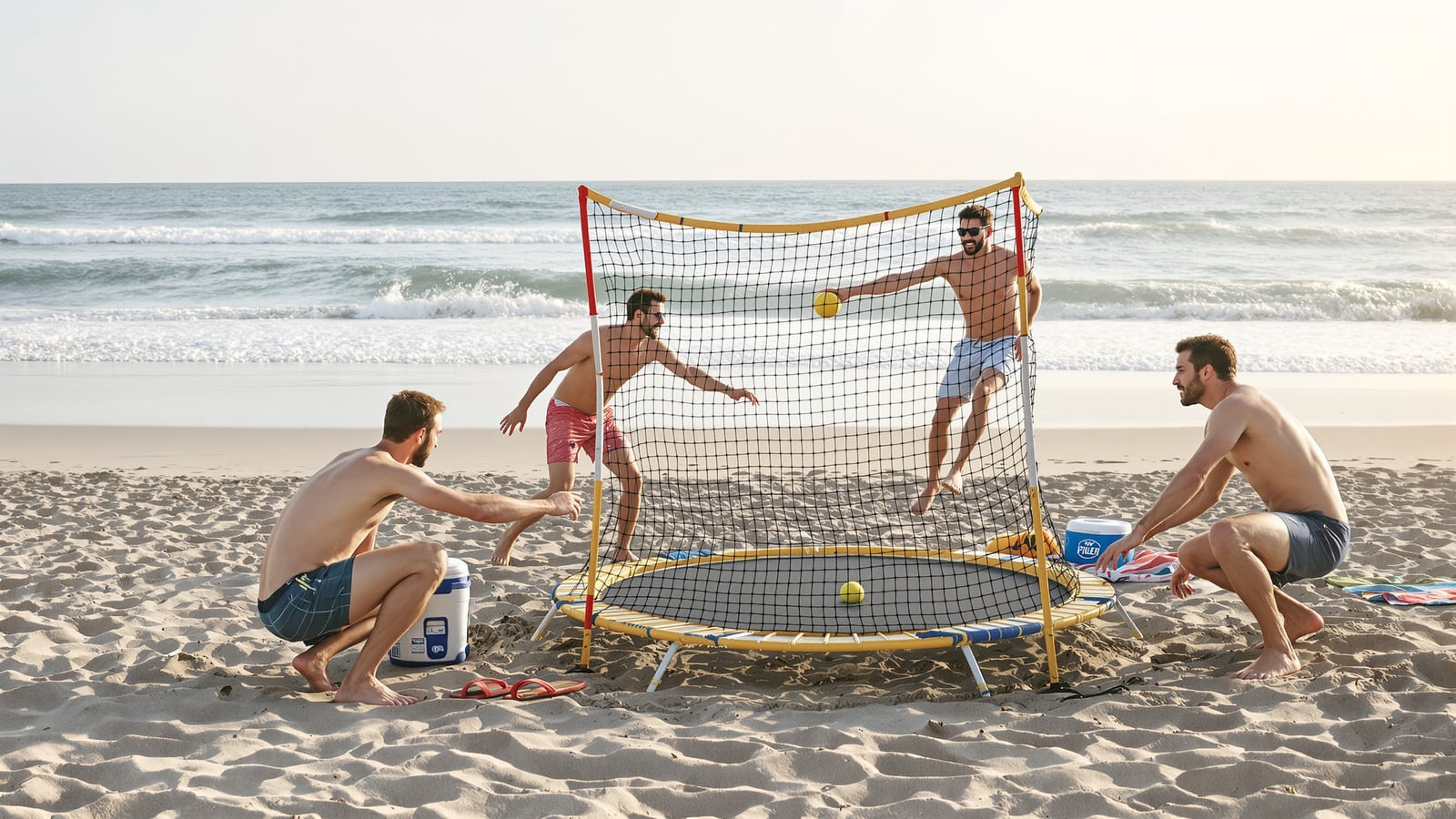
Quick answer: Set the net on flat grass with ten feet of clear space on every side. Play two against two. Each team gets three touches to send the ball back off the net. Teach it with a slow practice rally before you keep score, and wear sneakers.
Cornhole has a flaw nobody mentions at the cookout. At any moment, one person is playing and thirteen are standing around holding a plate.
That's fine. It's a social game, and it's a good one. But if you've ever watched a backyard party drift toward the cooler and the phones, you know what's missing. Nothing in cornhole makes you run.
Spikeball does. It's a round net about three feet across, stretched tight a few inches off the ground, with a small firm ball. Four players stand around it. Nobody gets to stand still for more than a few seconds.
What actually happens in a rally
One player serves the ball down onto the net. The other team gets three touches to return it, and the third (or an earlier one) has to put it back on the net. Then the first team gets three touches, and it keeps going until somebody drops it, misses the net, or hits the rim.
That's the whole game. Players circle the net, so you don't guard a side. A good rally has all four people moving at once, diving, lunging, calling for the ball.
On day one, you only need these six rules:
- Teams of two. Partners stand on opposite sides of the net to start.
- Three touches. One player can't hit it twice in a row.
- No catching. You hit it. Holding or scooping it's a fault.
- The rim is dead. If the ball hits the frame instead of the net, the rally's over.
- Serve from a distance. Stand back from the net, at least six feet, and hit the ball into it.
- Play to 21, win by 2. For a first afternoon, play to 11 and nobody will complain.
Official rules have more detail about rotating serves and blocking the net. Skip it for now. Add it once everybody's laughing at their own mistakes.
Where it beats cornhole, and where it doesn't
Speed is the obvious one. A cornhole game is a slow back-and-forth. A Spikeball rally can be over in three seconds or go thirty hits, and either way the next one starts right away. You get more actual playing in fifteen minutes than a round of cornhole gives you in an hour.
It also levels people in a way cornhole doesn't. In cornhole, the guy who's practiced in his garage wins. In Spikeball, a thirteen-year-old with quick feet can embarrass his uncle. That's a good thing, and the uncle will tell you so after he's caught his breath.
The honest trade-offs:
- Cornhole is easier on older bodies. Grandpa can throw a bag from a lawn chair. He can't dive for a Spikeball. Don't try to force it.
- Wind matters more. A gust on a light ball turns a clean serve into a joke. Set up where a fence or the house breaks the wind.
- It wants flat ground. A lumpy lawn is an ankle waiting to happen. Walk your yard barefoot first and you'll find the bad spot before somebody else does.
- Cornhole fits a conversation. You can talk through a whole game. You'll be too winded to talk through this one.
Keep both. Cornhole at one end of the yard, the net at the other. People sort themselves.
Teaching it in ten minutes
The mistake most hosts make is explaining the rules for five minutes while everyone's eyes glaze over. Don't. Hand someone the ball.
Start with a cooperative rally. Two people on one side, two on the other, nobody trying to win. The goal is to see how many hits you can string together. Most beginners get four or five and then somebody shanks it into the hedge. That's your lesson: three touches means pass, set, hit, and the first two are for your partner.
Then show them the one habit that separates players who improve from players who flail. Don't stand right next to the net. Beginners crowd it, because that's where the ball goes. Stay three or four feet back with your knees bent and you can reach almost everything. Crowd it and you'll jam your own fingers.
After about ten minutes of that, play a real game to 11. You'll lose count of the score by the fifth point. Nobody cares.
Set it up so nobody gets hurt
It's a running, diving, lunging game on grass. Treat it like one.
Wear sneakers. Flip-flops and a hard lunge are a bad pair. Five minutes of walking around, a few easy squats and some arm swings beforehand is enough of a warm-up for anyone under forty. If you're returning to hard play after years on the couch, take the advice on getting back to your old sport at forty seriously. A sprained ankle on a Saturday is a bad trade for a game of lawn volleyball.
Clear the yard. Move the sprinkler heads, the hose, the garden gnome, and whatever the dog has buried. Watch for toddlers and little kids wandering into the play area. It's fast, and a diving adult doesn't stop well.
And a courtesy that costs nothing: when you're done, pick up the divots you dug, stake the grass back down, and put the net away dry. If you're borrowing a set from a friend, return it with the ball pumped up and the bag cleaner than it came. That's how a loaner becomes a standing invitation.
Make it the thing you do on Saturday
Here's the part that matters more than any rule. A game that gets four people up and moving is a good excuse to get them together at all. Put the net on the lawn after lunch and the whole afternoon changes shape. Dads and sons end up on the same team. A mom and her daughter take on the neighbors and win. Somebody's teenager puts the phone down on the porch step and doesn't pick it back up for an hour.
If you want it to stick, don't wait for an invitation. Do what the weekly game piece argues: pick a day, tell people, and be there with the net whether six show up or two. Two is enough. Two against the garage door works for practice.
It's also a gift to a strained relationship. A father and a grown son who struggle to talk will talk easily when a ball's in the air. The easiest way back to your father is a game, and this one is quick enough to start after a ten-minute drive and a bag from the trunk.
Buy the set, find the flat spot, and hand somebody the ball. The first dive into the grass will do the selling.
Marcus Vale
Editor-in-Chief
Twenty years in magazines, most of it deciding what to cut. Writes about work, discipline and the decisions that compound.

Watch
Watch how it's done
Picked for this article.
From channels we rate. Plays on YouTube.
Cody Peterson
Explaining Every Spikeball Rule
Triple S Games
How to play Spikeball
Read next