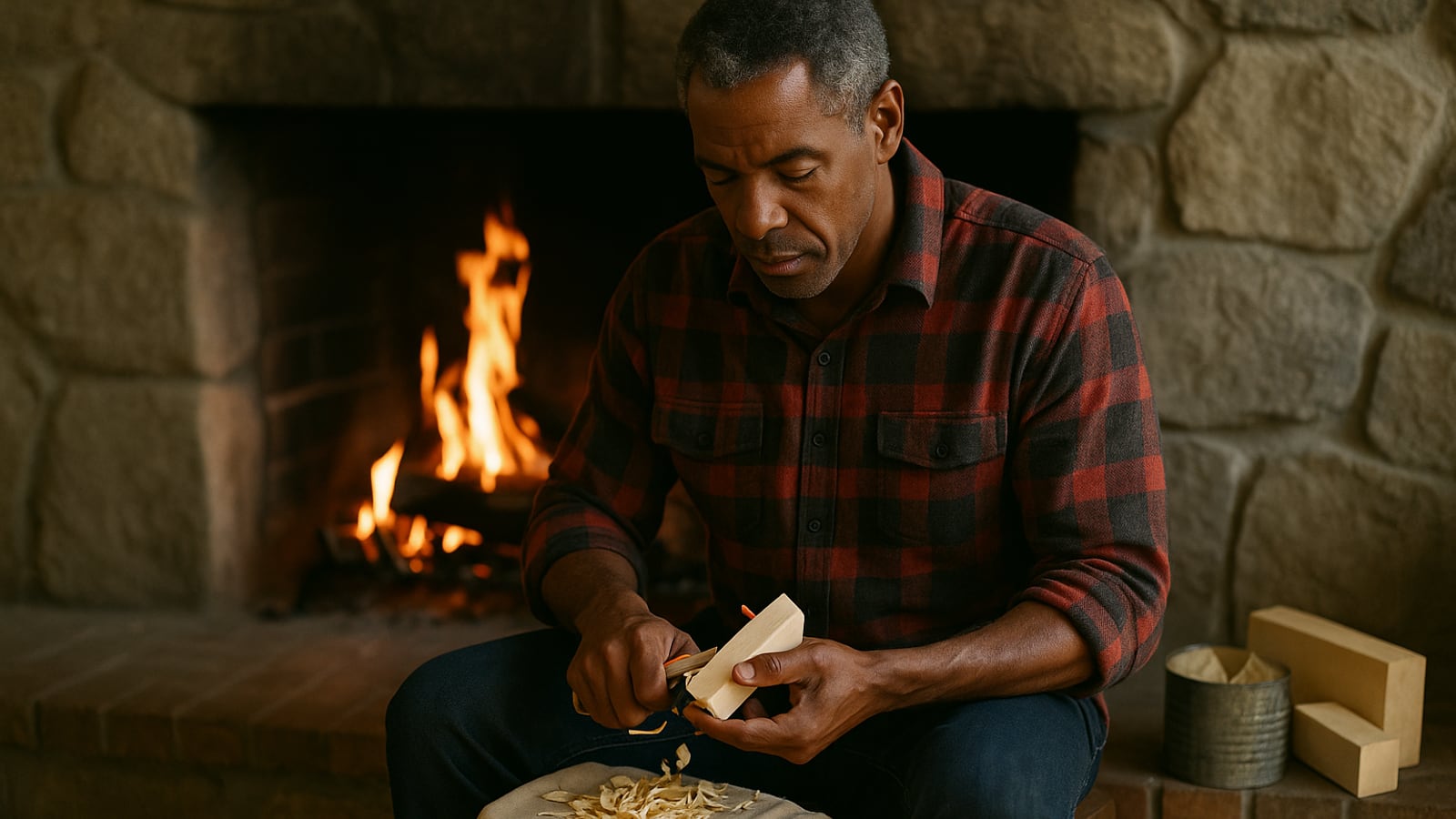
Buy a Morakniv 120. It's a stubby Swedish carving knife with a laminated steel blade about two and a half inches long, it costs less than a decent steak dinner, and it will outcarve a knife four times the price. The blade is short because control lives in the last inch. Long blades are for splitting kindling and looking impressive in a sheath.
That's the whole shopping list for week one. Knife, a block of basswood, and something to sit on.
You can spend more later. A Flexcut hook knife if you want to hollow a spoon bowl, a leather strop, a cut-resistant glove for the hand that holds the wood. None of it matters until you've filled a coffee can with shavings and learned what the grain does when you push against it.
The wood is half the job, and most guys get it wrong
Basswood is the standard for a reason. It's soft, pale, nearly grainless, and it takes a cut cleanly instead of tearing. Craft stores sell it in 2x2 blocks. Buy six. You'll ruin two.
What you should not start with is the dried construction pine leaning against your garage wall. Kiln-dried pine is a liar. It looks soft and it carves like a bundle of straws held together with glue, splintering where you want a curve and going rock-hard at every knot. Oak and maple will just laugh at you.
The other great option costs nothing. Green wood, meaning a branch you cut this week, carves like a firm apple. Willow, poplar, birch, silver maple, box elder. Take a wrist-thick branch, split it down the middle with a hatchet, and the inside is damp, bright and forgiving. The catch: green wood cracks as it dries. If you carve a spoon on Saturday and leave it on the windowsill, by Wednesday there's a split running down the handle. Slow it down by keeping the piece in a paper bag with its own shavings for a week, then letting it finish on a shelf.
Cottonwood bark is the other secret. It's the thick, corky bark off a dead cottonwood, and it carves like hard cheese. Every one of those little bark houses with the crooked doors you've seen at a craft fair came from it.
Four cuts do almost everything
You don't need a curriculum. You need these, and the discipline to stop hacking.
The push cut. Knife in your dominant hand, thumb of your off hand braced on the back of the blade, pushing it forward. Short, controlled, an inch at a time. This is your workhorse for removing bulk.
The pull cut, or paring cut. Exactly how you'd peel a potato toward your thumb, except your thumb sits on the wood well clear of the blade's path, not in it. Small motion. The knife barely moves. This is where the fine shaping happens.
The stop cut. Push the tip straight down into the wood across the grain to make a wall. Then carve toward that wall from the other side and the chip pops out clean instead of tearing past where you wanted it to end. Every crisp shoulder, every collar on a little figure, every place two shapes meet — that's a stop cut doing the work.
The V-cut. Two angled stop cuts meeting at the bottom, and the sliver between them lifts out. That's a mouth, a fold in a cloak, the line between two fingers.
Learn to read grain by feel. Cut one direction and the wood peels off in a ribbon. Cut the other and it fuzzes up and tears. When it tears, flip the piece and come at it from the opposite side. You'll do this a hundred times before it becomes automatic, and then you'll never think about it again.
Three projects, in this order
The spatula or butter spreader. Flat, forgiving, genuinely useful, and it teaches you to take a block down to a shape without panicking. Two evenings.
The comfort bird. It's a palm-sized bird with a rounded body and a swept tail, no legs, no feet, no eyes unless you want them. Smooth enough to live in a pocket. Old-timers carve them by the dozen and hand them out at hospitals and funerals. You'll carve one and immediately understand why.
The spoon. This is where you graduate. The bowl needs a hook knife, the handle needs everything you've learned about grain, and a green birch branch will give you one in an afternoon. Carve it slightly thicker than looks right, because it'll feel too thin in the mouth otherwise. Finish with mineral oil or walnut oil. Never varnish something people eat off.
Skip the ball-in-a-cage until you've done all three. It's a parlor trick and it'll frustrate you into quitting.
A sharp knife is the safety equipment
The knife that cuts you is the dull one, because a dull knife needs force and force goes where it wants. A sharp Mora slides through basswood under the weight of your hand.
Get a leather strop and a bar of green honing compound for about the price of lunch. Every fifteen or twenty minutes of carving, ten passes per side, dragging the blade backward across the leather. Never push forward into it or you'll cut a groove in your strop and round your edge. Done regularly, you'll go months without touching a stone.
The other rule is dumber and more important: know where the blade goes if it slips. Not your thigh. Not the hand holding the wood. Carve out past your knee or out over open air. A cut-resistant glove on the holding hand costs about ten bucks and has saved more thumbs than any amount of care has. Tape a strip of leather over the pad of your pushing thumb.
And no carving after the second beer. The knife doesn't care how relaxed you're.
Firelight is worse light than you think
The romance of this hobby oversells the fire. Flame light flickers, throws long shadows, and hides exactly the fine detail you're trying to see. You'll go in confident and come out with a face that has one eye a quarter inch higher than the other.
So use the fire for what it's actually good at. Rough out shapes by firelight — the bulk removal, the long push cuts, the part where you're just finding the form inside the block. Save the detail for the kitchen table under a lamp. A headlamp helps if you insist, though you'll look like a man performing surgery on a stick.
The shavings go in the fire when you're done. That's the best part of the whole business and nobody tells you about it. A handful of dry basswood curls flares up bright and fast, and the pile in your lap is proof you spent two hours doing something with your hands instead of scrolling.
When the kids want a turn
Somewhere around eight or nine, a kid with supervision can peel bark off a stick with a dull paring knife and learn where their fingers are. Ten or eleven and a real carving knife plus a glove is reasonable, sitting beside you, not across the yard. Rule one is the same for them as it's for you: the blade moves away from the body, every single time, no exceptions, no "I was just being quick."
Give them a marshmallow stick to sharpen first. The point has to be good enough to hold a marshmallow through a full roast without it dropping into the coals. That's a real standard, they'll take it seriously, and it's the most honest lesson in the whole craft.
Somebody in your family is going to keep the first spoon you make. It won't be the good one.
Marcus Vale
Editor-in-Chief
Twenty years in magazines, most of it deciding what to cut. Writes about work, discipline and the decisions that compound.

Watch
Worth an hour of your evening
More from Play.
From channels we rate. Plays on YouTube.
Read next