

A dull knife doesn't cut so much as wait for your hand to slip
Sharpness is physics, not fussiness. Here's why the blunt blade in your drawer takes more muscle, and why that extra muscle is what sends you to urgent care.
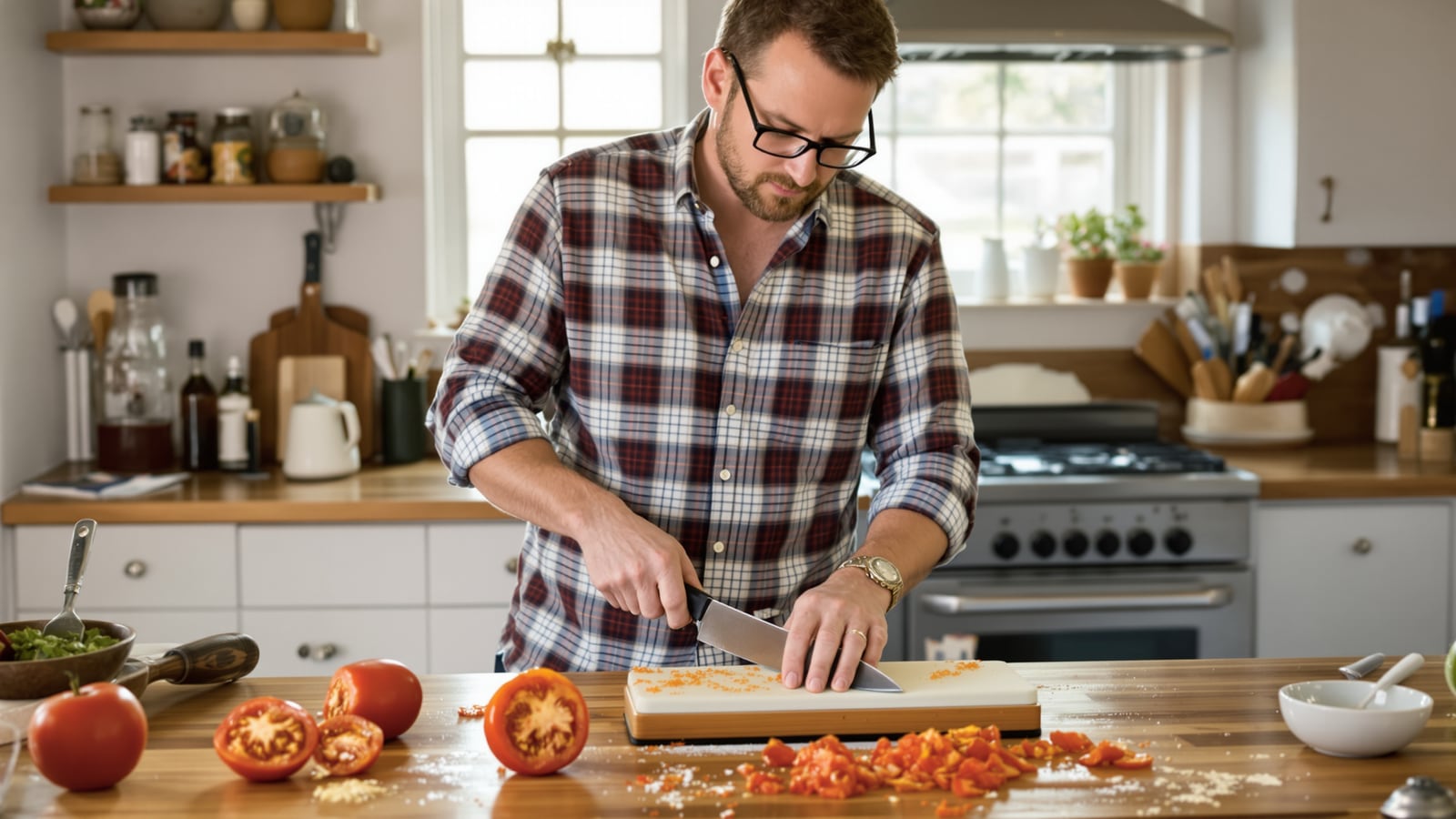
Quick answer: A knife cuts by concentrating your push onto a very small area. A dull edge spreads that push out, so you press harder to get the same result. The extra force is the danger, because when a dull blade finally skids, all of it goes somewhere you didn't choose.
Pressure is force divided by area
Push your thumb flat against a wall and nothing happens. Push a thumbtack with the same force and it goes in. The force is identical. The area it lands on isn't.
A knife is a thumbtack stretched into a line. What matters is how wide that line is at the very edge. A well-sharpened kitchen knife has an edge only a few microns across, a fraction of the width of a human hair. A knife that's been banged around for years has an edge many times wider, rounded over like the shoulder of a worn tire.
Run the numbers on a made-up but fair example. Say the dull edge is fifty times wider than the sharp one. Then it needs roughly fifty times the force to put the same pressure into the food. You won't push fifty times harder, but you'll push a lot harder, and you'll feel it in your wrist and forearm.
Material doesn't split because you pushed on it. It splits at the spot where the local stress beats what the material can take. A sharp edge reaches that threshold the instant it touches down. A dull one has to squash the surrounding material first, spreading the load around until enough of it gives way.
The tomato is the test
A ripe tomato is a thin, tough skin stretched over something soft and wet. Hold a dull knife over it and you'll see the problem. The blade presses down, the whole tomato dents, and the skin holds. You lean in. Nothing. You lean in more.
Then the skin gives, usually all at once, and the blade drops through faster than you meant it to.
That sequence is the whole hazard. You've loaded the knife with force, the edge is riding on a curved, slick surface, and there's no bite to hold it in place. A sharp knife grips the skin right away and goes where you aim it. A dull one slides sideways along the surface until it finds something to catch on, and that something is often the hand holding the tomato.
Onions, bagels, winter squash and anything frozen do the same thing. Round, slippery or hard, they're the foods that put people in urgent care, and they're exactly the ones a dull knife handles worst.
What the extra force costs you
Control. Fine control and heavy force don't go together. When you're pushing hard, your grip is tense and your wrist is locked. You can't steer a blade with that. You're just shoving it.
Dull knives also push you into sawing. You drag the blade back and forth because it can't slice cleanly in one stroke, which sweeps the edge across a wider path and gives it more chances to wander.
Now put it together. A heavy push, a tense hand, a slick surface and a sideways skid. Nobody has time to react. The knife travels the distance your hand was pushing it over before your brain has finished registering the slip.
The honest counterpoint
None of this means a sharp knife is harmless. A razor edge will open a finger without any effort at all, and a careless person with a sharp knife is still a careless person. Sharpness makes a blade predictable. It doesn't replace attention.
There's also a real trade-off in how the injuries look. A sharp blade makes a clean cut. A dull, crushing one tends to leave a messier wound. A clean cut is generally easier for a doctor to close, but that's a point for a medical professional, not a reason to hunt for a dull knife. If you cut yourself badly, get it looked at.
Honing isn't sharpening
Most people use these words interchangeably. They're different jobs.
In daily use, the very edge of a knife doesn't wear away so much as fold over, like a hair bent at the tip. Honing with a steel nudges that folded edge back into line. It's quick, it removes almost no metal, and it's worth doing before you cook.
Sharpening removes metal to cut a fresh edge. Eventually every knife needs it, because honing can only realign what's still there.
- Whetstone: the best result and the cheapest in the long run. Start with a medium stone around 1000 grit, then finish on a finer one. Hold a consistent angle. Many Western kitchen knives sit around 15 to 20 degrees per side, and many Japanese knives run a little shallower.
- Pull-through sharpeners: fast and fine for a beater knife. They tend to be coarse and take off more steel than they need to.
- A professional: for a good knife you're nervous about, hand it to someone who does this all day.
The paper test, and how to cut
Hold a sheet of printer paper by one corner and slice down through the edge. A sharp knife goes through without snagging or tearing. A dull one crumples it. Don't test on your thumb.
Then fix the habits that keep you out of trouble even with a sharp blade:
- Put a damp towel under the cutting board so it can't slide.
- Curl the fingers of your guiding hand back like a claw, with the knuckles leading and the fingertips tucked.
- Cut a flat face on anything round before you slice it, so it sits still.
- Cut away from your body and your other hand, never toward them.
If you borrow somebody's knife, hand it back sharper than it came. It's a small courtesy people remember, and a dull blade is the last thing to leave in a friend's kitchen.
Why this isn't only about knives
Engineers call the principle stress concentration. A sharp tip focuses force into a tiny spot, and that's a feature in a knife and a catastrophe in a structure. It's how a hairline crack in steel grows. It's also why early jetliners such as the de Havilland Comet developed fatigue cracks that started near sharp-cornered cutouts in the fuselage, and why airplane windows are rounded today. The same idea runs through what holds a bridge up and what eventually takes one down and why airplanes can take the abuse of turbulence.
You've been using the principle your whole life. The drawer in your kitchen has one tool built to concentrate force and a few that have forgotten how. Sharpen the one you trust, and the next tomato will take no force at all.
Dean Shaw
Gear & Garage
Reads the warranty, the parts list and the long-term owner reviews before anything else. Trucks, tools, watches, and the cheap version that costs more.

Watch
Worth an hour of your evening
More from Science & Space.
From channels we rate. Plays on YouTube.
Read next