

Your grill's hot spots are physics, and half of them are fixable
A propane grill heats unevenly for a handful of reasons. Some take a paper clip and ten minutes to fix. Others you just cook around.
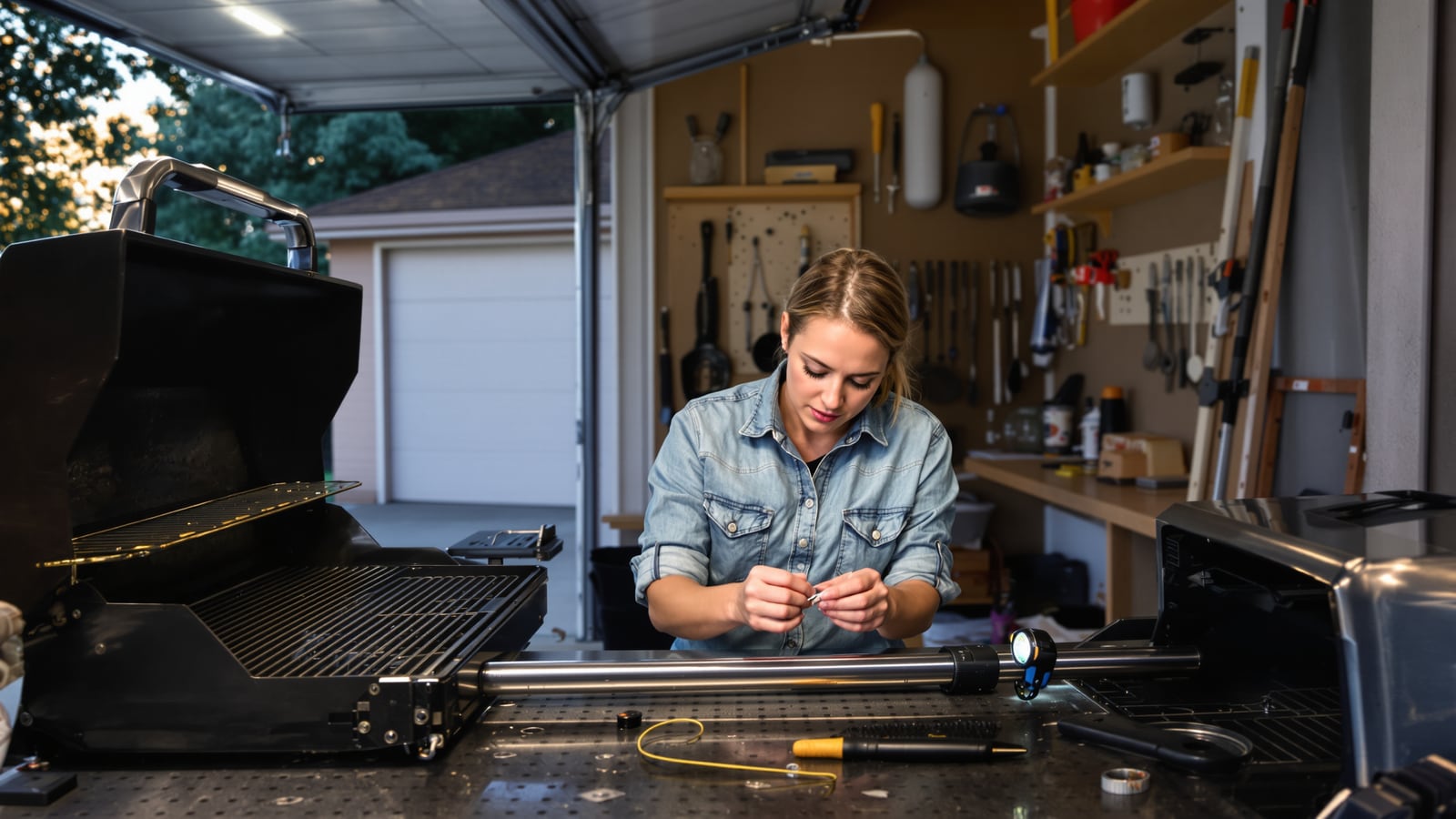
Quick answer: Most uneven heat on a propane grill comes from clogged burner ports, blocked venturi tubes, a regulator that's throttling, or a grill that's out of level. All four are fixable at home. The rest is design, and you handle that by cooking in zones.
Run the bread test first
Before you fix anything, find out what's wrong. Preheat the grill on high with the lid closed for ten minutes. Then lay slices of plain white bread edge to edge across the whole grate, close the lid, and wait about a minute.
Flip the slices. The toast is a map of your grill. Dark patches are hot. Pale patches are cold. A grill with a dead stripe down the middle has a different problem than one that's scorching in the back right corner.
Take a photo of it. You'll compare against it after each fix.
Where the heat comes from
Here's the part most people have backwards. The flame isn't doing most of the cooking. The flame heats the metal above it, whether that's the grate, a heat tent, or a flavorizer bar, and that metal radiates heat up at your food. Hot gas rising off the burners does the rest.
That means your cooking surface is only as even as the metal between the flame and the meat. Thin stamped steel, wide gaps between burners, and bare burner tubes all produce stripes. A heavy grate and a solid heat shield smooth things out because they soak up uneven heat and spread it before it reaches the food.
It also explains why the back of the grill runs hot or cold on so many models. The lid traps rising air, and that air escapes through a vent. Wherever it leaves, you get a current. The same basic idea, air following a path of lower pressure, is why a wing works, and you can read how that plays out in Why Airplanes Fly and Why Turbulence Won't Break One. In your grill it just means one corner gets a steady breeze of hot air and another sits in a pocket.
Fix one: clogged burner ports
Each burner tube has a row of tiny holes along it. Grease, rust flakes, and ash plug them one at a time. A plugged hole means a dead patch of flame, and a dead patch of flame means a pale stripe on your toast.
Turn the gas off and let everything cool completely. Pull the grates and heat shields. Look at the burners in daylight. You want a steady row of small blue flames when it's running, so any gap in the row after the clean-up tells you where to look next.
Use a stiff wire brush across the tube to knock off the crust. Then clear each port with a straight paper clip or a drill bit held in your fingers, never a toothpick, which snaps off inside. Don't enlarge the holes. They're sized for the gas pressure the grill was built to run on.
Fix two: the venturi tubes
Each burner starts with a short tube where propane mixes with air before it reaches the ports. That's the venturi. Gas rushes through a narrow spot and pulls air in with it, and the mix has to be about right to burn clean.
Spiders and mud daubers love these tubes. A nest in there starves the burner of gas or air, and the flame sputters, burns yellow, or fades to nothing at the far end. If one burner is weak and the others are fine, this is the first place to check.
Push a bottle brush or a stiff pipe cleaner through each tube. Do it after every winter, and again if the grill has sat unused for a month in warm weather.
The air shutter at the base of the tube matters too. A flame that's lazy and yellow with a sooty tip usually wants more air. A flame that's loud, blue, and lifting off the port wants less. Adjust a little at a time and watch.
Fix three: the regulator is throttling
Sometimes the whole grill runs low, with flames an inch tall even on high. That's frequently the regulator, and there's a built-in safety feature behind it. If you open the tank valve fast, the sudden surge can trip a flow limiter that cuts the gas down to a trickle for safety.
The reset takes two minutes:
- Close the burner knobs and the tank valve.
- Disconnect the regulator from the tank.
- Wait a minute.
- Reconnect it and open the tank valve slowly, a full turn over several seconds.
- Light the grill as usual.
If the flames are still weak, the regulator itself may be failing, and a replacement costs a lot less than a frustrating summer. Match the part to your grill's model.
Whenever you reconnect gas, mix a spoonful of dish soap into a cup of water, brush it on every fitting and the hose, and open the valve. Bubbles mean a leak. If you ever smell gas, shut the valve, move away from the grill, keep flames and sparks out of the area, and get help from your local fire department before you touch it again. Lawful, careful ownership of anything that burns starts with respecting it.
Fix four: level and wind
Grease runs to the low corner and so does a lot of the heat. A grill sitting on a slight tilt will grease-fire in one spot and run cool in another. Put a level on the grate and shim the wheels or the legs.
Wind is the other quiet culprit. A steady breeze across the burners pushes flames sideways and cools the windward side. Park the grill with its back to the wind, or give it a windbreak at a safe distance from anything flammable.
What you can't fix
Some unevenness is built in. Burners with wide spacing leave cooler lanes between them. Thin lids lose heat at the edges. Cheap grates can't hold a sear at all.
You can improve it. Replacement heat tents and flavorizer bars cost less than most people expect, and they do evener work than a bare burner. A thicker cast iron or heavy stainless grate holds heat longer. Thick metal moving heat around is the same reason engineers lean on mass in what holds a bridge up: material you can count on doesn't swing with every change in temperature.
After that, stop fighting the grill and use the hot spots.
Cook in zones on purpose
Light only some of the burners. On a three-burner grill, run the left on high, the middle on low, and leave the right off. Now you've got a sear zone, a warm zone, and a cool zone. Steaks get seared hot and finished on the warm side. Chicken goes on the cool side with the lid down. Anything that flares up gets dragged out of the fire without drama.
Once you know your bread map, you can use it. The back left corner that burns everything is where you warm the buns. The pale stripe is a landing pad for food that's done and needs to wait.
Do the clean-up, then do the bread test again. If the second batch of toast looks better than the first, you fixed something real.
Dean Shaw
Gear & Garage
Reads the warranty, the parts list and the long-term owner reviews before anything else. Trucks, tools, watches, and the cheap version that costs more.

Watch
Worth an hour of your evening
More from Science & Space.
From channels we rate. Plays on YouTube.
Read next