

Why a Small Jack Lifts a Truck and Your Back Can't
A hydraulic jack doesn't cheat physics. It trades distance for force, and your body is built to do the opposite trade.
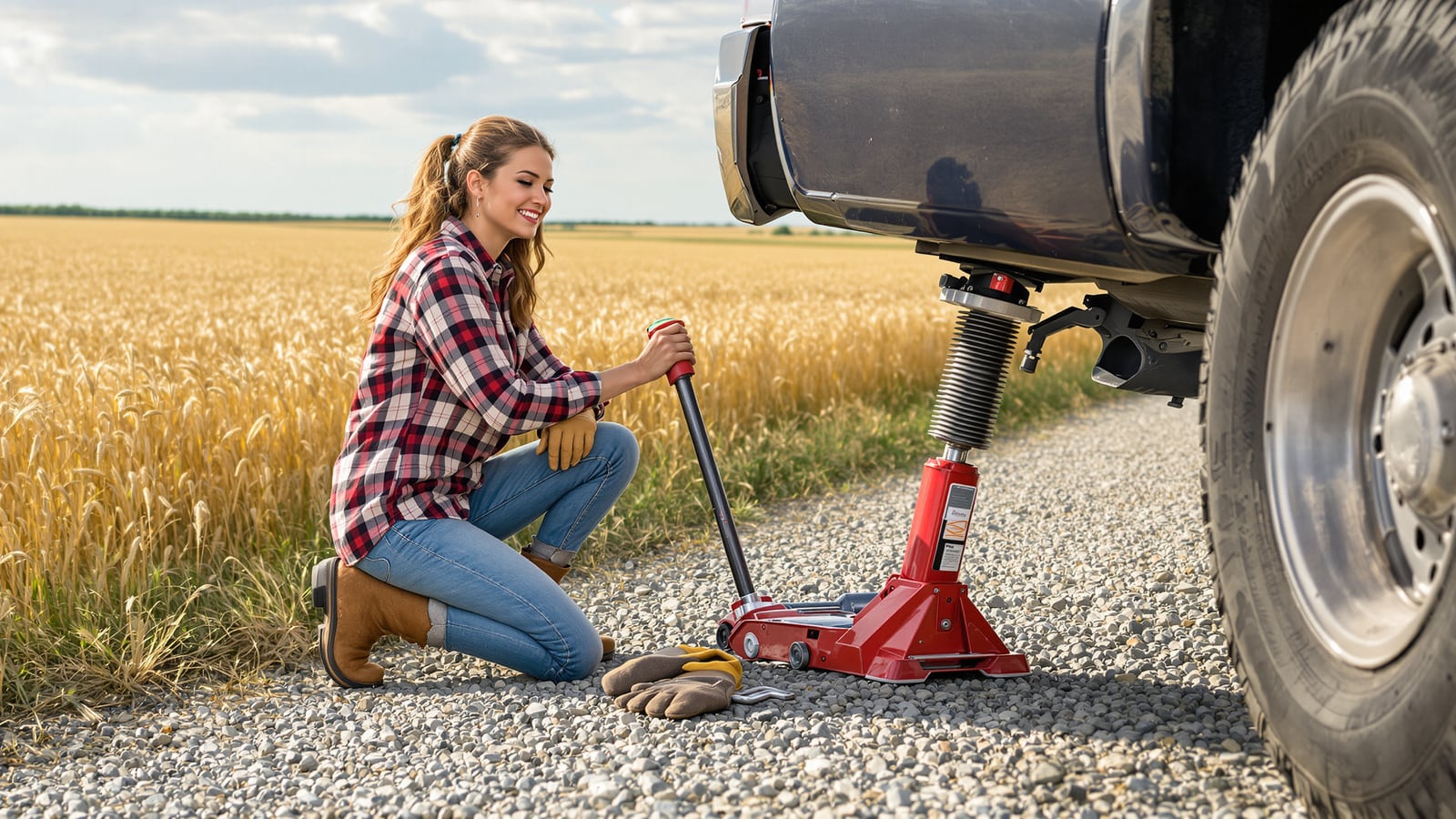
Quick answer: A jack doesn't create strength. It swaps a long, easy push for a short, enormous one, using fluid that won't compress. Your muscles can't make that swap because your skeleton is wired the other way.
Try the numbers first
Take a floor jack. These are round numbers for illustration, not any particular model.
You push down on the handle with 25 pounds. The handle is a lever, and the pump piston sits about one-twelfth of the way along it, so that piston gets pushed with roughly 300 pounds.
That piston presses on oil in a sealed chamber. The oil transmits the pressure to a second, much wider piston, the ram. Say the ram has 20 times the area of the pump piston. Same pressure, twenty times the area, twenty times the force.
300 pounds becomes 6,000.
That's a truck's worth of weight, lifted by a push you could manage with one hand while holding a coffee in the other.
The part where physics gets its cut
Nothing is free. Here's the bill.
To raise the ram one inch, the pump piston has to travel twenty inches in total. And the handle has to travel twelve times farther than that. One inch of lift costs you 240 inches of handle movement, which is 20 feet.
Check the work. Lifting 6,000 pounds one inch is 500 foot-pounds. Pushing 25 pounds across 20 feet is also 500 foot-pounds. The books balance, minus whatever friction and seal drag take off the top.
That's why you pump a jack dozens of times for a few inches of lift. Every stroke moves a small amount of oil into the big cylinder. A pair of one-way valves keeps the oil from flowing back between strokes, so the gain holds while the pump piston resets.
Why the oil matters
Oil is the quiet hero here. Liquids barely compress, so when you push on one end of a sealed volume of oil, the pressure shows up everywhere in it at once. A French mathematician named Blaise Pascal worked this out in the 1600s, and the idea carries his name.
A gas wouldn't work. Air would squash like a sponge, and your pumping would just compress it. Oil passes the push along nearly intact.
The English engineer Joseph Bramah turned the principle into a working hydraulic press in the 1790s. Every shop jack, excavator arm and brake pedal in your life descends from that idea.
Your brakes, by the way, are the same trick. A light press of your foot becomes serious clamping force at the wheels.
Why your muscles can't pull the same move
Your body is a machine of levers, and it's geared for speed instead of strength.
Take your biceps. It attaches to the forearm bone only an inch or two from the elbow joint, while your hand sits about a foot out. A short pull at the attachment becomes a big swing at the hand. That's handy for throwing a ball or swinging a hammer. It means the muscle has to pull several times harder than the weight in your hand.
So your muscles are working at a disadvantage built into your frame. And you can't pick a different gear. The jack lets you choose a ratio of 240 to 1. Your arm gives you one ratio, and it's the wrong direction.
Then there's the raw material. A muscle's strength depends mostly on its cross-section, how much tissue is pulling. Training grows it. It doesn't change the ceiling that bone, tendon and joint set for a person. That's why lifters, who do the hardest version of this work, get strong over years and not over a weekend.
A 6,000-pound lift needs a different kind of machine.
What this means in your garage
The same physics that makes a jack miraculous makes it a bad thing to trust.
A jack holds a load by trapping oil behind seals and valves. Seals wear. A jack that holds a truck on Tuesday can sink on Wednesday, slowly or all at once. Hydraulic force doesn't care what's under the truck.
So the rules are plain.
- Jack on hard, level ground. Asphalt or concrete. Never dirt, never a driveway with a slope, never a soft shoulder.
- Lift at the manufacturer's jacking points. They're in the owner's manual, and they're reinforced for a reason.
- Set jack stands before you go anywhere near underneath. Then lower the truck onto them. The jack is for lifting. The stands are for holding.
- Never get under a vehicle supported only by a jack. Not for a quick look, not for thirty seconds.
- Keep the fluid topped off. If a jack feels spongy or won't hold, there's often air in the system. Many jacks have a way to purge it, and the instructions that came with yours will say how.
- Don't exceed the rating. A 2-ton jack is a 2-ton jack, and that's a rating for the whole job, not a suggestion.
And if you borrow a buddy's jack, bring it back wiped down and with the fluid checked. Better than you found it.
The bigger lesson
Mechanical advantage is one of the great free lunches in engineering, and it's not free at all. You always pay in distance, in time, or in speed. The pulley, the crowbar, the gear set, the hydraulic ram all work the same way. You give up something you have plenty of in order to get something you don't.
That's also how engineers hold up a bridge or lift a steel beam, and it's worth reading about in what holds a bridge up and what eventually takes one down. If you like seeing forces handled with an elegant idea instead of brute strength, why airplanes fly and why turbulence won't break one is the same kind of story, with lift doing the quiet work.
The next time you pump a jack handle and watch a truck rise off the ground, you'll know what you're doing. You're spending twenty feet of effort to buy one inch of lift. And it's a good deal.
Dean Shaw
Gear & Garage
Reads the warranty, the parts list and the long-term owner reviews before anything else. Trucks, tools, watches, and the cheap version that costs more.

Watch
Worth an hour of your evening
More from Science & Space.
From channels we rate. Plays on YouTube.
Read next