

Why Cast Iron Builds a Coating and Stainless Steel Won't
A well-used skillet wears a slick black finish you made with oil and heat. Stainless steel plays a completely different game, and it's worth knowing both.
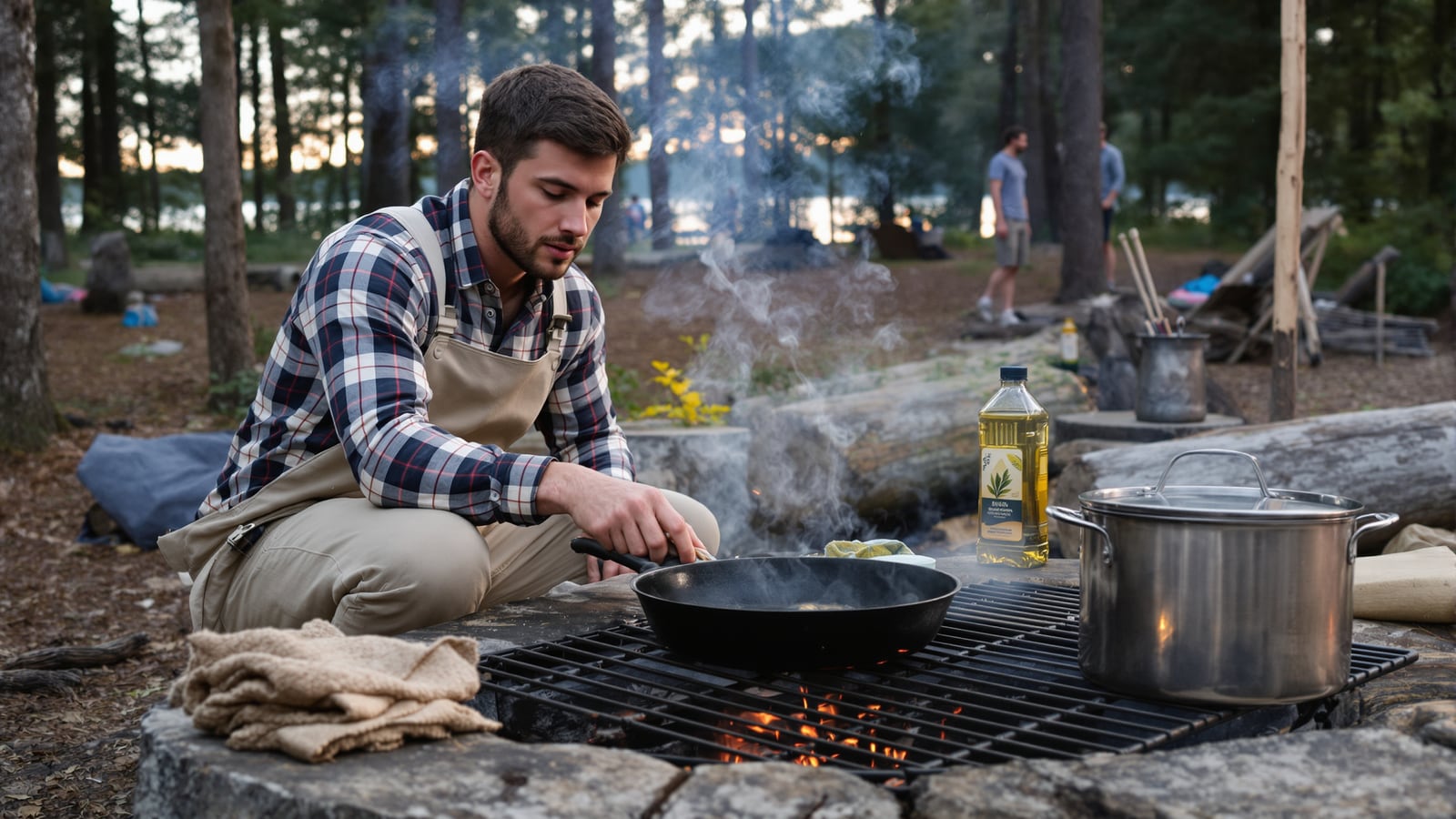
Quick answer: Seasoning is cooking oil that heat has turned into a hard, plastic-like film bonded to rough iron. Stainless steel carries its own invisible armor from the factory, so there's nothing to build and nothing that would hold.
Your grandmother's skillet is black, smooth, and slides an egg out like it's on ice. A new one from the store, same metal, same shape, will weld that egg to the bottom. The difference is a layer far thinner than a human hair, and you can make it yourself.
What seasoning actually is
It isn't oil soaked into the pan. Iron doesn't absorb anything.
Cooking oils are made of long fatty acid chains, and many of those chains have double bonds in them, the "unsaturated" part of the label. Heat a thin film of that oil in the presence of air and those double bonds break open. The loose ends grab onto neighboring chains. Chain links to chain until the liquid has become a solid, cross-linked mesh. Chemists call that a polymer. Plastic is a polymer too, and the family resemblance is real: seasoning is hard, glossy, water-resistant, and it doesn't wash off.
This is the same reaction that turns linseed oil into a finish on a gun stock and makes an oily rag in a heap a fire hazard. Oil plus air plus heat, and the oil stops being oil.
It also explains the gummy, sticky pan. That's oil that was applied too thick and never finished the job. Liquid fat left on the surface isn't seasoning. It's a future rancid smell.
Why iron holds onto it
Cast iron comes out of a sand mold, and the surface is rough on a microscopic scale, full of tiny peaks and pits. A polymer film flows into that texture and locks on, like paint on a wall someone sanded first. Polished steel gives it far less to grip.
There's a second job, too. Bare iron and oxygen are old enemies. Add water and you get rust, which is iron slowly handing itself back to the air. Seasoning is a barrier that keeps water off the metal. It's the same war that eventually takes down bridges, fought at the scale of a pancake.
Why it improves with use
Every time you cook with fat at real heat, a little more oil polymerizes onto the surface. Bacon does it. Searing a steak does it. Frying chicken does it better than anything. Nobody is "building a seasoning" on those nights. They're making dinner, and the pan is quietly getting better.
That's why a skillet that's cooked in every week for twenty years looks like black glass, and one that lives in a cabinet and comes out for cornbread twice a year never gets there.
Two things set it back:
- Long, wet, acidic cooking. A tomato sauce simmering for an hour can pull at a young seasoning. A mature one shrugs it off.
- Soaking. Leave a skillet in the sink overnight and you'll find rust by morning. Wash it, dry it on a warm burner, and wipe on a few drops of oil.
And the old warning about soap is out of date. Modern dish soap doesn't contain the lye that used to wreck a seasoning. A quick wash is fine.
Stainless takes the opposite approach
Stainless steel is steel with at least 10.5 percent chromium. Chromium reacts with oxygen almost instantly, and the result is a layer of chromium oxide only a few nanometers thick. It's tight, it's chemically stubborn, and it's invisible. Scratch it and it re-forms in the open air.
So iron loses to oxygen and you armor it by hand. Chromium makes oxygen build the armor for you. Neither pan needs anything from the other.
That's why stainless never needs seasoning and wouldn't keep one anyway. The surface is smooth and inert, and nothing anchors.
Here's the honest wrinkle. Heat a little oil in a stainless pan and walk away, and you'll get a brown or rainbow-tinted film. That's the same polymerization. But it sits on a slick surface with nothing to grip, so it scrubs off with a little effort and never builds into a finish. It's a stain, not a seasoning.
Why food sticks to stainless, and the fix
Meat proteins bond to metal when they hit a pan that isn't hot enough. They grab at the microscopic roughness that even smooth steel has. Once a crust forms, the bond lets go on its own. That's why food that's stuck solid at the one-minute mark flips easily at four.
The fix is preheating. Warm the empty pan over medium heat for a couple of minutes, then flick a drop of water in. If it breaks up and sizzles away, wait. If it balls up and skates around like a bead of mercury, you're there. That's the Leidenfrost effect, a cushion of vapor under the droplet, and it means the pan is hot enough that food will glide at first contact.
Now add the oil, let it shimmer, and put in dry food. Pat the meat first. Then leave it alone. This is where most people lose the fight, because they poke the steak at thirty seconds.
Seasoning a skillet from scratch
If you've got a new, stripped, or rusty pan, this takes an afternoon and not much else.
- Scrub off any rust with steel wool, wash, and dry the pan completely on a burner.
- Rub in a thin coat of neutral oil. Canola, vegetable, and grapeseed all work.
- Wipe it off as if you'd made a mistake. You want it to look nearly dry. This is the step everyone gets wrong, and it's what causes stickiness.
- Put the pan upside down in a 450 to 500°F oven for one hour, with a sheet of foil on the rack below. Open a window, because it'll smoke.
- Let it cool in the oven.
- Repeat three or four times.
Flaxseed oil gets mentioned a lot because it's high in the fats that polymerize fastest. It makes a hard finish, but plenty of people report it flaking. A plain cooking oil is the dull and reliable choice.
The truth is that the oven is only a head start. The best seasoning you'll ever put on that pan is a hundred ordinary dinners.
Which one to reach for
Own both.
Cast iron holds heat like a sandbag, which is why it's the right pan for a hard sear, fried chicken, skillet cornbread, or anything that starts on the stove and finishes in the oven.
Stainless is better when acid is involved, and when you want the browned bits on the bottom, the fond, to dissolve into a pan sauce instead of sticking to a seasoned surface. Wine, tomatoes, and lemon juice are all happier in it.
One more difference. A stainless pan from your twenties will still be in decent shape in your sixties. A cast iron skillet will be better in your sixties, and your kids will fight over it.
Dean Shaw
Gear & Garage
Reads the warranty, the parts list and the long-term owner reviews before anything else. Trucks, tools, watches, and the cheap version that costs more.

Watch
Worth an hour of your evening
More from Science & Space.
From channels we rate. Plays on YouTube.
Read next