Your Porch Thermometer Is Telling You About Itself
In direct sun, a thermometer reports its own temperature, not the air's. Here's why that happens and how to fix it in about ten minutes.
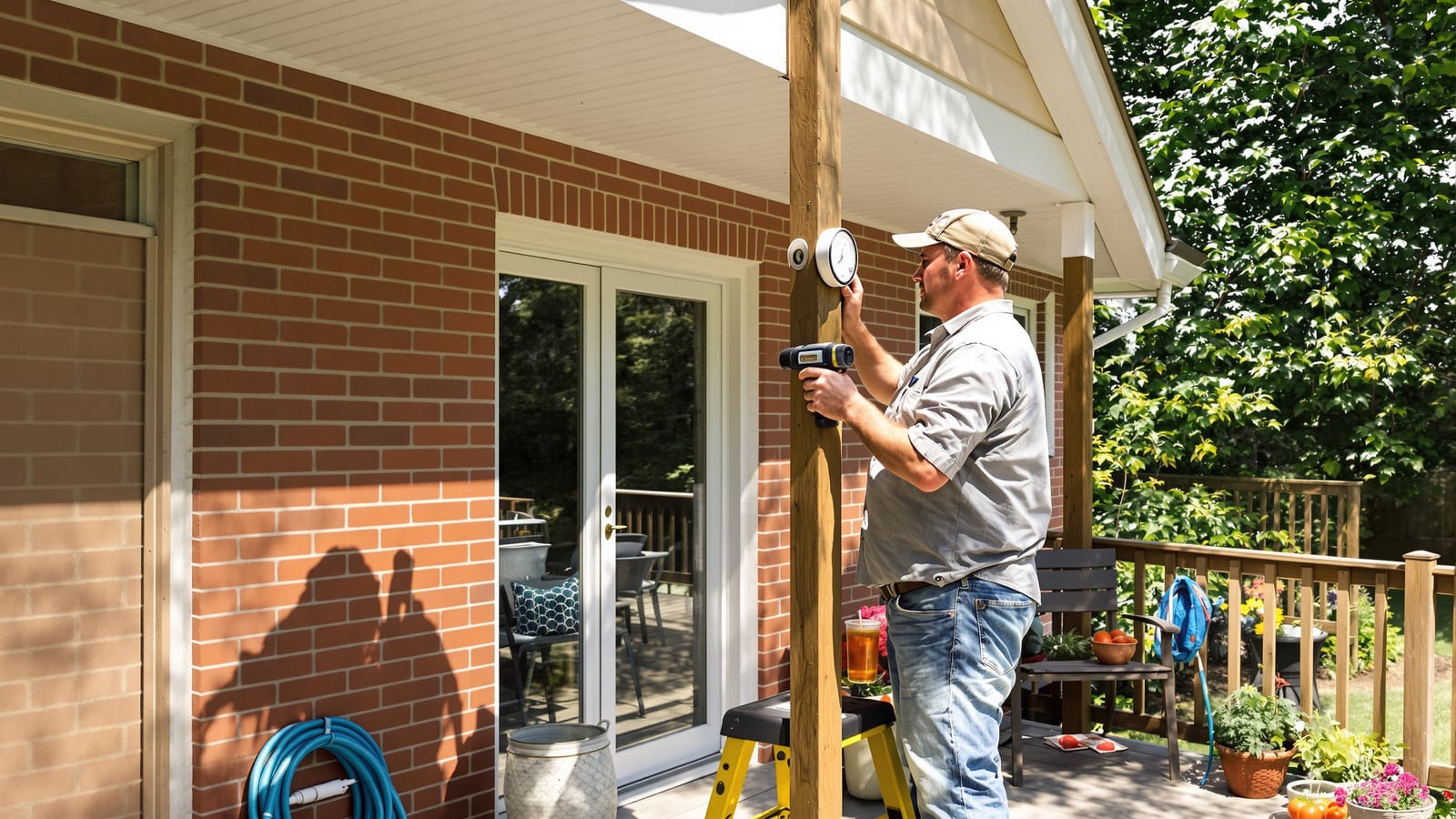
Quick answer: A thermometer only knows its own temperature. In direct sun it heats above the air around it, so it reads high. Shade, moving air and distance from walls and pavement matter more than how much you paid for it.
The 108-degree lie
You've seen it. The thermometer by the back door says 108 while the forecast says 93. Somebody in the house announces it's a furnace out there, and somebody else points out that the news disagrees.
Nobody's broken. The thermometer is doing exactly its job. It's just answering a different question than the one you asked.
What a thermometer actually measures
The bulb, coil or chip inside doesn't sense "the air." It sits there until heat coming in equals heat going out, then it settles. That settling temperature is what you read.
In the shade, the only heat flowing in or out comes from the air touching it. So it settles at the air temperature. Fine.
Put it in sunlight and a second source shows up. The sun's radiation hits the casing and the sensor and gets absorbed. Now heat comes in from two directions, and the only way out is the thin layer of air touching the surface. The thermometer climbs until it's shedding heat to the air as fast as it's collecting it from the sun. That takes it above the air temperature, because the air has to be cooler than the sensor for heat to flow out of it.
How far above depends on a few things. They aren't equal.
What matters most, in order
1. Direct sun. Nothing else comes close. On a still, bright summer afternoon, a bare thermometer in full sun can read several degrees high, and more than ten isn't unusual. A dark casing absorbs more. A white or shiny one absorbs less, which helps but doesn't solve it.
2. Airflow. Moving air carries heat away from the sensor. In a stiff breeze, a sunlit thermometer gets closer to the true temperature because it sheds heat faster. In dead calm air it cooks. That's why the same spot can read honest at noon on a windy day and silly at 3 p.m. on a still one.
3. What's around it. A thermometer screwed to a sunbaked brick wall is measuring the air that wall just heated. Same story over a concrete patio, an asphalt driveway or next to a dryer vent or an air conditioner's exhaust. Those surfaces warm the air layer right above them. Mount one on the south or west side of a house and it'll run high all afternoon. At night, the same wall gives off stored heat and keeps the reading a bit warm.
4. Lag. A thermometer with more material in it takes longer to catch up. A small digital probe settles in a minute or so. A big dial thermometer with a metal case can take much longer. Carry one from a 70-degree kitchen to a 40-degree porch and read it right away, and you're reading the kitchen.
5. The sensor itself. Cheap thermometers can be off by a couple of degrees even in perfect conditions. That's real, but it's a smaller problem than the sun, and it's the one people blame first.
How the weather service handles it
Official stations don't trust a bare thermometer in open air either. The sensor sits inside a shelter with white louvered sides that block sun and let air flow through. It's mounted roughly five feet off the ground, over natural ground like grass instead of pavement. Some use a small fan to pull air across the sensor, which is called aspiration.
Aircraft deal with the same problem from the other direction. A probe on a fast plane gets heated by air being compressed against it, so the instruments correct for that. The measurement problem is the same. A sensor reports what's happening to the sensor. Everything else is engineering around that fact. If you want the bigger picture of what's happening around an airframe, why airplanes fly covers it.
Astronomers know the cousin of this problem. A telescope that's been sitting in a warm garage has to cool to the outdoor temperature before the view sharpens, which is why serious observers set one out early. If you're thinking about buying one, the 8-inch Dobsonian piece gets into it.
Fix yours in ten minutes
You don't need a new thermometer. You need a better spot.
- Move it to shade. North side of the house is the classic choice. Under a deep eave works if direct sun never reaches it.
- Pull it off the wall. A foot or more of air gap between it and the siding makes a real difference. A small standoff or a bracket does it.
- Get it up to about five feet and away from the driveway, patio, dryer vent and AC unit.
- Shield it. A white louvered box works. Even a white plastic cup turned over it, cut so air can flow, beats nothing. The point is blocking the sun without trapping the air.
- Give it time. Wait fifteen or twenty minutes after moving it before you believe it.
Check the sensor with ice water
If you want to know whether the thermometer itself is honest, test it. Fill a glass with crushed ice, add just enough cold water to make slush, and stir. Stick the probe in the middle without touching the glass, and wait a couple of minutes.
It should read 32°F. If it reads 34, you've learned the thing's off by two degrees, and you can subtract that from every reading. Boiling water works too, but the boiling point drops with altitude, so you'd have to look up yours. Ice is simpler and works anywhere.
The trade-off
Even a good setup won't match the official reading across town exactly. Temperature really does vary from your lawn to the airport, especially near water, hills or lots of pavement. A degree or two of difference from the nearest station isn't a sign you did something wrong.
Your phone does a version of this too. Its weather number usually comes from a station somewhere nearby, while the temperature warnings you sometimes get come from sensors inside the phone, which tell you about the phone. The battery piece shows why that matters.
Next time the porch thermometer says 108, go look at where it's hanging. If the sun's on it, you've got your answer. It was never lying. It was just measuring a very hot little piece of plastic.
Dean Shaw
Gear & Garage
Reads the warranty, the parts list and the long-term owner reviews before anything else. Trucks, tools, watches, and the cheap version that costs more.

Watch
Worth an hour of your evening
More from Science & Space.
From channels we rate. Plays on YouTube.
Read next