

Ice floats, and that one oddity keeps lakes alive
Almost every liquid sinks its own solid. Water doesn't, and that quirk decides which fish see spring and which pipes burst in your wall.
Quick answer: Freezing locks water molecules into an open, six-sided lattice that takes up about 9 percent more room than the liquid. Ice is lighter per cubic inch, so it floats. That's why lakes freeze from the top down and the fish underneath make it to spring.
Fill a glass bottle to the brim, cap it, and leave it in the freezer overnight. In the morning you'll have either a bulge or a mess. It's the cheapest physics experiment there is, and it explains most of what follows.
Why the molecules do this
A water molecule is one oxygen and two hydrogens, and it's lopsided. The oxygen side carries a slight negative charge, and the hydrogen side carries a slight positive one. So each molecule grabs its neighbors, hydrogen to oxygen. Those grabs are called hydrogen bonds.
In liquid water the bonds form and break constantly, billions of times a second. The molecules jostle and crowd close together.
Freezing stops the jostling. Each molecule settles into bonds with four neighbors at fixed angles, and those angles build rings of six with a lot of empty space in the middle. It's a scaffold. Scaffolds take up more room than a crowd, which is why every snowflake has six sides and why ice has a density of about 0.92 compared with water's 1.0.
Most substances do the opposite. Their solid packs tighter than their liquid, so the solid sinks. Water has company in the exception column. Silicon, gallium and bismuth also expand when they freeze. But none of them covers 71 percent of the planet.
The 39-degree detail
Here's the part most people never hear. Water isn't densest at its freezing point. It's densest at about 39°F.
Cool water from 50 degrees down toward 39 and it behaves normally, shrinking and getting heavier. Below 39, small clumps of that open lattice start forming in the liquid, and the water begins to expand again. By 32 it's lighter than it was at 39, and it freezes.
That narrow window does all the work.
What a lake does in winter
In October the surface water cools, gets denser and sinks. Warmer water rises to replace it. The lake churns top to bottom until the whole column sits near 39°F.
Then the surface keeps cooling past 39, and now the cold water is the lighter water. It stays on top. It reaches 32 and freezes into a lid.
Under that lid, the bottom of a deep lake sits near 39°F all winter. Ice is a decent insulator, and a layer of snow on it makes it better. The fish aren't enjoying a spa, but they're alive, slow, and living in water that never went below the point where they can function.
Now run it the other way. If ice sank, each winter's freeze would pile up on the lakebed, where summer sun has a hard time reaching it. Shallow lakes would freeze solid, and deeper ones would be in trouble too. The ice pack on top that we take for granted is a blanket. Without it, northern lakes would be a very different place.
Seawater does something similar with a twist. Salt lowers the freezing point to about 28°F, but the ice that forms still floats. That's why icebergs bob with roughly nine-tenths of their mass underwater, and why a ship's lookout in cold seas has plenty to worry about.
One concession is worth making. Very shallow ponds do freeze solid, and even in deep lakes fish die some winters. Snow-covered ice blocks the light, plants stop producing oxygen, and decay under the ice uses up what's left. Anglers call it winterkill. Floating ice gives fish a fighting chance. It doesn't give them a guarantee.
The same trick on your house
Expansion is the other half of the story, and it doesn't care what it breaks.
Pipes. The break usually isn't where the ice is. Ice forms a plug in the pipe, and as more water freezes, it squeezes the trapped water between the plug and a closed faucet. That trapped water has nowhere to go, the pressure spikes, and the pipe splits in the stretch that's still liquid. You find out when it thaws and the floor gets wet.
On a hard-freeze night, let a faucet drip on any pipe along an exterior wall. Moving water is harder to freeze, and an open faucet relieves the pressure. Open the cabinet doors under sinks on outside walls so house heat can reach the pipes. Disconnect and drain garden hoses in the fall, because a hose left on a spigot can crack the spigot and the pipe behind it.
Roads. A pothole is a freeze-thaw machine. Water seeps into a crack, freezes and expands, widens the crack, thaws, and seeps in deeper. Repeat for a winter. Bridges and concrete take the same abuse, which is part of why what holds a bridge up and what eventually takes one down is mostly a story about water finding small cracks.
Gear. Cold also does odd things to ordinary equipment, batteries included, and why your phone dies at 30 percent is a good place to see how.
If you walk out on the ice
Floating ice is why ice fishing exists, and it's also how people get hurt.
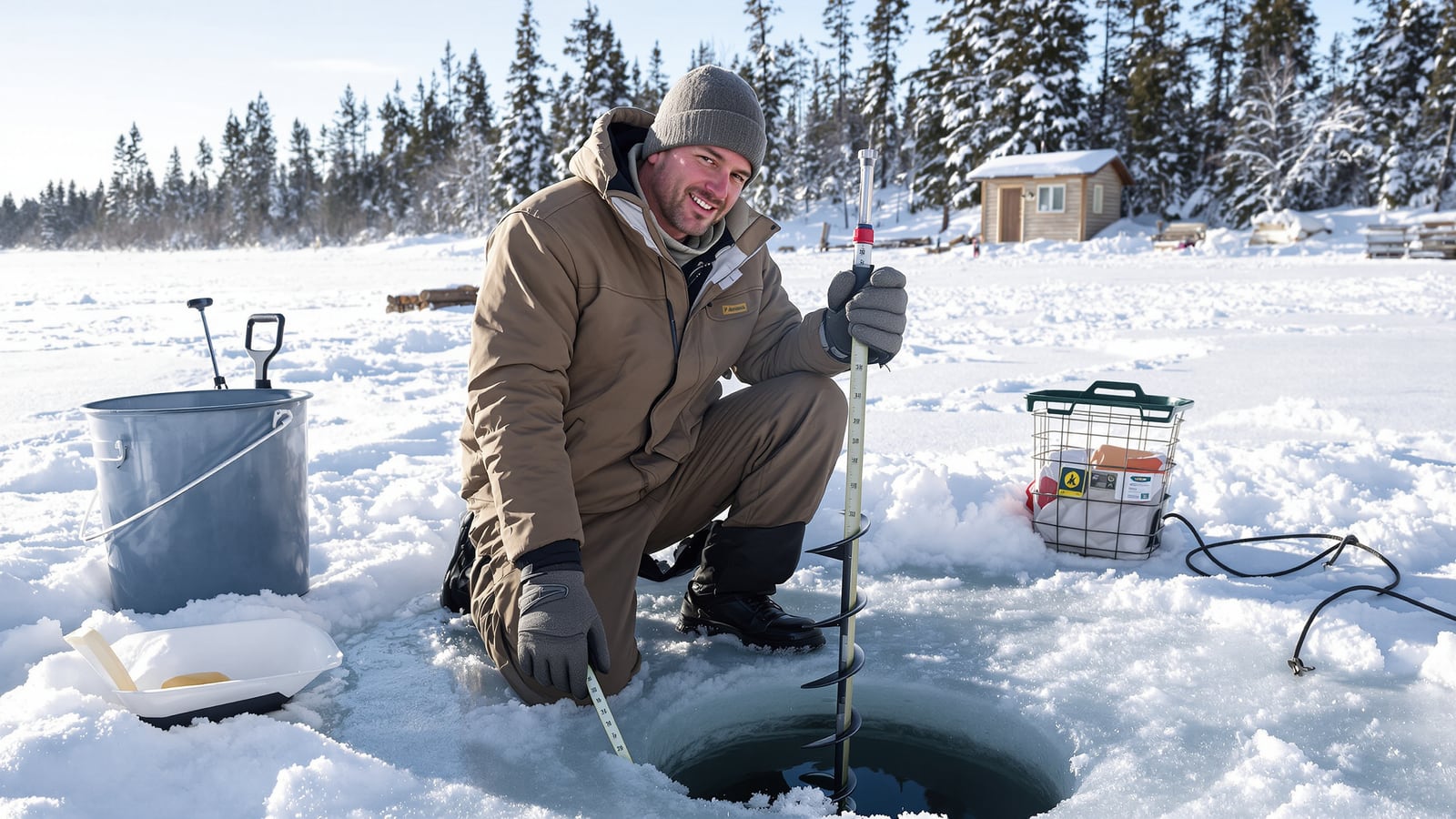
State wildlife agencies publish thickness charts, and they're worth checking for your own state. The usual guidance is a minimum of about 4 inches of clear, solid ice to walk on, with far more for a snowmobile and a foot or more for a truck. Clear ice is the strong stuff. Cloudy or white ice is weaker, and ice near current, inlets, docks or springs can be thin even in a hard freeze. Don't trust a thickness you haven't drilled and measured yourself.
Tell someone where you're going and when you'll be back. Wear ice picks on a cord around your neck, where you can grab them with numb hands.
If you do go in, the first minute is the dangerous one. Cold shock makes you gasp involuntarily, and that's how people inhale water. Cold-water safety courses teach a 1-10-1 rule. You get about one minute to control your breathing, about ten minutes of useful movement in your arms and legs, and about an hour before you lose consciousness. Don't thrash. Turn toward the way you came, because that ice held you. Get your arms up on the edge, kick hard, and pull yourself out flat. Then roll away from the hole instead of standing up. Once you're out, get dry, get warm, and get medical help right away even if you feel fine.
One odd little scaffold
A bent molecule with lopsided charge ends up shaping the winter of every northern lake. The ice on top is the reason the water underneath stays liquid, and everything alive down there owes its winter to a molecule's awkward geometry.
Dean Shaw
Gear & Garage
Reads the warranty, the parts list and the long-term owner reviews before anything else. Trucks, tools, watches, and the cheap version that costs more.

Watch
Worth an hour of your evening
More from Science & Space.
From channels we rate. Plays on YouTube.
Read next