Ask your supplier for terms before you ask for a discount
The percentage off is the least interesting thing a supply house can give you. Here's what to ask for first, and how to keep the relationship intact.
Quick answer: Pull a year of purchases, pick the one or two suppliers you spend the most with, and ask for payment terms, job-quote pricing and fewer fees before you ask for a lower price. Those cost the supplier little and can be worth as much as a discount to you.
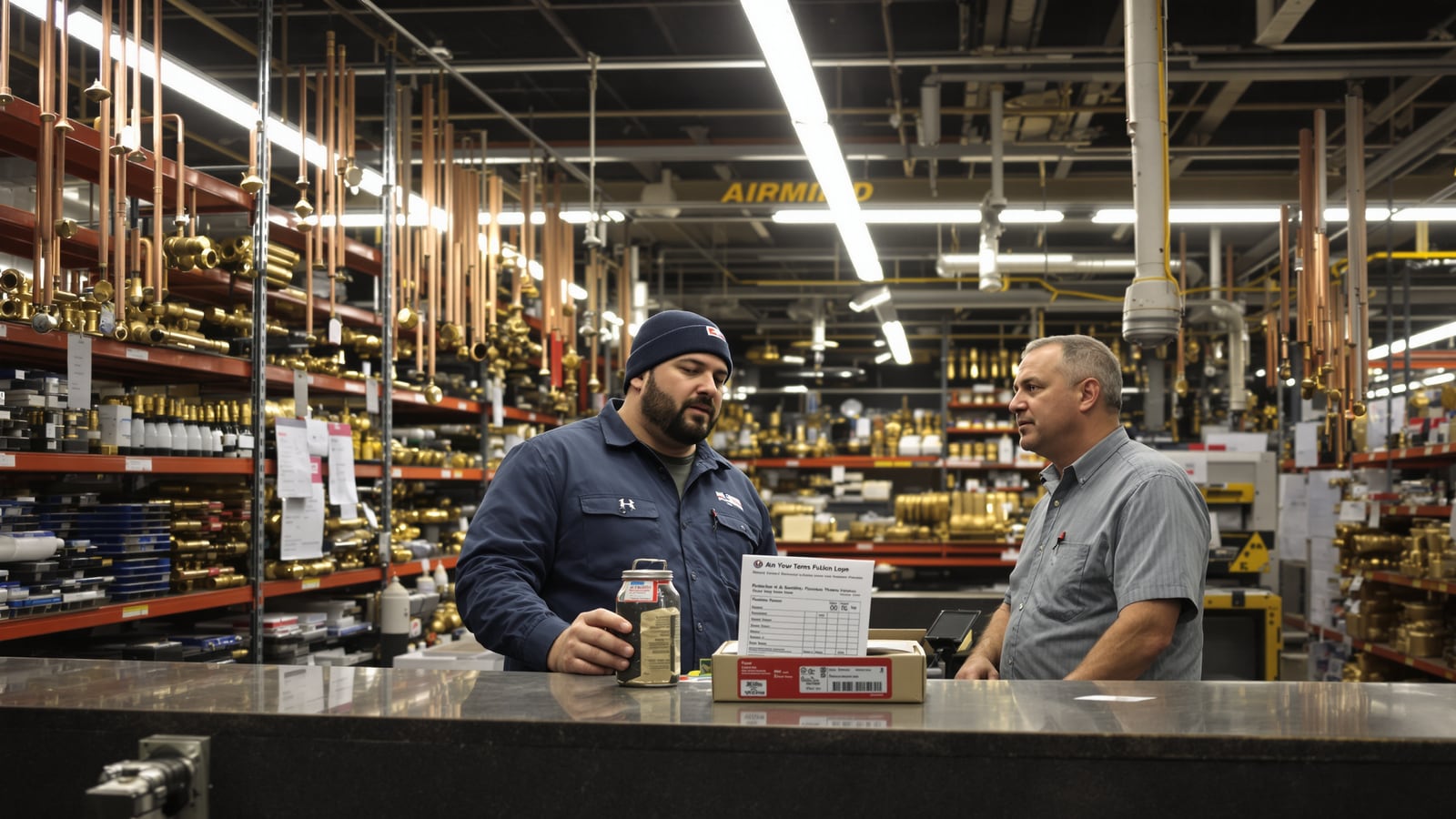
The guy ahead of you at the counter at 6:45 a.m. is paying less for the same fittings, and he isn't smarter than you. He asked. Or he spends in a way the counter manager can see on a screen, and you spend in a way that looks like a stranger with a card.
Most self-employed guys never negotiate with a supplier because it feels like haggling at a flea market. It's closer to a conversation between two small businesses that both want the other one to stay in business.
Know what you spend before you walk in
You can't negotiate with a feeling. Pull twelve months of purchases by supplier. If you've kept one business account (the Friday habit makes this a ten-minute job), sort by vendor and add them up.
Here's a labeled example, not a benchmark. Say a plumber spends $3,500 a month at one supply house. That's $42,000 a year. To that supplier he's a real account, and he's been acting like a walk-in.
Write down three numbers before you talk to anyone: your yearly spend with them, how many jobs it covers, and how often you pay late (hopefully never). That's your whole case.
Ask for terms first
A discount is the first thing everybody asks for, so it's the first thing everybody gets told no on. Terms get a different reaction.
Terms mean you get the material now and pay in 30 days. If you've been paying at the counter, that's float. On the $3,500-a-month example, it's roughly a month of materials funded by somebody else, which matters in a business where you often buy the pipe in March and get paid by the homeowner in April. It's also the cure for the cash squeeze that hits every January. See your January was decided back in July.
Two other terms worth asking about:
- Early-pay discount. Some suppliers offer something like 2 percent off for paying within ten days. On $3,500 that's $70 a month. Small, but it's a free raise for doing what you'd do anyway.
- Fees. Ask what they charge for delivery, restocking and special orders. A 15 percent restocking fee on a returned water heater hurts more than a one-point price difference. Ask whether it can be waived for account customers.
Expect them to ask for something in return, usually a credit application and sometimes a personal guarantee. Read that guarantee before you sign it, and ask your accountant or attorney what it means for you personally. That one's not a counter-guy question.
Bring the job, not the part
Nobody gets a better price by asking about one box of connectors. Bring them a bid.
Example: a $22,000 bathroom-and-kitchen remodel with $7,500 in materials. Take the full materials list to your rep and ask for a project price. If they come back 4 percent under their usual number, that's $300 on one job. Do that on a dozen jobs a year and you've paid for a decent compound miter saw.
It also gives the supplier something they like, which is a predictable order. They can stage it, schedule the truck and plan their stock. Predictability is worth money to them, and it's the thing you can actually give.
Be honest about the job size. If you tell them it's a big one and it shrinks, you've cost them something. Do it once and the pricing quietly goes back to retail.
Consolidate, but keep a second source
Spreading $42,000 across four suppliers makes you a small customer to all of them. Putting most of it with one or two makes you a customer worth calling back. Pick the supplier that has the best stock, the best counter people and the fewest surprises, and give them the volume.
But keep a second source warm for the big-ticket items. Once in a while you'll need something the first guy can't get, or can't get by Thursday. A backup you've bought from twice a year is a lot easier to call than a stranger.
Honest trade-off: if you only spend $1,200 a month, your leverage is thin. A supplier might nudge the price a point or two, or not at all. In that case ask for service instead. Same-day will-call, a rep who texts you when a back-ordered item lands, a staged order ready at 6 a.m. Service is worth real money to a one-man outfit, and it's the thing a small account can still get.
Don't buy down on the parts that call you back
The easiest way to improve margin is to buy cheaper product. It's also the easiest way to lose it. The saved $11 on a valve is gone the day you drive back across town to replace it, and that's before the customer's opinion of you drops.
Squeeze the commodity items. Fasteners, tape, sealants, standard fittings, paint sundries. Hold the line on anything that's hidden in a wall, carries load, carries current or carries water. If you save $300 on a job and risk a callback that eats a day, you've lost money and a reference.
And pass real cost changes along. If material prices swing, put a clause in your estimates that the quote holds for 30 days. After that, materials are repriced. Your margin is a pricing problem as much as a buying problem, which is the same lesson as your seventy-hour week is a pricing problem.
Be the customer they're glad to see
Negotiation works when the other side likes working with you. The unwritten rules:
- Pay on time. Better, pay early. Nothing builds credit with a supplier like an account that never has to be chased.
- Don't argue with the counter kid about something his manager decided. Ask for the manager, politely, once.
- Don't shop their quote to the guy across the street and then come back for the same price. Do that once and the rep notices.
- Bring the pallet rack back the way you found it. Stack your returns. Say thanks.
- When you've got a slow month, tell them. A supplier who knows you're good for it will carry you through a rough patch. One who hears about it from a collections letter won't.
When you ask, make the request specific and short. "I spent about $42,000 with you last year and paid every invoice inside terms. I'd like net-30 and a contractor tier on that volume. What can you do?" Then stop talking. The silence is the part most guys can't stand.
You may not get everything. You'll get something, and you'll have said it to a person who now knows your name.
Ray Okonkwo
Money & Business
Former commercial banker turned small-business owner. Covers salary, credit, margins and the arithmetic nobody does before signing.

Watch
Worth an hour of your evening
More from Self-Employed Men.
From channels we rate. Plays on YouTube.
Read next