

It's not the lighting, and your eye doctor can tell you why
Dim menus, glaring headlights, signs that seem smaller than they used to be. Here's how to tell a bad restaurant from a vision problem, in three minutes.
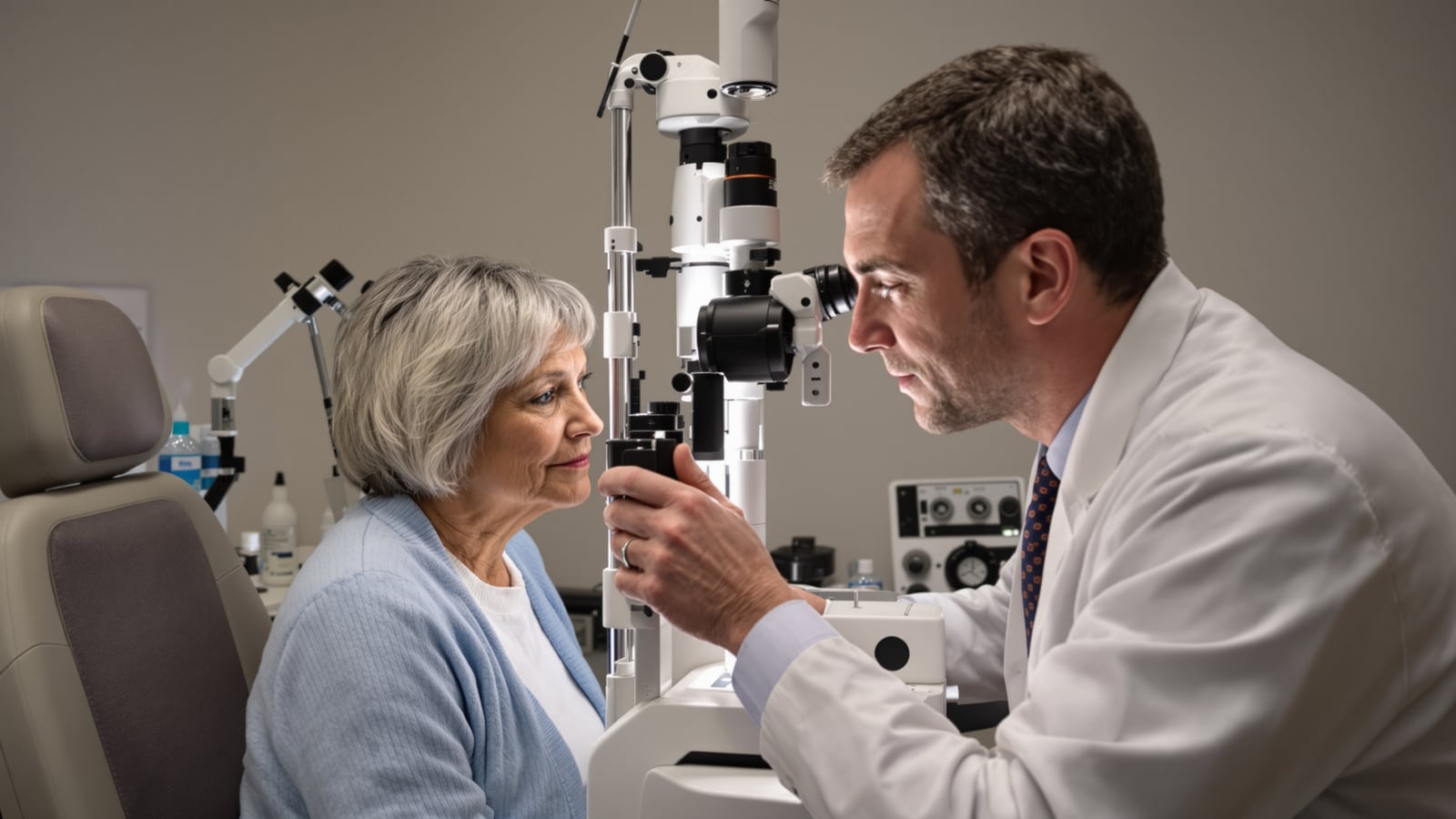
Quick answer: In good daylight, cover one eye, then the other, and look at a doorframe or a tiled wall. If anything looks blurry, dim, warped or missing in either eye, book a dilated eye exam this month. Many age-related eye conditions can be treated or slowed if they're caught early, and that exam is what keeps you driving.
The excuses everybody makes
The restaurant has gone cheap on the bulbs. Headlights are brighter than they used to be. Road signs are printed smaller. The pharmacy label is in a font designed by someone who hates you.
Some of that is true. Restaurants really are dim, and headlight glare really has gotten worse for everyone. But if you've caught yourself saying "it's the lighting" more than a couple of times this year, particularly about the same kind of task, that's worth a second look.
An excuse that keeps getting used is a symptom.
Why you don't notice it happening
Your two eyes cover for each other. Your brain is even better at it, quietly filling in gaps and smoothing over blur so the picture feels whole. You can lose a real chunk of vision in one eye and not know it, because the other eye and your brain are doing the repair work.
Glaucoma is the classic case. It tends to take the edges of your side vision first, slowly, and without pain. By the time you notice, you may have lost a good deal. Cataracts, the clouding of the lens, creep in the same way. Colors fade and glare gets worse, and you adjust a little at a time until you've forgotten what normal looked like.
That's why the test below checks one eye at a time.
The three-minute check
Do this in good daylight, with your usual glasses on if you wear them.
- Cover your left eye with your palm. Look at a doorframe, a tiled wall or a window with straight edges. Are the lines straight? Is anything blurred, bent, dim or missing in the middle?
- Switch eyes and do it again. Compare. A difference between the two eyes is the thing you're hunting for.
- Look at a sign across the street, one eye at a time. Can each eye read it equally well?
- Think back on your last few night drives. Halos or starbursts around headlights, trouble judging how far away a car is, lane lines that seem to vanish. Any of those counts.
This isn't a diagnosis. It's a way to turn a vague feeling into something specific you can tell a doctor.
What it usually turns out to be
The common causes in later life are cataracts, macular degeneration (damage to the center of your vision, which is what you read and recognize faces with), glaucoma, and changes from diabetes. Dry eye can blur things too, and so can some medications. Sometimes it's simply a prescription that's three years out of date.
A good number of these are fixable. Cataract surgery is one of the most common operations in the country, and plenty of people come out of it able to drive at night again. Others can't be reversed but can be held where they are, and that only works if they're found early.
Who to see, and what to say
You want a dilated eye exam, where drops widen your pupils so the doctor can see the back of your eye. A quick screening at the license office or a store kiosk won't catch what this does.
Either type of eye doctor can do it. An optometrist handles exams, glasses and many eye conditions. An ophthalmologist is a medical doctor who also performs surgery. Start with whichever you can get into first, and they'll send you to the other if you need it.
Before you go, write down:
- When the trouble happens (night, glare, reading, one eye)
- Every medication and supplement you take
- That you drive, and how much
That last one matters. Tell them plainly. Doctors can only weigh in on driving if they know it's on the table.
Ask how often you should come back. For many people past sixty-five, every year or two is common, but your doctor knows your eyes.
What Medicare covers
This surprises people. Original Medicare doesn't pay for a routine eye exam whose only purpose is to get you glasses. It does cover certain things: a yearly eye exam for people with diabetes, a glaucoma test once a year for people at higher risk, and cataract surgery that implants a lens, along with one pair of glasses or contacts afterward.
Many Medicare Advantage plans add routine vision benefits, so check yours. Medicare.gov or 1-800-MEDICARE (1-800-633-4227) can tell you what applies to you. The free counselors at your state's SHIP, 1-877-839-2675 or shiphelp.org, will go through it with you line by line.
About your license
Renewal rules for older drivers vary a lot by state. Some require a vision test at renewal, some shorten the renewal period past a certain age, and some do neither. Look at your state motor vehicle agency's website instead of guessing.
Passing the screening at the counter isn't the same as seeing well. It tests sharpness straight ahead, in good light. It doesn't test glare, depth or side vision, which is where night driving falls apart.
Here's the part that should help. Finding out from your eye doctor is far better than finding out from a mailbox, a curb or someone else's bumper. It's also the version where you stay in charge. Most vision problems end in a new prescription, a procedure or a few adjustments, not in handing over your keys.
If you do need to adjust while you wait for treatment:
- Drive in daylight and skip rush hour for now
- Stick to roads you know
- Clean the inside of your windshield, which fogs with a film more than you'd think
- Ask your passenger to say so if they see you drifting, and don't take it as an insult
And if it ever does come to giving up the driving, that's a loss worth taking seriously, but it doesn't have to mean being stuck. Walkable neighborhoods, a ride arrangement with a neighbor, and the downsize-the-house math are all real options. So is keeping your legs strong enough to use them, which is what this piece on knees and hips is about.
When it can't wait
Some changes mean you shouldn't schedule anything for next month. Get medical help right away, the same day, if you have:
- A sudden loss of vision in one eye, even if it comes back
- A curtain or shadow drifting across your sight
- A burst of new floaters or flashes of light
- Sudden eye pain with a headache or nausea
Go to an emergency room or an urgent eye clinic. Don't wait to see if it clears up.
The Monday call
Pick up the phone Monday and make the appointment. It takes five minutes, and the worst case is a clean report and new glasses.
The restaurant will still have the same dim bulbs, but you'll be able to read the menu anyway.
This is general information, not medical, financial or legal advice. For your own eyes, ask your eye doctor. For Medicare coverage questions, the free SHIP counselors can help.
This is general information to help you think things through, not medical, legal or financial advice. Please check with your doctor, pharmacist or a qualified adviser before making a change.
Marcus Vale
Editor-in-Chief
Twenty years in magazines, most of it deciding what to cut. Writes about work, discipline and the decisions that compound.

Watch
Worth an hour of your evening
More from BRO Seniors.
From channels we rate. Plays on YouTube.
Read next