Ceiling fans pay well until the wiring says otherwise
Hanging fans and light fixtures can earn real Saturday money. It can also cost you a house, so here's where the line sits.
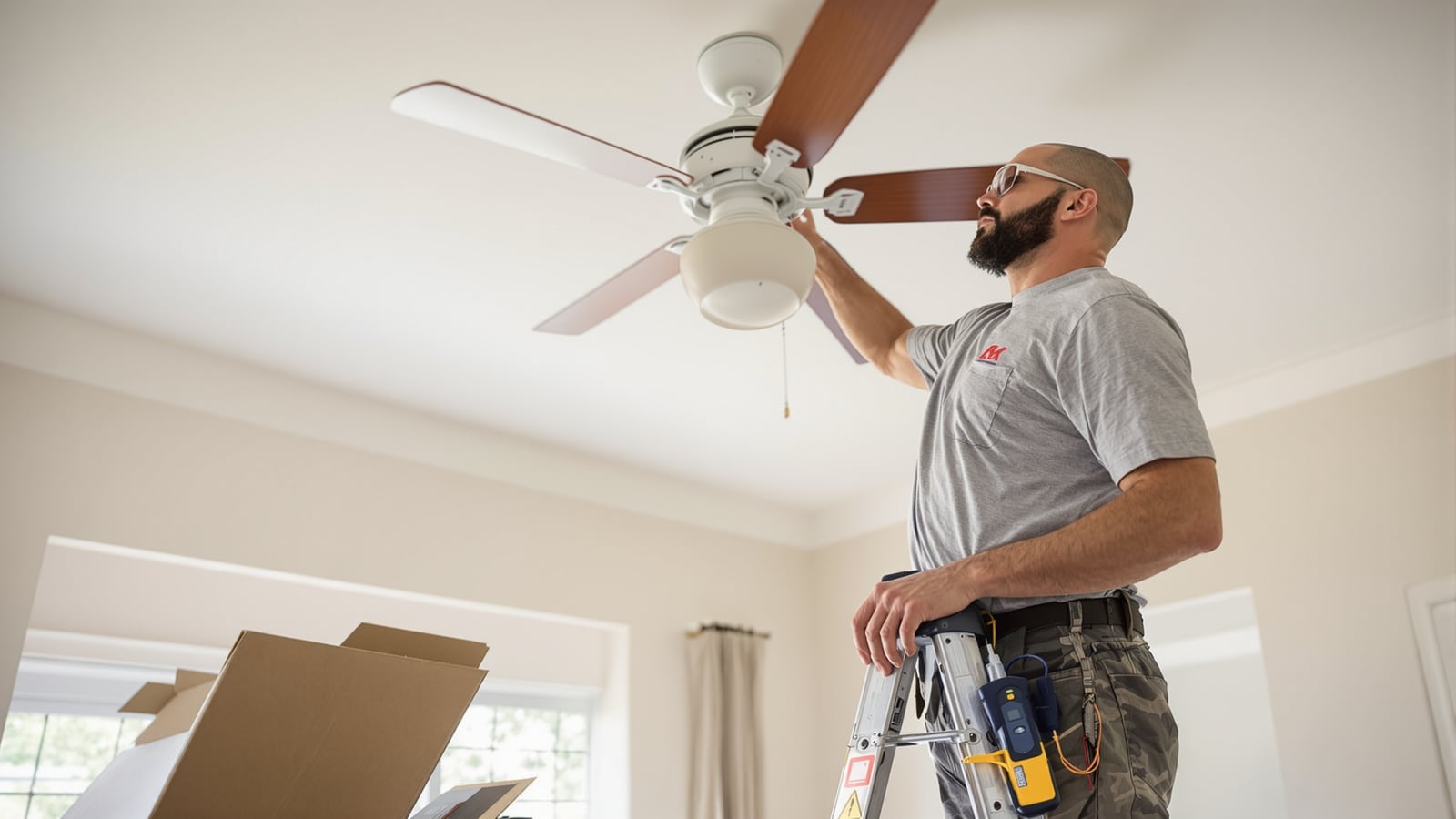
Quick answer: A fixture or fan swap into wiring and a box that are already there is a good Saturday job. Expect two or three jobs a day at a flat price, a few hundred dollars to start, and a license and insurance question you have to settle before the first customer. If the job needs new wiring, hand it to an electrician and say so with a straight face.
The license question comes first
Most people skip this and regret it. In many states, any electrical work for pay needs a licensed electrician. Some states carve out a handyman exemption, usually with a dollar cap per job. Some treat a like-for-like fixture swap differently from running new wire. Rules also change by city and county.
Call your state contractor licensing board. Ask this exact question: "Can I be paid to replace a light fixture or install a ceiling fan on existing wiring without an electrician's license?" Write down who answered and when. If the answer is no, you have two choices. Work under a licensed electrician, or pick a different hustle.
Don't treat this as paperwork. An unlicensed install that starts a fire is the kind of mistake an insurance company walks away from.
What the job really is
Most of the money is in three jobs:
- Swapping an old light fixture for a new one.
- Replacing an old ceiling fan with a new one.
- Replacing a light with a fan, where a fan-rated box is already up there.
Each one is the same few steps. Kill the breaker. Prove the power is off with a non-contact voltage tester, then test the tester on something live so you know it works. Take the old unit down. Check the box. Hang the new unit. Wire black to black, white to white, ground to ground. Cap it all and tuck it in.
The step that separates a pro from a hazard is the box. A fan wobbles, pulls and vibrates for years. It needs a box marked as fan-rated, or a brace that bolts to the framing. A plain plastic light box will eventually let go of a fan. Check the box before you quote the job, not after you've pulled the old fixture down.
Where you say no
A good Saturday operator turns down more work than he takes at first. Walk away, politely, when you see any of these:
- Cloth-covered or crumbling wire.
- Aluminum wiring.
- No ground wire in the box.
- Scorch marks or a burnt smell at the old fixture.
- A box that's loose or cracked and can't be reached from an attic or crawlspace.
- A request to add a new switch, a new circuit or a fixture where none existed.
Don't try to be a hero on a house built before your grandfather retired. Tell them what you found, why it's beyond a swap and that an electrician should look at it. You'll lose that job. You'll keep your name, and the customer will remember who told them the truth.
Startup cost
Budget a few hundred dollars if you're starting from nothing. These are rough planning numbers, so price them at your local hardware store.
- A fiberglass stepladder tall enough for the ceilings you'll meet. This is the big item, and it shouldn't be aluminum.
- A non-contact voltage tester, plus a basic multimeter.
- A cordless drill and a screwdriver and nut driver set.
- Wire strippers, wire nuts, electrical tape.
- A few fan-rated brace kits and boxes to carry in the truck.
- A drop cloth, a headlamp and a small shop vac.
Skip the fancy specialty tools until a job demands one. Most of this is already in your garage.
The hours and the money
Here's a worked example. Your numbers will differ, and so will your market. Say you charge $150 flat to swap one existing fan for another.
A clean job takes about 90 minutes on site. Add driving, a text exchange before and a walk-through after, and it's three hours of your day. That's about $50 an hour, before costs.
Your first few will run slow. Plan on four hours the first time you hang a fan, because the instructions are written for a person with three hands. By the tenth you'll know where every fan wants to hide its screws.
Now stack a month. Two jobs a Saturday for four Saturdays is eight jobs. Eight at $150 is $1,200 gross, about 24 hours of work. Subtract materials you didn't pass through, insurance and fuel. Then set money aside for taxes. Self-employment tax alone is 15.3 percent on top of ordinary income tax, so most people park a quarter to a third of every payment. What to Set Aside for Taxes on Side Income From Dollar One walks through it.
You'll likely keep somewhere around $700 to $800 of that $1,200, and the figure only holds if you actually have eight customers. Finding them is the real work. Start with neighbors, the hardware store's job board and local landlords or property managers. Rental turnovers need fixtures swapped constantly, and those jobs come in clusters.
If you want to know how to price work that isn't a fan, What to Charge for Saturday Handyman Work covers it.
Insurance
Your homeowner's policy doesn't cover a business. If you hang a fan, it falls on a child's bed and the claim turns out to be your install, you want a general liability policy behind you. Some customers and property managers ask for a certificate of insurance before you set foot in the door.
Get a quote before you buy the ladder. For a one-person outfit, insurance may be the largest fixed cost on your sheet, and it can change whether the math works. Ask the agent plainly whether the policy covers electrical work, and what exclusions apply. Some policies exclude it. Read that part twice.
Is it worth it?
It's worth it if you already do this work well on your own house, your state lets you do it for pay, and you can fill four to eight jobs a month without driving across the county. It's a nice way to turn a Saturday morning into a few hundred dollars while helping people who are afraid to touch a wire.
It's not worth it if you're guessing at the wiring, if the license answer is no and you plan to do it anyway, or if you think a few jobs can replace a paycheck. At $150 a job and the hours above, it won't. If it grows past a weekend, read When a Side Hustle Should Become a Business and When It Shouldn't before you quit anything.
Leave the room better than you found it
Vacuum the drywall dust. Put the old fixture in a box and haul it away if they want it gone. Tighten the loose cover plate in the next room while you're there. Send a text when you're done that tells them what you did and what the breaker panel looked like, in case anyone ever asks.
Customers don't remember the price of a fan install. They remember whether the floor was clean and whether the guy told them the truth when the wiring looked bad.
This is general education, not financial, legal or tax advice. Your state licensing board, an insurance agent and a tax professional can give you the answers that apply to you.
Ray Okonkwo
Money & Business
Former commercial banker turned small-business owner. Covers salary, credit, margins and the arithmetic nobody does before signing.

Watch
Worth an hour of your evening
More from Side Hustles.
From channels we rate. Plays on YouTube.
Read next