

Start with concrete, insure before you spray, sell the fall
A pressure washer is the cheap part. Insurance, the right first jobs and a September booking plan decide whether this side hustle pays.
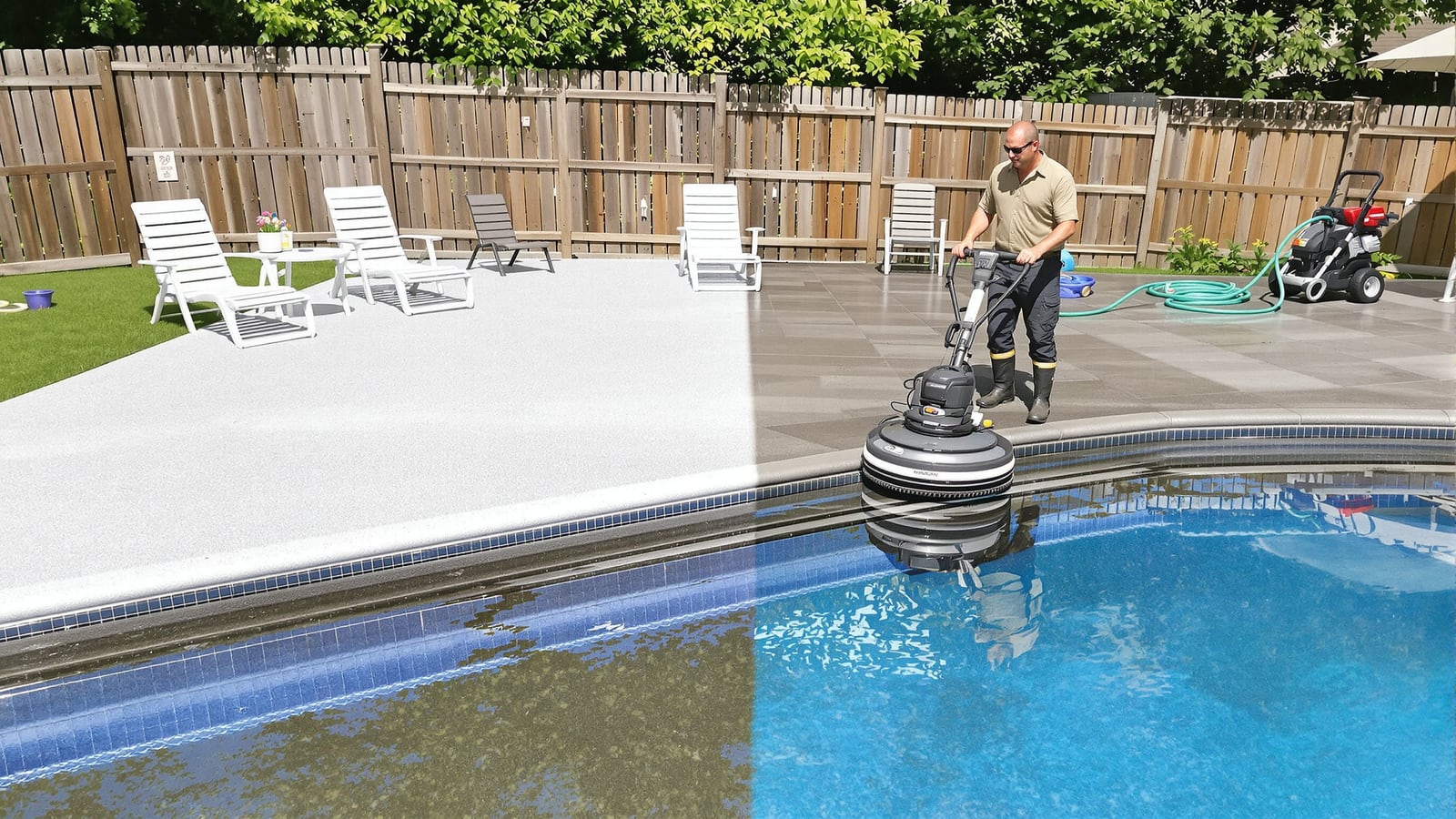
Quick answer: Start with concrete, not siding. Get liability insurance before your first paid job. Sell your fall slots in late summer, because the freeze, not demand, ends the season. Plan on a few thousand dollars to start, and treat every dollar figure below as a ballpark to check against your own market.
Why concrete first
Driveways and walks forgive mistakes. Siding doesn't.
A flat-surface cleaner, the round spinning attachment that looks like a floor buffer, takes a decent beginner and makes him look like a pro. Overlap your passes, keep the wand level, and the stripes disappear. The worst outcome is a faint swirl you fix in ten minutes.
Siding is different. Blast it from the wrong angle and you push water up behind the lap, into the wall. Hold a hard nozzle too close to older vinyl and you'll gouge it. Hit a window with the wrong spray and you've broken a seal you'll be paying for. The pros who clean houses safely use a soft wash: low pressure, a cleaning solution that does the killing, and a rinse. It's a different skill from pressure washing, and it's learned on your own house and your brother-in-law's before it's learned on a stranger's.
So build the first season on driveways, sidewalks, patios and pool decks. Add house washing once you've done a dozen concrete jobs and spent a few weekends practicing soft washing on cooperative family.
What the gear actually costs
These are rough ranges. Prices move, and used equipment varies wildly. Look at current listings before you budget.
- Gas pressure washer, roughly 3,500 to 4,000 PSI and around 4 gallons per minute: $700 to $1,500. Flow rate matters as much as pressure. A small homeowner machine will make you slow, and slow is what kills your hourly rate.
- Surface cleaner, 18 to 20 inches: $200 to $400. Skip the wand-only approach on flat work. You'll be faster and the finish will be even.
- Hoses, fittings, nozzles, a few spare O-rings: $200 to $300. Buy a second set of the small parts. Something always leaks on a job.
- Soft wash setup, either a small dedicated pump or a chemical injector: $200 to $500.
- Cleaning chemicals: a few hundred dollars gets you through a season of beginner work.
- Protective gear: safety glasses, chemical-resistant gloves, rubber boots. Under $100. Don't skimp on the glasses.
- Ladder you trust: you probably own one already. If it's wobbly, replace it.
Call it $1,800 to $3,500 all in, before insurance, and before a trailer if you don't already have a truck bed or a way to haul water. If you need a water tank, that's extra. Most customers have a spigot, but not all of them, and "bring your own water" is a pricing conversation you want to have before you arrive.
If you already own a pressure washer, you're partway there. A decent home machine still does fine on small concrete jobs while you save for the bigger one.
Insurance is the real startup cost
Your homeowner's policy doesn't cover you when you're working on somebody else's property for money. Your personal auto policy may not cover a truck hauling business equipment, either. Call your agent and ask both questions plainly.
For the work itself, you want general liability insurance. Ask three things:
- Does it cover property damage from water intrusion, broken windows and stripped paint?
- Does it cover damage from the cleaning solutions? Some policies carve out chemical or pollution claims, which is exactly the claim a house-washing business is most likely to face. Get the answer in writing.
- Does it cover the equipment itself, or do you need a separate rider?
Premiums vary by state, by what you do and by how you answer those questions. Expect somewhere from a few hundred to over a thousand dollars a year, and get at least two quotes. A small-business insurance agent can sort this out in a single phone call. That's a professional's job, not a blog's.
If you hire a helper, even part-time, workers' compensation enters the picture and the rules differ by state. Ask before the first paycheck, not after the first injury.
One more safety point: a high-pressure stream can injure skin far worse than it looks. A small puncture on a hand or foot can hide serious damage underneath. If you get hit, get medical help right away, even if it only looks like a pinprick.
Selling the fall
Spring gets all the attention. Fall is where a weekend operator can quietly do better, in most of the country, for three reasons.
The mess has built up. A summer of pollen, mildew on the shady side of the house, and wet leaves leaving tea-colored stains on concrete. Customers see it when the leaves drop and the light changes.
People are getting ready for gatherings. Thanksgiving and Christmas mean relatives walking up the driveway. "Before the family comes" is an honest reason to book, and it's a deadline the customer set, not you.
Spring customers already trust you. Your best fall leads are the people you cleaned for in April. Text them in late August.
Here's how to work it:
- Late August: message every past customer with two or three open Saturdays in October. Name the dates.
- September: offer a small discount for booking two surfaces together, say the driveway and the walk, or the patio and the house.
- Ask for the neighbor. Park in the driveway, and the house next door sees the before and after. Leave a card at both neighbors' doors the day you work.
- Take a deposit on anything over a couple hundred dollars. Rain cancels jobs, and a deposit keeps the rescheduled one from evaporating.
- Watch the thermometer. Don't wash concrete when it's near freezing. Water that sits and freezes leaves a slick sheet on a walkway, and that's a fall waiting to happen, with your name on the invoice. In cold states, the season ends when the nights drop below freezing, usually somewhere in November.
If you live somewhere warm, flip the whole thing. Fall is your peak, and summer heat is the slow patch.
What the money looks like
This is an illustration, not a promise. Say you do three concrete jobs on a Saturday at an average of $200, so $600 gross. Fuel, chemicals, hose wear and a share of equipment cost might eat $60 to $100. Between driving, setup and talking with customers, you've put in eight or nine hours. That's about $55 to $65 an hour before taxes and insurance, once you're quick. Your first few weekends will be slower and the number will be lower.
Run eight good fall weekends and you might gross a few thousand dollars. Then subtract insurance, marketing and the machine you're paying off.
Set money aside for taxes from the first job. Self-employment tax alone is 15.3 percent of net earnings, before income tax. Our piece on what to set aside for taxes on side income from dollar one walks through it, and a CPA can tell you what applies to you. For what to charge, see weekend pressure washing and what it actually pays.
When it isn't worth it
Skip this if you can't get insured at a price that leaves room for profit. Skip it if you hate ladders, wet shoes and cold hands. Skip it if your winters shut you down for four or five months and you need steady income in January. And skip it if your realistic number, after gas, chemicals, insurance and taxes, lands under what you'd make working an extra shift.
If you get a good Saturday run and the customers start calling you instead of the other way around, read when a side hustle should become a business and when it shouldn't before you quit anything.
Leave every driveway cleaner than the customer expected, wind up the hoses before you knock on the door to say you're done, and take the empty bottle with you. That's how a September text turns into an October calendar.
Ray Okonkwo
Money & Business
Former commercial banker turned small-business owner. Covers salary, credit, margins and the arithmetic nobody does before signing.

Watch
Worth an hour of your evening
More from Side Hustles.
From channels we rate. Plays on YouTube.
Read next